Goal / operation
Aggressive roughing, high torque
Recommended jaw & grip method
Serrated jaws + longer grip length
Why it works (notes)
Serrations bite into scale; longer engagement improves stability on 5-axis tool access.
This series is built for shops that need centered holding, cleaner tool access, and predictable setup repeatability across mixed part sizes. Ideal when the vise needs to move between zero-point plates, pallets, or automated loading workflows.
Compared with the P75/P110/P150 pneumatic vise: the S52/S96 family uses manual leadscrew clamping and 52 / 96 mm zero-point interfaces. Compare the selected models for actuation, clamping force, mass and height before choosing; the self-centering family is not uniformly lighter or lower.
Best fit
A strong choice for aerospace, mold, and mixed-batch parts where centered grip, tool clearance, and repeat setup carryover all matter.
Compare first
Those three decisions usually resolve whether the vise fits the real part family before you dive into the full specification tables.
Go next
Selection sizes the vise. Integration ties it into zero-point or pallets. Specs & Downloads is where the dimensioned drawings live.
A 43-second product demonstration showing a 5-axis self-centering vise mounted with a zero-point plate and the resulting tool-access layout.
Watch the self-centering vise in action
See how the vise supports centered holding, 5-axis tool access, and fast setup carryover between machines or pallets.
We recommend the right self-centering vise platform, jaw strategy, and zero-point mounting path before you spend time comparing model tables.
Fast RFQ paths
Share your part family and target clamping range so engineering can reply with the right platform.
The RFQ form will prefill Self-Centering CNC Vise for a faster reply.
Send part length, width, height, material, rough or finished surfaces, and whether the part needs five-side access.
Tell us if you prefer 52 mm or 96 mm mounting, soft jaws, serrated jaws, quick-change jaws, or zero-point mounting.
Include target quantity, delivery region, required repeatability, and whether you need drawings, STEP files, or a paired setup.
Learn how the engineering works behind our Self-Centering Vise.
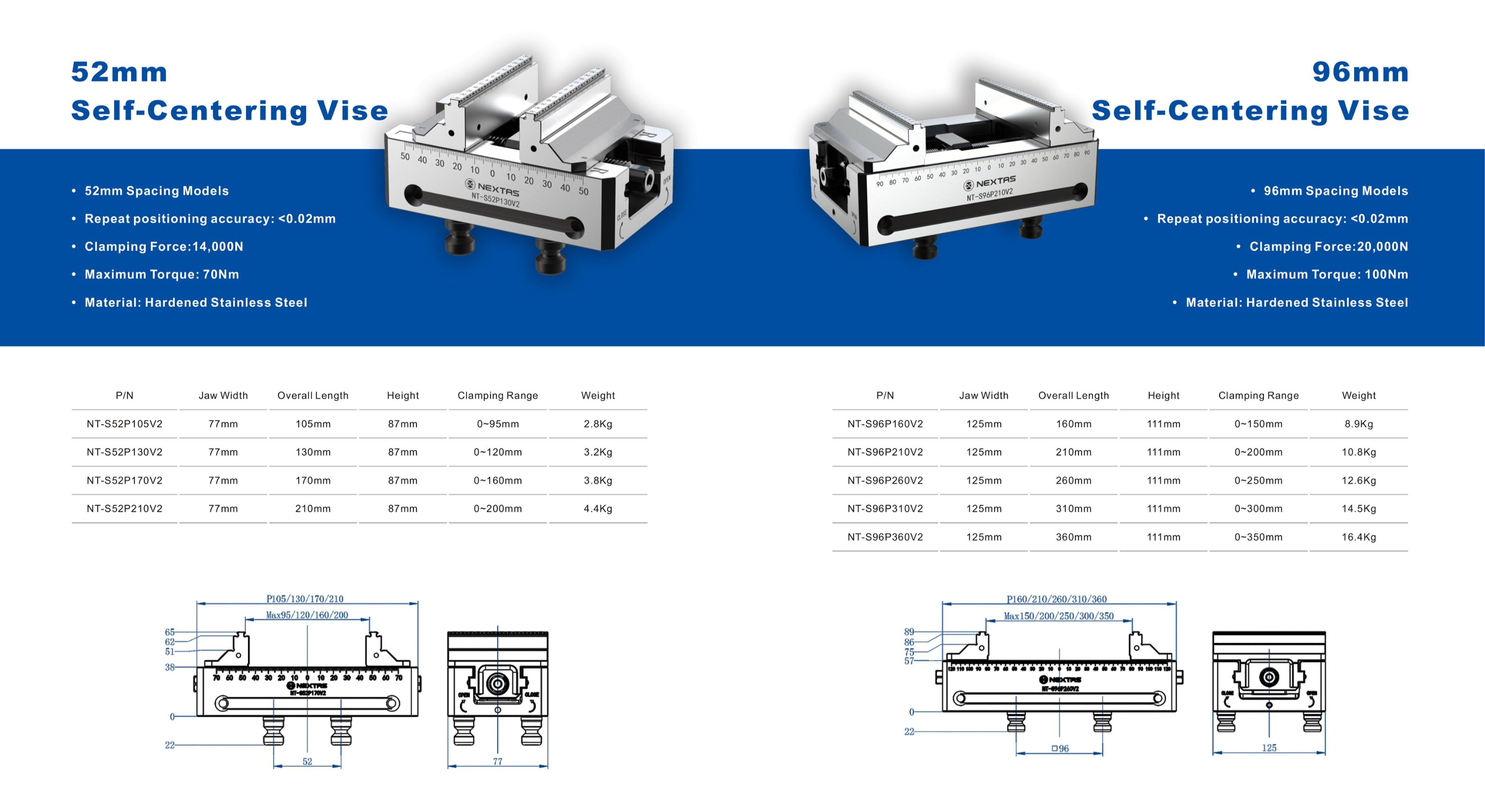
| Family | Spigot Distance | Repeat Positioning Accuracy | Clamping Force | Maximum Torque | Material | Representative Models |
|---|---|---|---|---|---|---|
| 52 Self Centering Vise | 52 mm | <0.02 mm | 14,000 N | 70 Nm | Hardened martensitic stainless steel | NT-S52P105V2 / 130V2 / 170V2 / 210V2 |
| 96 Self Centering Vise | 96 mm | <0.02 mm | 20,000 N | 100 Nm | Hardened martensitic stainless steel | NT-S96P160V2 / 210V2 / 260V2 / 310V2 / 360V2 |
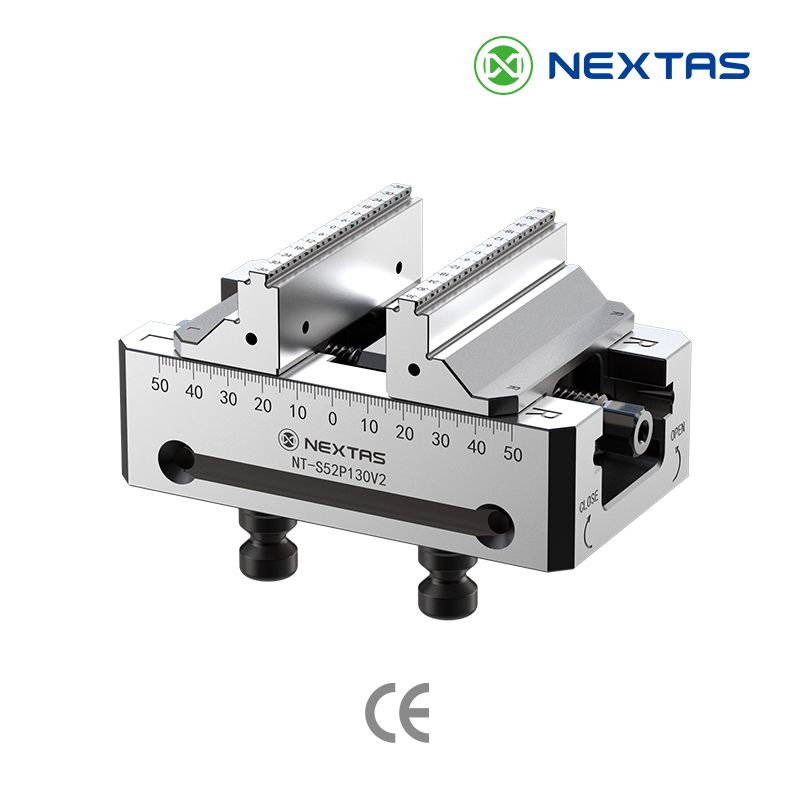
The S52 self-centering vise family uses a 77 mm jaw width, while the S96 family uses a 125 mm jaw width. The 52 mm and 96 mm values identify the mounting pattern, not jaw width. Use the model matrix below to compare overall length, clamping range, and model weight without returning to the PDF.
| Product Code | Jaw Width | Overall Length | Height | Clamping Range | Weight |
|---|---|---|---|---|---|
| NT-S52P105V2 | 77 mm | 105 mm | 87 mm | 0 ~ 95 mm | 2.8 kg |
| NT-S52P130V2 | 77 mm | 130 mm | 87 mm | 0 ~ 120 mm | 3.2 kg |
| NT-S52P170V2 | 77 mm | 170 mm | 87 mm | 0 ~ 160 mm | 3.8 kg |
| NT-S52P210V2 | 77 mm | 210 mm | 87 mm | 0 ~ 200 mm | 4.4 kg |
| NT-S96P160V2 | 125 mm | 160 mm | 111 mm | 0 ~ 150 mm | 8.9 kg |
| NT-S96P210V2 | 125 mm | 210 mm | 111 mm | 0 ~ 200 mm | 10.8 kg |
| NT-S96P260V2 | 125 mm | 260 mm | 111 mm | 0 ~ 250 mm | 12.6 kg |
| NT-S96P310V2 | 125 mm | 310 mm | 111 mm | 0 ~ 300 mm | 14.5 kg |
| NT-S96P360V2 | 125 mm | 360 mm | 111 mm | 0 ~ 350 mm | 16.4 kg |
A simple checklist for selecting model size, jaw set, and mounting interface—so you get predictable accuracy on day one.
Use your part envelope, cutting load, and changeover frequency to decide.
| Model | Best for | Notes |
|---|---|---|
| NT-S52P170V2 | Compact parts, 5-axis clearance, lighter rotary setups | Fast handling, lower mass, excellent for dense multi-vise layouts |
| NT-S52P210V2 | Larger parts, longer jaw travel and a wider clamping range | The S52 series remains rated at 14 kN; choose an S96 model when higher clamping force is required. |
If you share a drawing + material + target tolerance, we can recommend jaw style and grip strategy.
More context for engineering teams evaluating 5-axis workholding and repeatable setups.
Build a shop-specific self-centering vise ROI case from measured setup time, changeover frequency, labor, rework, downtime, project cost and a controlled pilot.
Choose a 5-axis self-centering vise by proving part envelope, tool access, jaw contact, grip depth, rotary load and a safe first-cut release trial.
Check both mating drawings, load path, support, envelope and acceptance before treating a mixed 52 mm and 96 mm layout as compatible.
Match jaw style to material, surface condition, and cutting load. The matrix below is a practical starting point for selecting jaws on a 5-axis self-centering vise (and for repeatable automation setups).
Repeatability is a system result (interface + vise + jaws + process). Use the checks below to stay on track when you’re chasing tight tolerances on 5-axis workholding.
The catalogue specifies a hardened martensitic stainless-steel body and repeat positioning <0.02 mm. The leadscrew moves the two jaws toward a common centerline; actual part position depends on the jaw contacts, workpiece geometry, installation and applied torque. Confirm the working datum by measurement, particularly for rough or asymmetric stock.
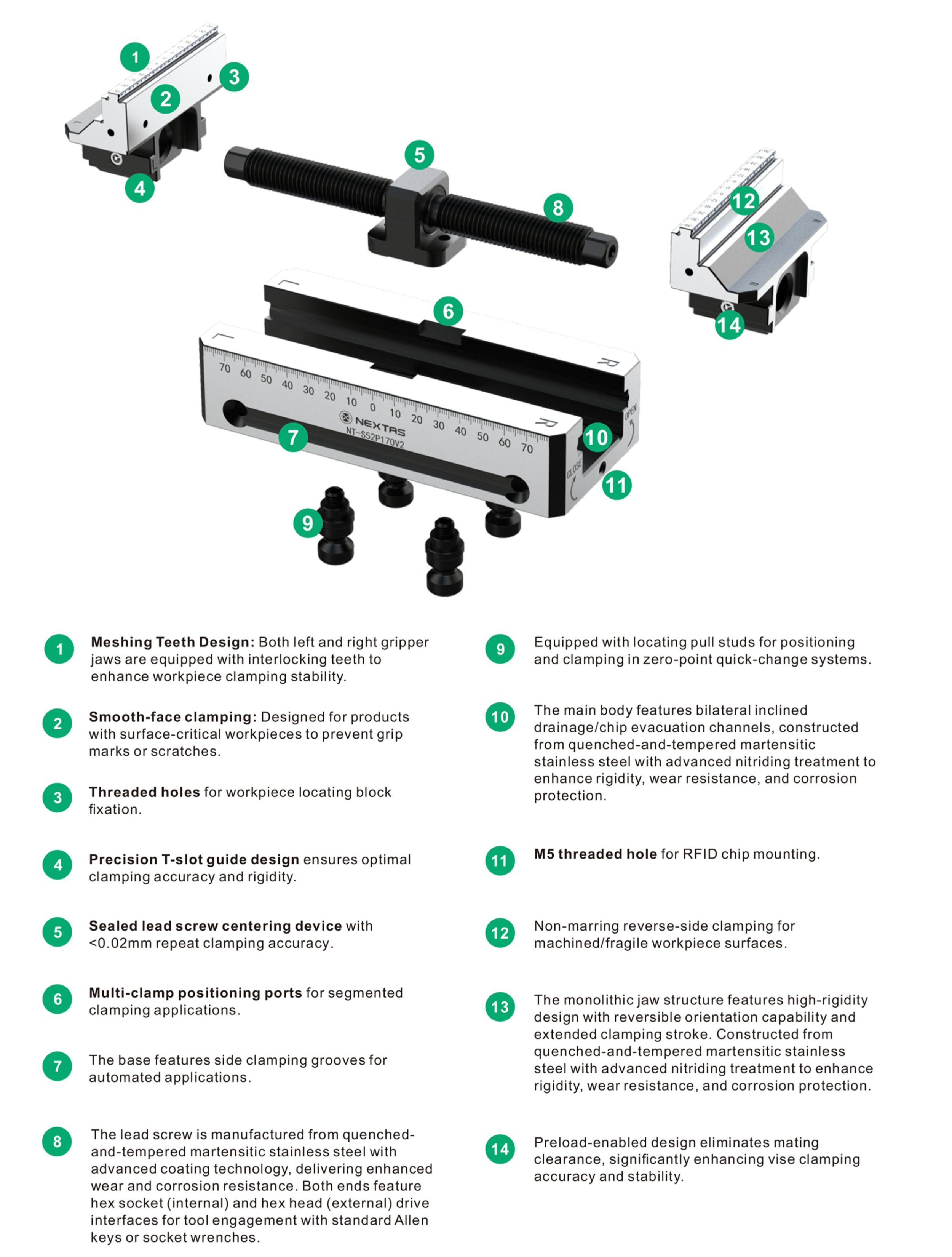
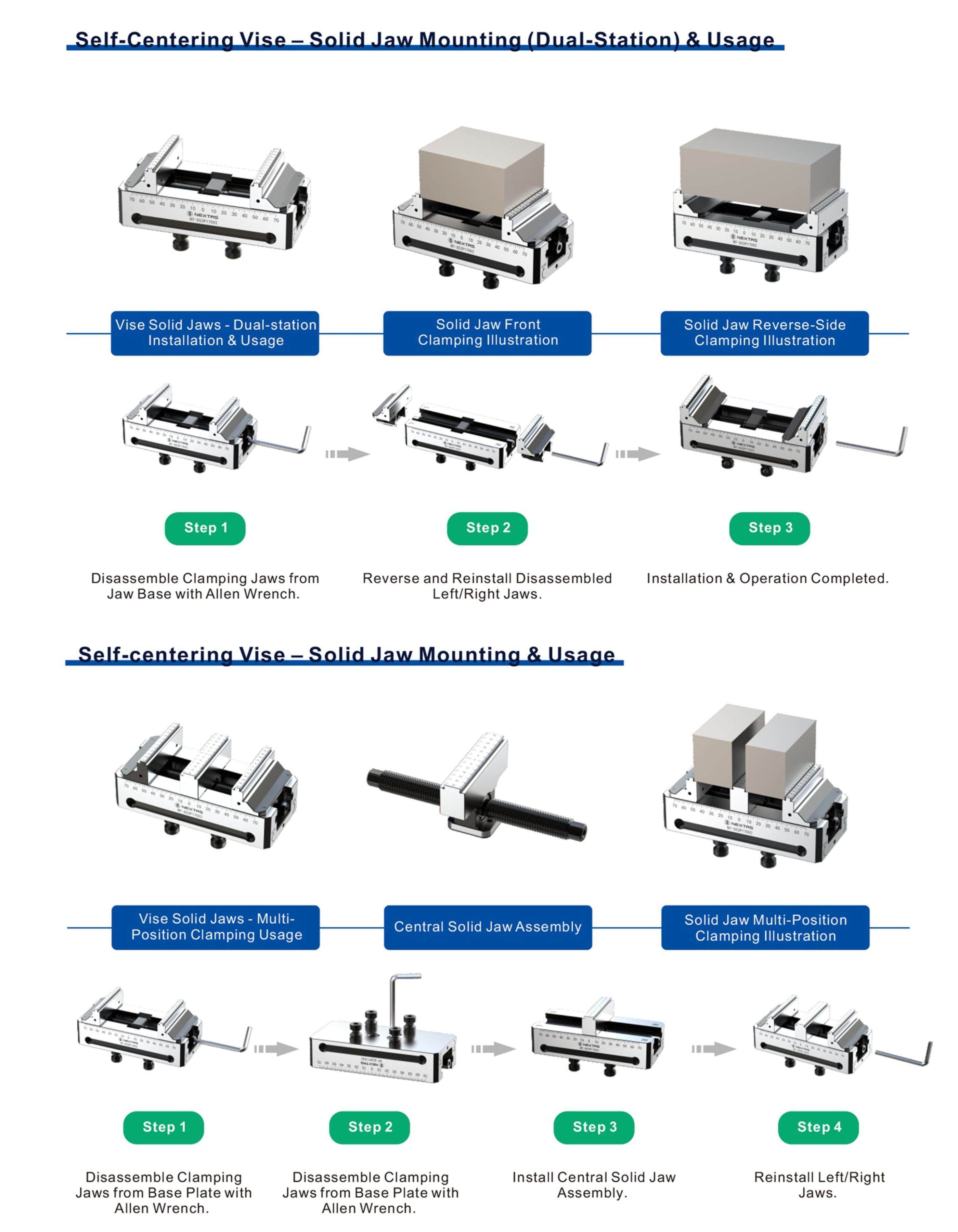
The vise takes standard and custom jaws, so you can clamp anything from raw castings to finished parts. The quick-change jaw design lets you reconfigure a setup in minutes instead of stripping the vise down.
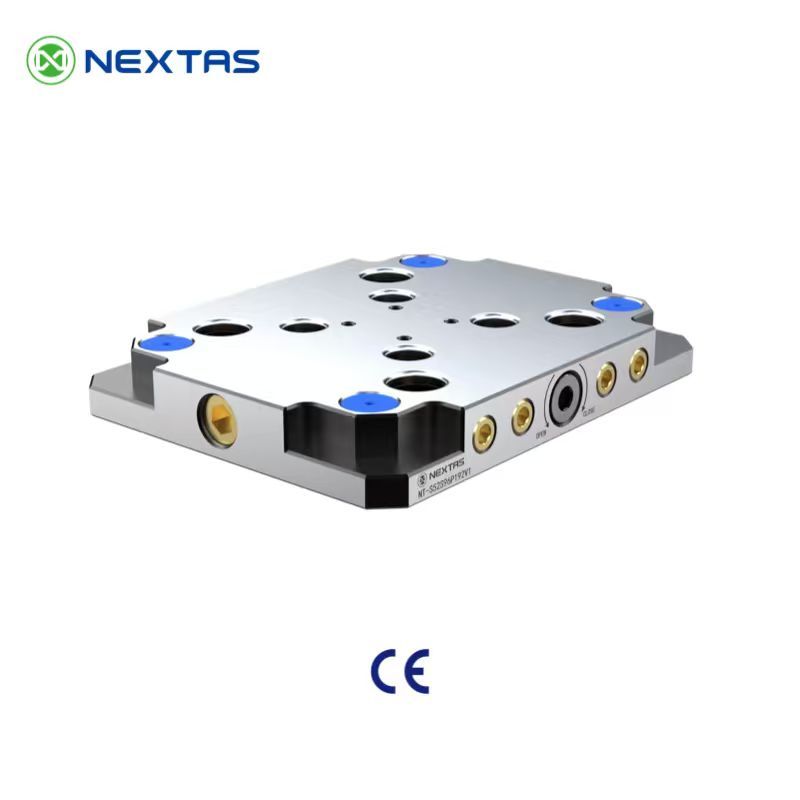
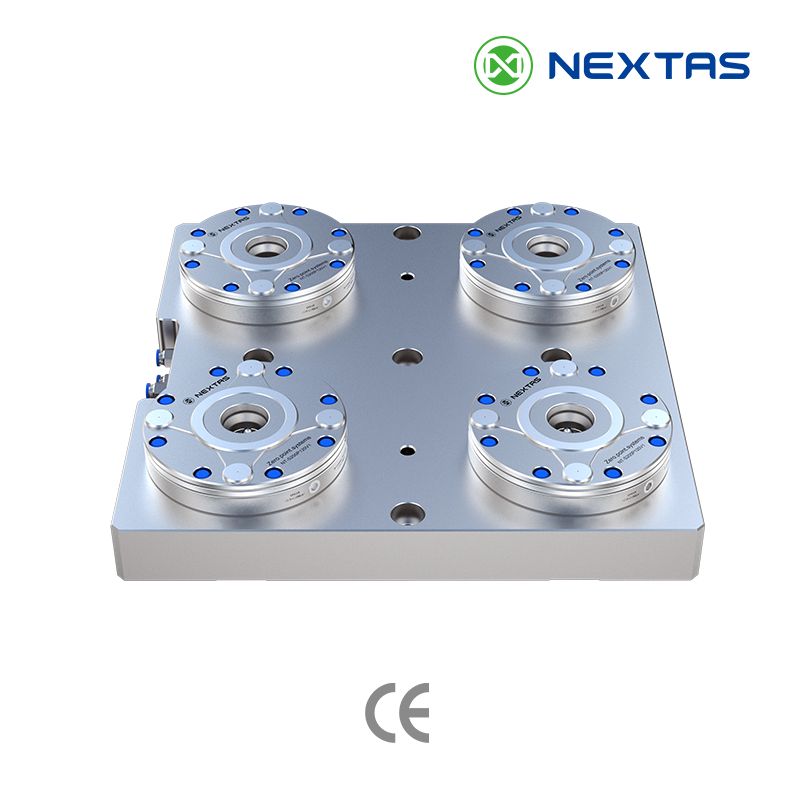
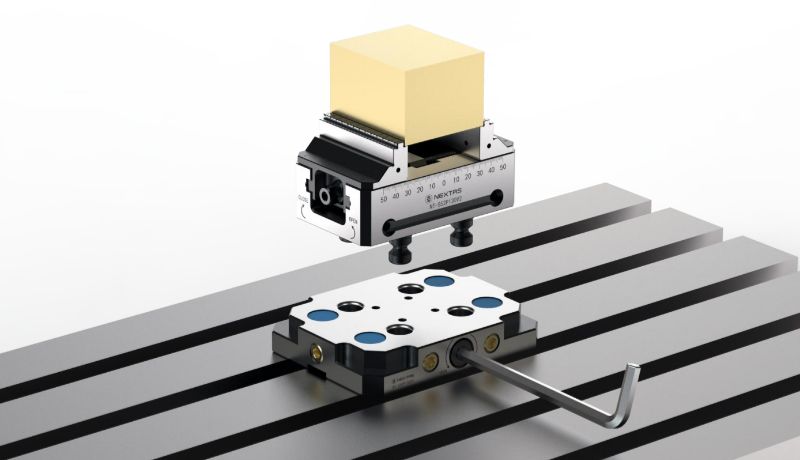
The vise base mounts straight onto our zero-point clamping systems for fast, precise setup. Once bolted down it behaves as one rigid unit with the table, which keeps chatter down during high-speed, high-feed cutting and protects surface finish.
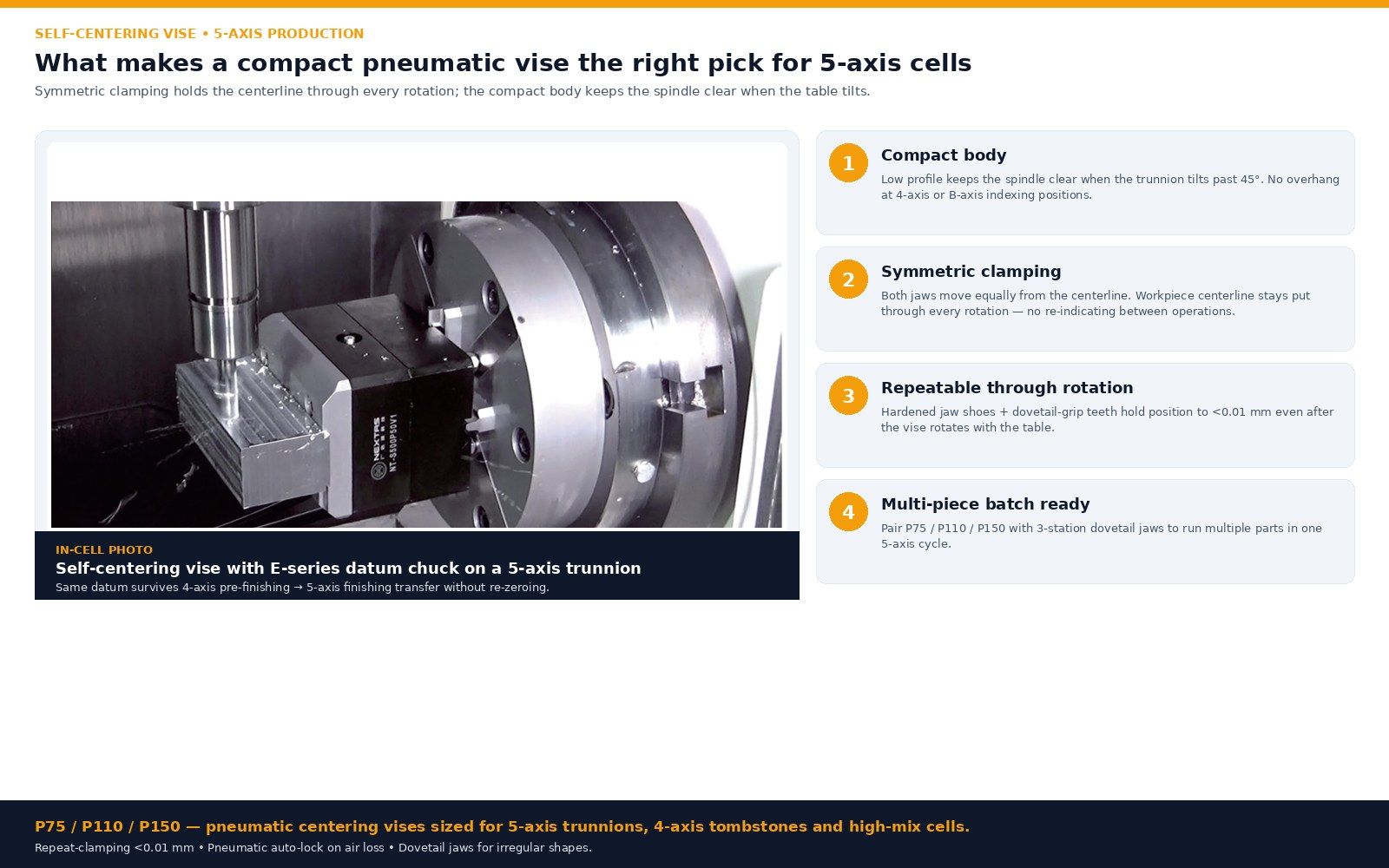
The low-profile body keeps the cutter clear of the fixture when the table tilts, so you can run shorter tools — less vibration, better cutting in tight 5-axis work.
Dimensional drawings, jaw-travel ranges, and mounting interfaces for 52 mm and 96 mm vise models.
Resources & Downloads
Compare the 52 mm and 96 mm vise families, then request the catalog or STEP files that match your mounting stack.
Request the current catalog for the S52 and S96 families. Engineering confirms the applicable models and quoted information scope.
Open 2026 product catalogSend your machine model, part envelope, material, and whether the vise will sit on a zero-point plate so our team can match the right STEP files faster.
Request CAD Files5-AXIS PRODUCTION
Symmetric clamping holds the centerline through every rotation; the compact body keeps the spindle clear when the table tilts.
See our vise in action across various industries and setups.
The compact design of the NEXTAS self-centering vise provides excellent tool accessibility for 5-axis machining. For impellers, molds, or complex structural parts, it keeps tools clear and lets you machine complex surfaces with tight tolerances.
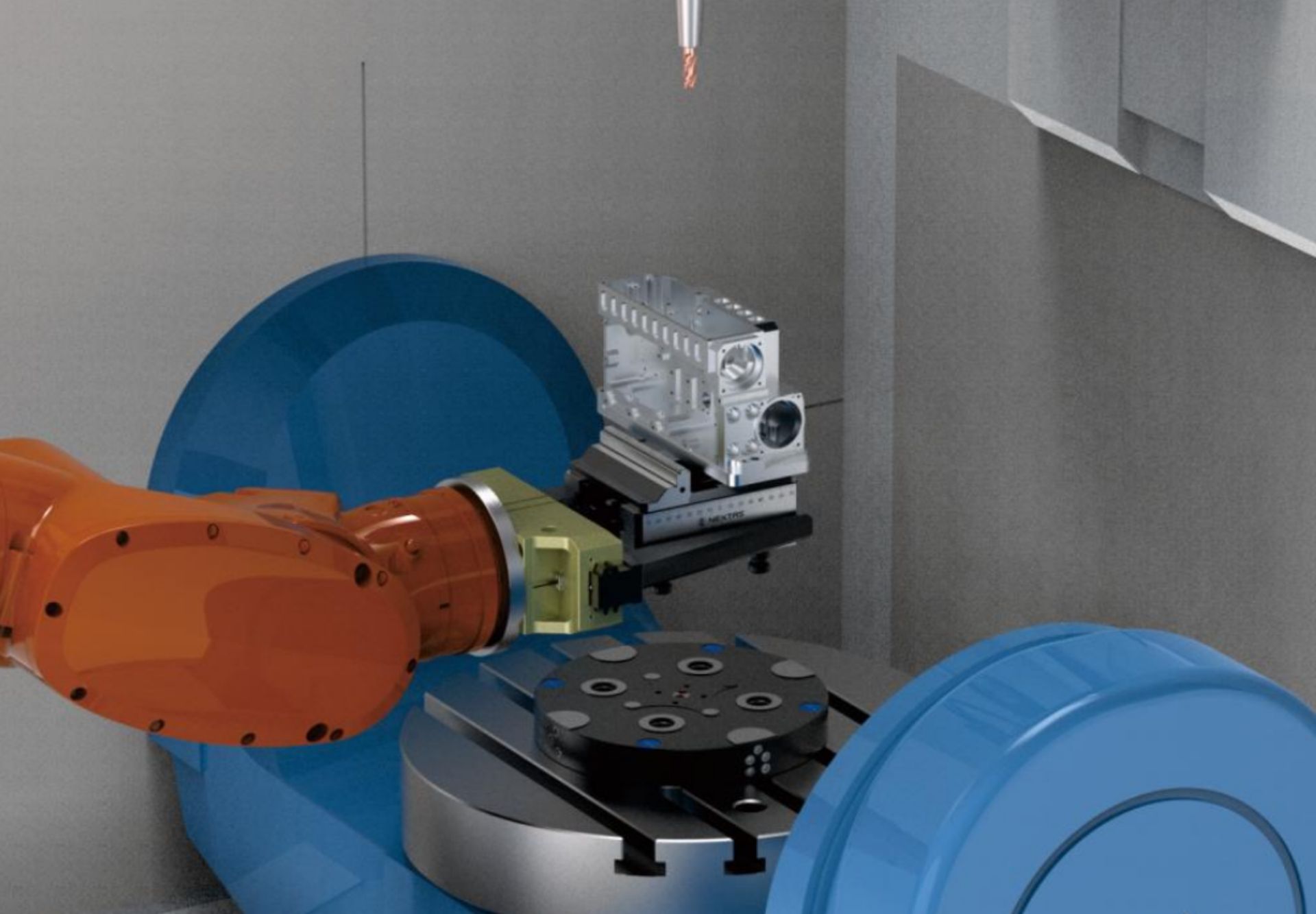
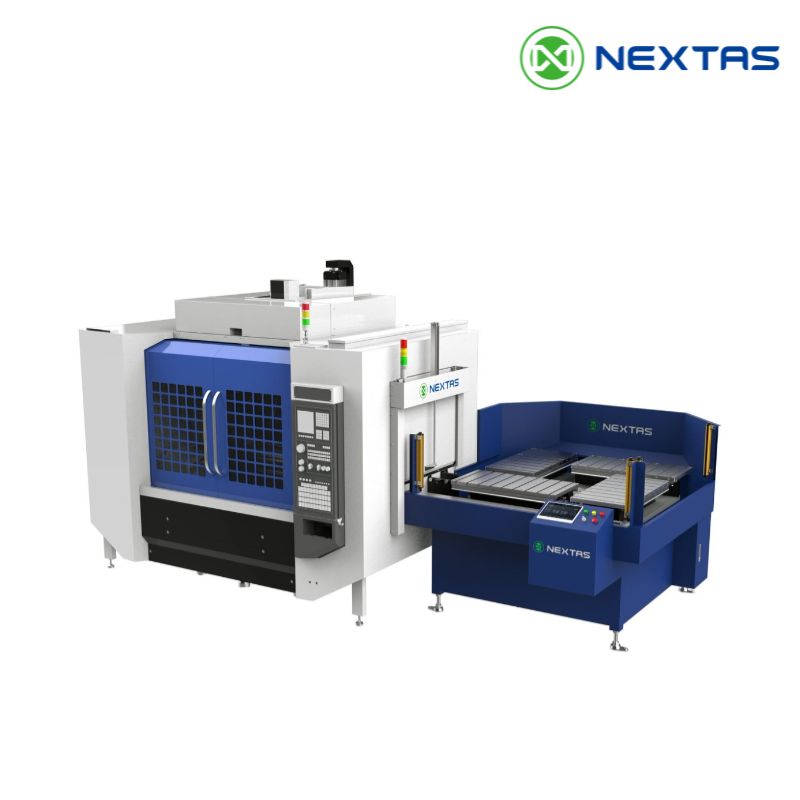
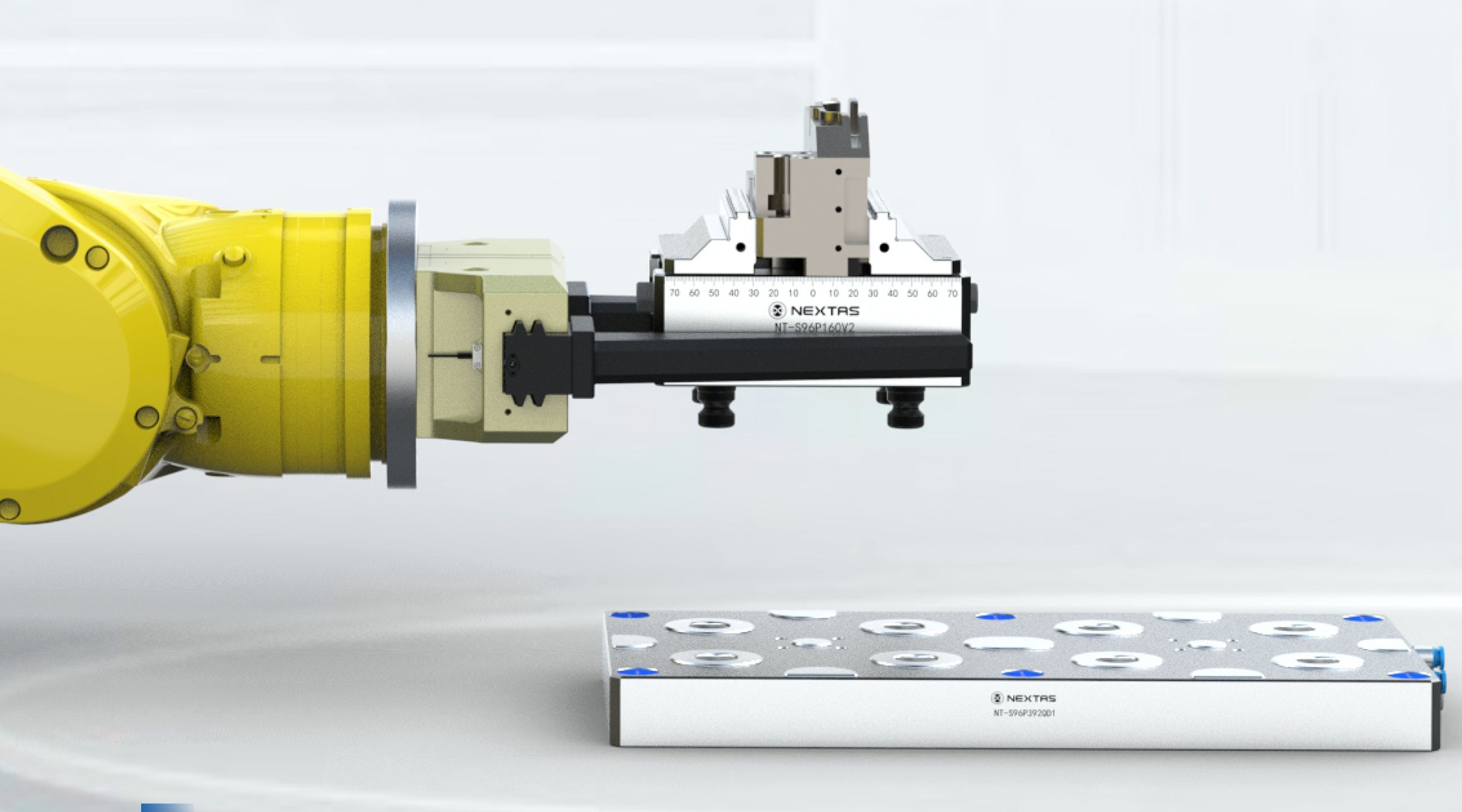
Application rendering only—not a validated cell layout. The gripping interface can support robot integration when the selected vise, gripper, actuation, sensing, guarding, interlocks and safety concept are validated together. Any unattended operating window depends on acceptance of the complete cell.
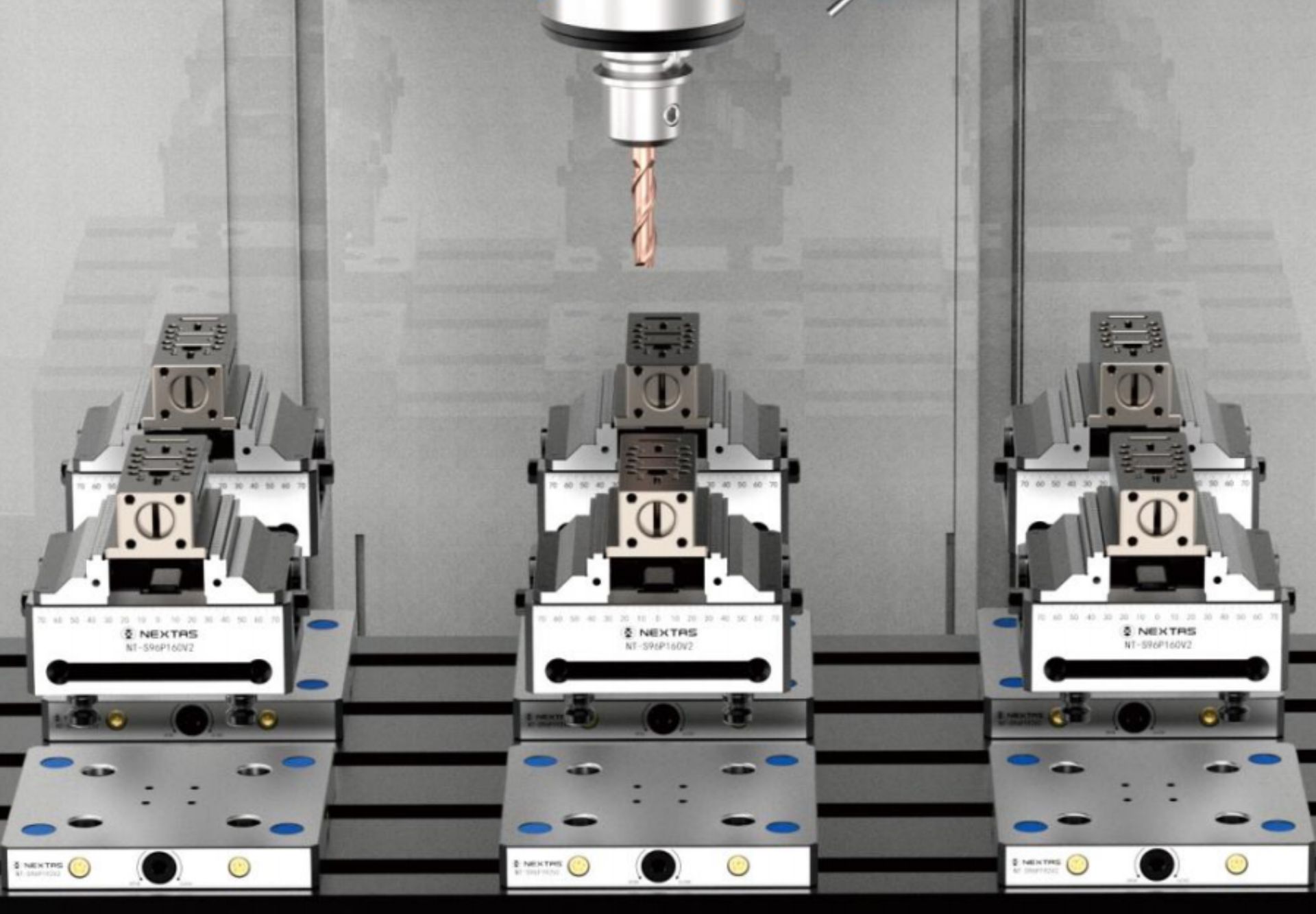
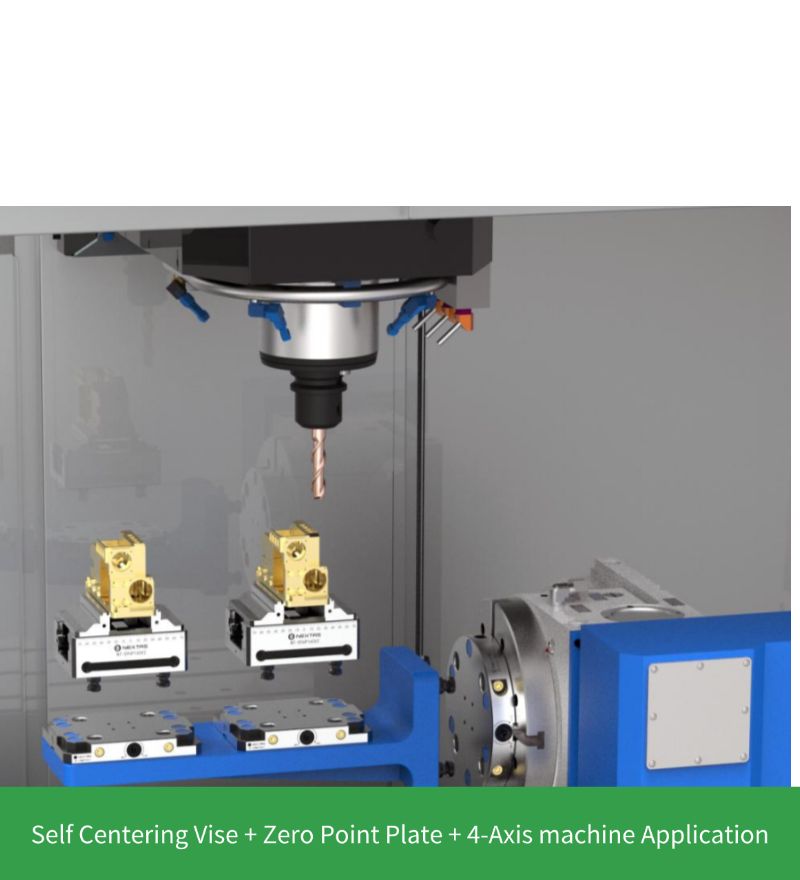
Arranging multiple vises on the machining center's worktable allows for the processing of multiple workpieces in a single setup, significantly boosting production efficiency.
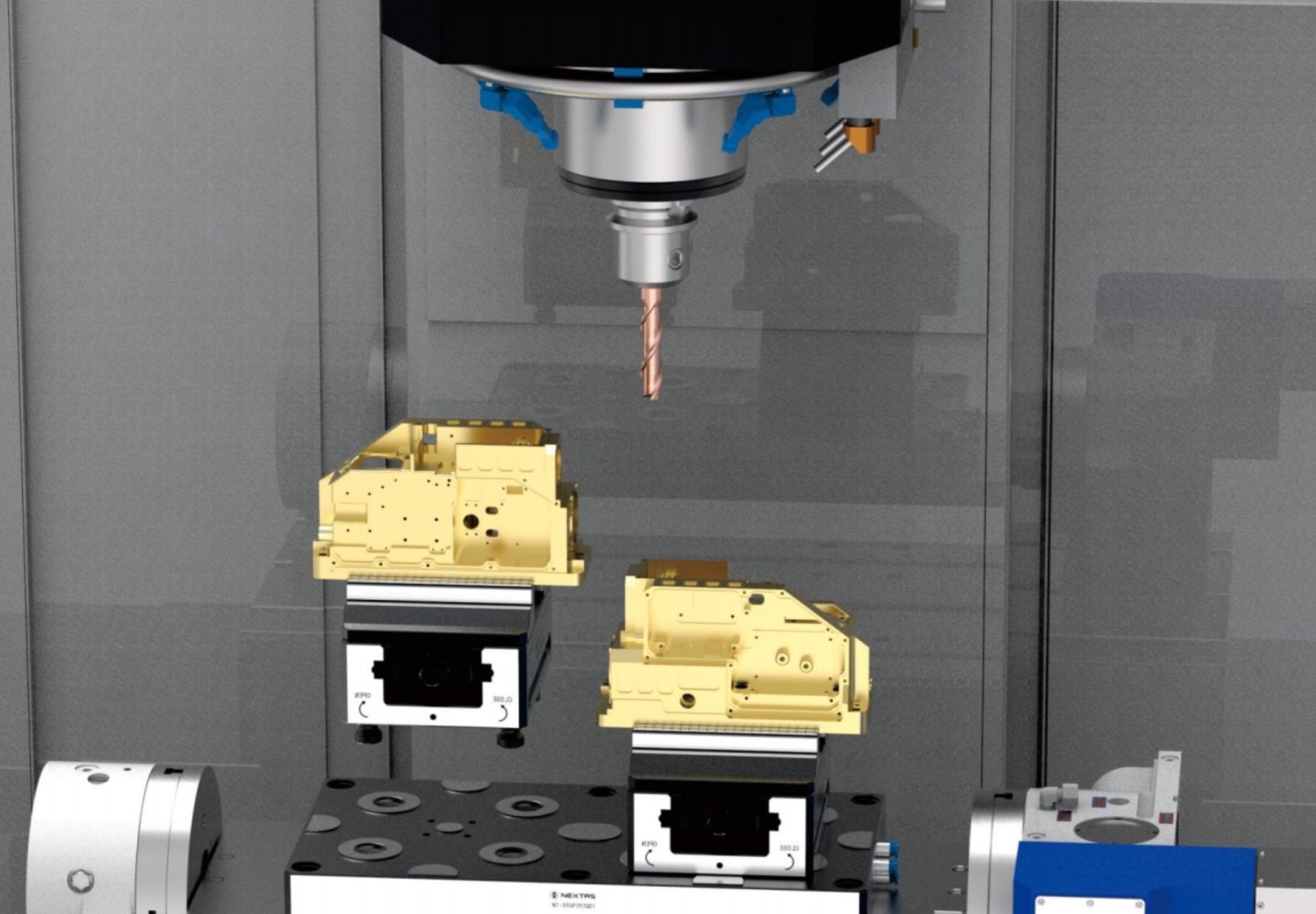
Mounting the vise on a standardized pallet allows for offline pre-setup, sharply cutting machine downtime and increasing equipment utilization.
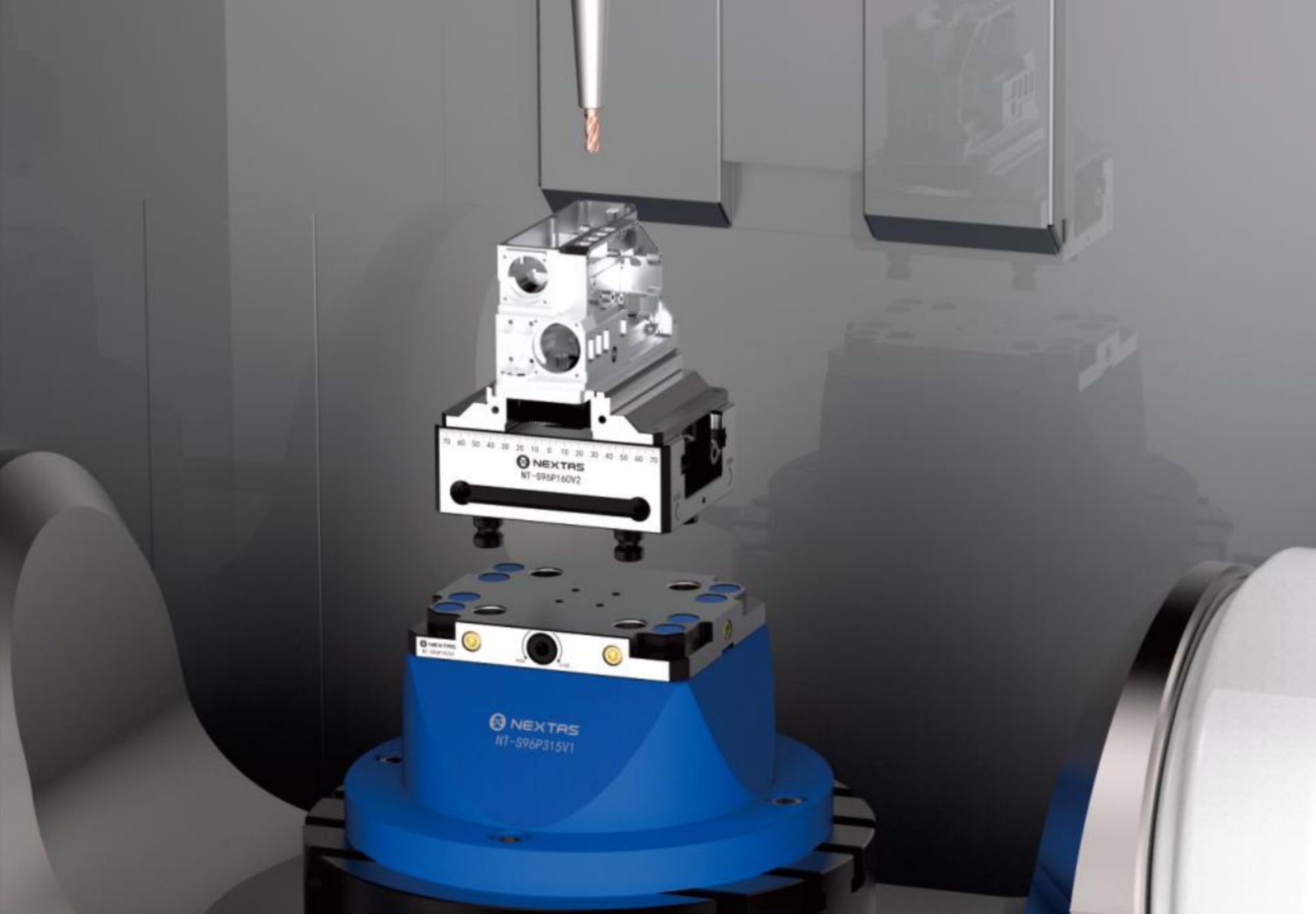
By using special jaws, it can securely clamp various irregularly shaped workpieces such as castings and forgings, providing a stable machining base.
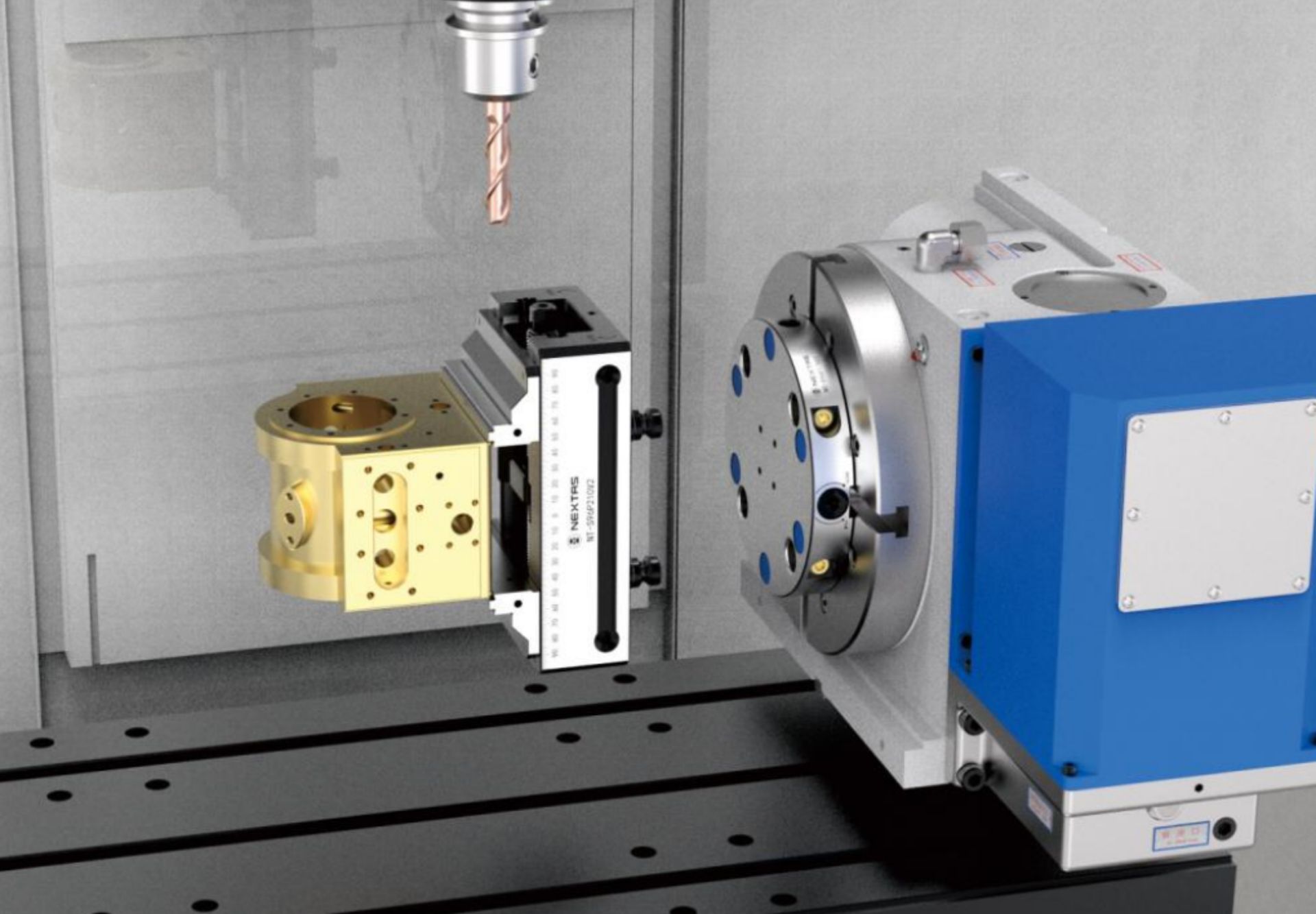
The vise's lightweight and high-rigidity features also make it suitable for mounting on a 4th-axis rotary table for multi-sided component machining.

Paired with V-jaws, it can easily achieve precise and stable center clamping of round bar workpieces, suitable for machining shaft-like parts.
These workshop photos document mounting and workholding arrangements—not customer cycle times or machining results. Use them to review machine envelope, rotary-axis clearance, jaw contact and part access. Final vise model, jaws and interface are confirmed from drawings and operating conditions.

A self-centering vise is mounted on a perforated fixture plate inside a machining center. Confirm bolt pattern, locating method, stack height and available travel before using a similar layout.
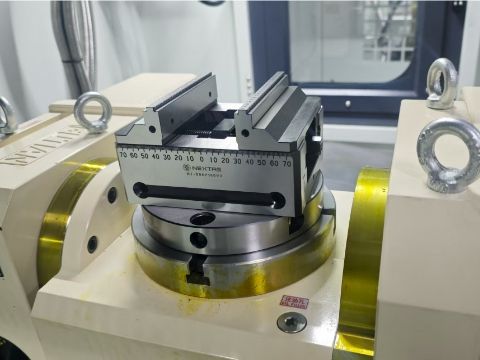
The vise is installed on a rotary-axis interface with the jaws open. Check the full swept envelope for spindle, toolholder and jaw clearance before cutting.

A rectangular block is held for multi-side access on a rotary axis. Jaw style, grip depth, torque and support still depend on material and cutting load.

A pocketed workpiece is clamped inside a machining center. Validate contact faces, part support, datum plan and first-article inspection for the actual component.
One-to-one technical service is available for your project.
The Made-in-China supplier profile records the business type and a third-party supplier assessment for procurement due diligence.
Your questions, answered.
The leadscrew moves both jaws toward a common centerline. For rough, cast or asymmetric stock, contact geometry can shift the actual datum; self-centering does not automatically align the part’s theoretical center with the machine spindle. Select suitable jaws and supports, then probe or measure the datum on the actual clamped part.
Set cleaning, lubricant type, quantity and service intervals from the selected model’s instructions and the actual chips, coolant and cycle rate. Protect precision surfaces from impact, inspect the jaw and mounting contacts, and recheck datum and repeatability after jaw changes, a collision or abnormal readings. The catalogue does not specify a universal weekly grease schedule.
Yes, after the interface is verified. The vise base uses a 52 mm or 96 mm mounting pattern, depending on the model, and can be paired with the corresponding NEXTAS zero-point plate. For a third-party system, confirm the bolt pattern, locating geometry, pull-stud and receiver arrangement, stack height, and load capacity from drawings before ordering. Changeover time and system repeatability depend on the selected plate, installation, cleanliness, and acceptance test; the vise interface alone does not guarantee them.
The listed S52/S96 catalogue models use manual leadscrew clamping. Gripper grooves and the 52 / 96 mm zero-point interface can support transfer of the complete vise, but the catalogue does not document pneumatic or hydraulic jaw actuation for these models. Confirm any automatic actuation as a separately documented configuration. Validate the vise, gripper, actuation, sensing, guarding, interlocks and recovery as a complete cell before defining unattended operation.
The jaw mechanism includes a pull-down geometry: as clamping force rises, the jaws are drawn toward the base rather than being pushed upward. The workpiece seats flat against the jaw reference surfaces, which supports tight parallelism tolerances and consistent surface finish during high-feed cutting.
Both. Hobbyists benefit from the simple self-centering action and repeatable results. In production, the high clamping force, rigidity, and reliable accuracy make it a fit for CNC and 5-axis machining. Share your machine and workpiece envelope and we can recommend the right size and jaw type.
Yes. Jaw pads are serviceable wear parts and are swapped when the gripping surface is worn or when moving between jaw styles (smooth, serrated, or soft jaws). Standardizing the torque and datum on jaw changes keeps clamping consistent from setup to setup.
The common root causes are chips or coolant residue on the jaw faces, contamination on the leadscrew, or a jaw style mismatched to the workpiece surface. Corrective sequence: clean the jaw faces and vise bed, re-grease the leadscrew per the maintenance interval, and re-select the jaw style for the workpiece condition. If the behavior persists, the engineering team can review a photo of the part and jaws to confirm root cause.
Faster setup, cleaner datums, and more stable cutting—especially on 5-axis.
Choose the jaw type using the Jaw & Grip Strategy Matrix, then follow the setup checklist below. For torque-heavy cuts, include an anti-rotation feature in the jaw design.
A short, repeatable routine helps a self-centering vise deliver stable results across pallets, shifts, and operators.
Wipe interface + jaw bed; remove burrs and chips
Tip for 5-axis / automation: Treat it like a fixture: cleanliness = repeatability
Seat on table/pallet/zero-point; apply specified tightening pattern
Tip for 5-axis / automation: If you use a zero-point system, avoid re-indicating every changeover
Probe/indicate vise centerline once; store as a work offset/macro
Tip for 5-axis / automation: Makes multi-pallet and robot loading predictable
Use consistent torque; confirm full jaw contact
Tip for 5-axis / automation: For thin walls: use soft jaws + support pads
Probe a reference feature (first-article)
Tip for 5-axis / automation: Log the offset; watch for drift after warm-up
For long cycles: re-check after jaw swaps or tool changes
Tip for 5-axis / automation: Small checks prevent big scrap batches
Simple care keeps the lead screw, jaw guidance, and contact surfaces performing like a precision workholding system.
If you machine complex parts (aerospace, medical, precision molds), this workflow keeps access high and collisions low.
Use serrated jaws + higher clamp force. Keep grip length conservative for stability.
Switch to soft jaws or precision pads. Probe critical features to protect tolerance stack-up.
Fast quote
Three fields are enough — our engineers reply after reviewing the request with pricing and configuration advice.