Best for
Repeatable clamping in automation and pallet work
Tip
Keep seats clean; use locating keys to protect ≤0.01 mm repeatability.
P75 / P110 / P150 workholding for repeatable clamping, faster cycle timing, and pallet-ready automation.
The NEXTAS pneumatic centering vise family covers P75, P110, and P150 so you can size the workholding around part range, clamping force, and automation flow before the fixture concept is locked. Start by choosing the body size, then confirm air or hydraulic actuation, jaw strategy, and pallet or zero-point integration.
Pick this family over the 52/96 mm 5-axis self-centering vise when raw clamp force, hydraulic boost (up to 45 kN at P150), and a 0–250 mm jaw range matter more than five-side tool clearance for compact mold or aerospace parts.
Best fit
Choose this route when clamp timing and repeatability must stay stable in automated loading
A practical match for robot-loaded CNC cells, palletized workholding, and repeat jobs that need faster clamp / unclamp flow than manual vises can provide.
Compare first
Decide body size and actuation before going deep into jaw details
That sequence usually resolves the real question faster: compact cell vs heavier cut, air-only simplicity vs hydraulic force, and whether the vise should sit on a pallet or zero-point base.
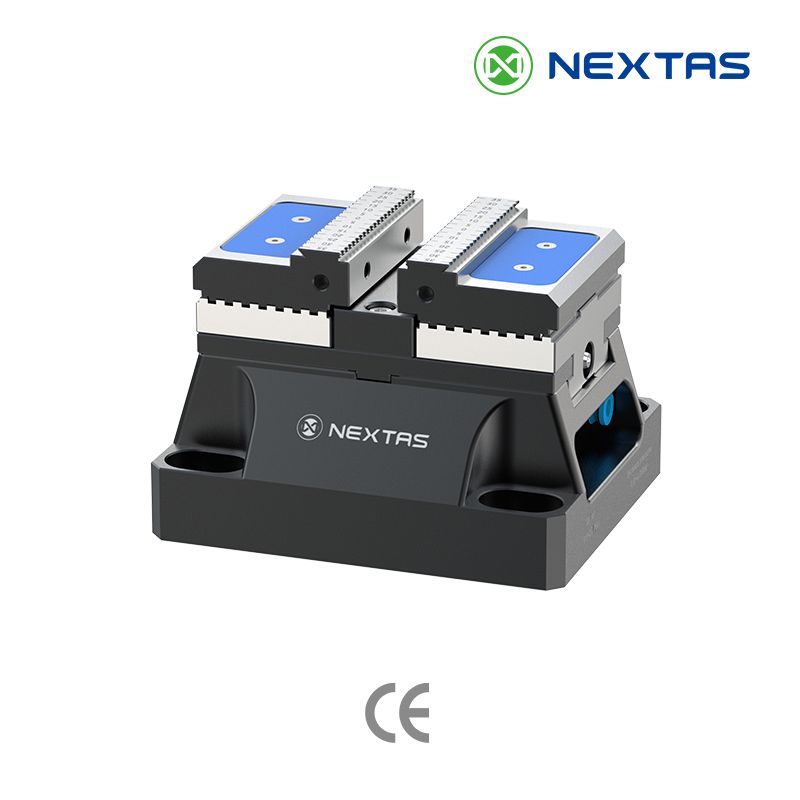
We size the right pneumatic or hydraulic vise model to your clamping force, workpiece envelope, and production throughput requirements.
Fast RFQ paths
Need drawings or a quick reply? Send air supply, jaw width, and cycle timing directly.
The form arrives pre-filled for the Pneumatic CNC Vise, so your enquiry reaches the right engineer faster.
Tell us the CNC machine model, available air pressure (typically 0.5-0.8 MPa), number of air ports on the table, and whether this is a VMC, HMC, or lathe application.
Share the workpiece shape (round, square, irregular), material and hardness, required jaw width (P75/P110/P150), and the clamping force needed to resist cutting loads.
Specify your target cycle time per part, batch size, whether pneumatic or hydraulic actuation is preferred, and any multi-vise gang mounting or automation plans.
The catalogue lists three self-centering vise sizes with pneumatic and hydraulic variants, making it easier to shortlist by workpiece envelope, cutting load and available machine space instead of forcing a one-size-fits-all choice.
| Model | Product code | Actuation | Working pressure | Repeatable clamping accuracy | Clamping force | Adjustment range | Weight |
|---|---|---|---|---|---|---|---|
| P75 | NT-S75P75V1 | Pneumatic | 0.5–0.8 MPa | <0.01 mm | 4,200 N | 0–125 mm | 7 kg |
| P75 | NT-S75P75V2 | Hydraulic | 6 MPa | <0.01 mm | 9,000 N | 0–125 mm | 7.4 kg |
| P110 | NT-S110P110V1 | Pneumatic | 0.5–0.8 MPa | <0.01 mm | 12,000 N | 0–200 mm | 23.2 kg |
| P110 | NT-S110P110V2 | Hydraulic | 6 MPa | <0.01 mm | 30,000 N | 0–200 mm | 24.9 kg |
| P150 | NT-S150P150V1 | Pneumatic | 0.5–0.8 MPa | <0.01 mm | 20,000 N | 0–250 mm | 41.6 kg |
| P150 | NT-S150P150V2 | Hydraulic | 6 MPa | <0.01 mm | 45,000 N | 0–250 mm | 42 kg |
Best for smaller parts, tighter robot access, or machines where table space is limited.
A good fit for general CNC production and mixed part families where you need more range and force without jumping to the heaviest body size.
The largest family is the right starting point for larger workpieces, stronger roughing loads, and more demanding automation cells.
A practical checklist for choosing a pneumatic self-centering vise and integrating it into robotic CNC cells, pallet systems, and high-mix production—without sacrificing repeatability.
Choose jaws based on how you want to locate the part (OD/ID, flats, or custom profile) and how often you will change part families.
A robot should never load/unload against an unknown clamp state. These are common signals used with an automation-ready pneumatic vise.
Holds the part through robot load and unload, so a cell can run lights-out for long stretches without anyone resetting clamps.
Clamps to the same point every cycle in automotive and electronics work, which keeps parts in tolerance and trims seconds off each load.
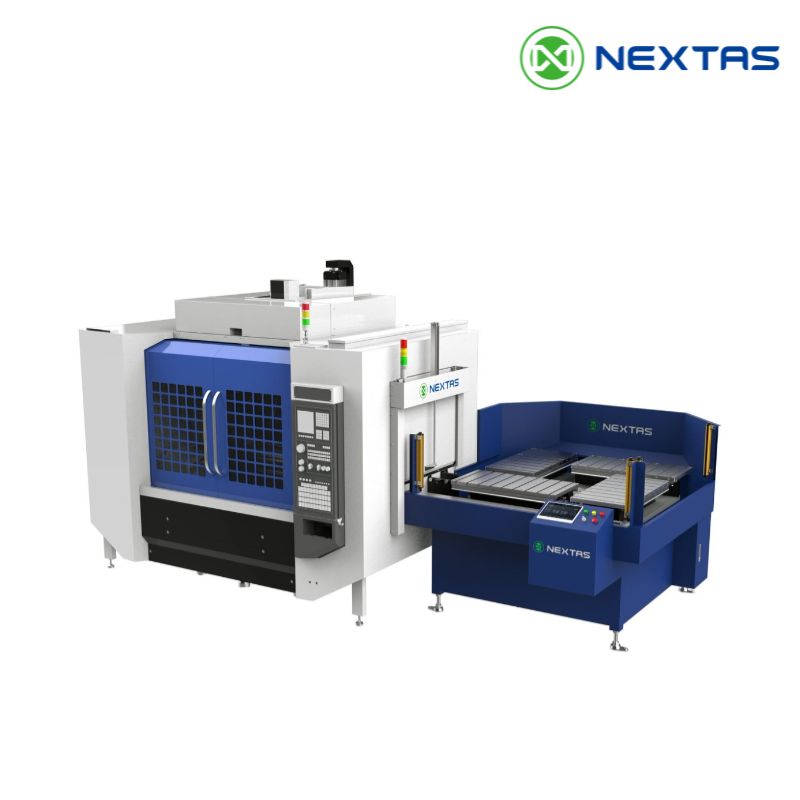
Pairs with pallet changers so several workpieces run through one setup instead of several.
Keeps the workpiece steady under high-feed, deep cuts — the kind of load you hit in mold roughing.
Two-minute product demonstration
Watch the clamping action and setup context, then compare your air supply, jaw width, part envelope, and target cycle time with the available P75, P110, and P150 configurations.
Review Selection & IntegrationUse this matrix to decide where a pneumatic or hydraulic vise adds the most value—especially in lights-out machining, palletized systems, and robot loading.
Stable air supply and basic housekeeping are what keep a pneumatic vise predictable in automation. Use this as a quick commissioning + upkeep checklist.
Use these checks to develop the selected model’s service plan for the actual cycle rate, chips and coolant. Complete-cell validation and acceptance are required before unattended operation.
JAW SWAP GUIDES
Two short visual guides for the team that runs the cell — flip hard jaws or mount soft jaws without pulling the manual every time.
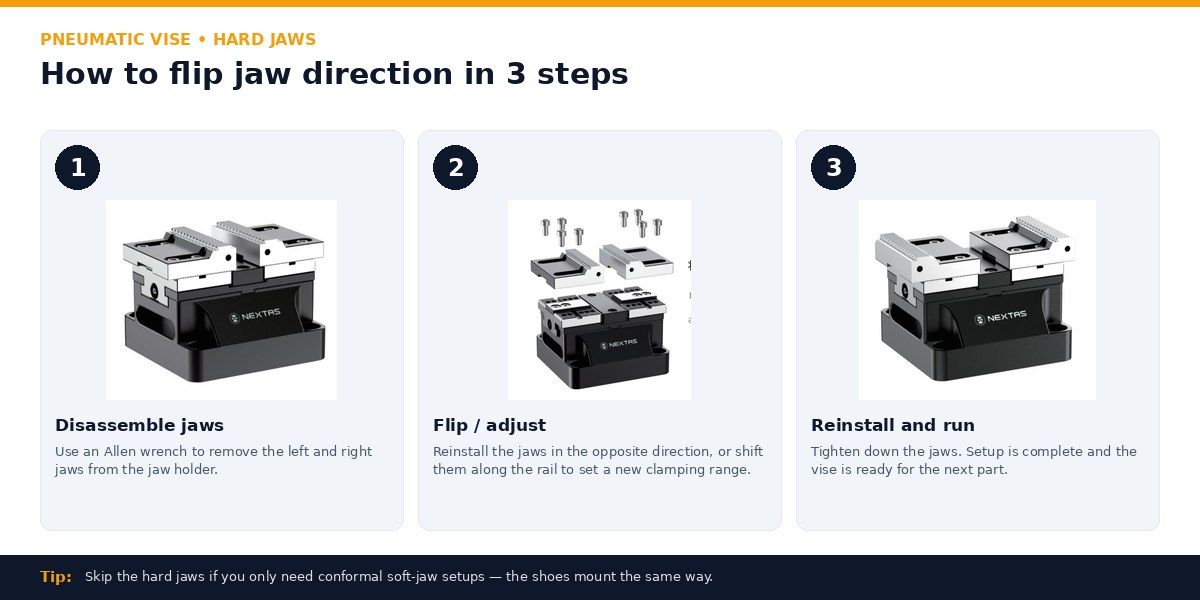
Hard jaws — 3 steps
Re-orient hard jaws to switch between front-face and back-face clamping, or to set a different clamping range.
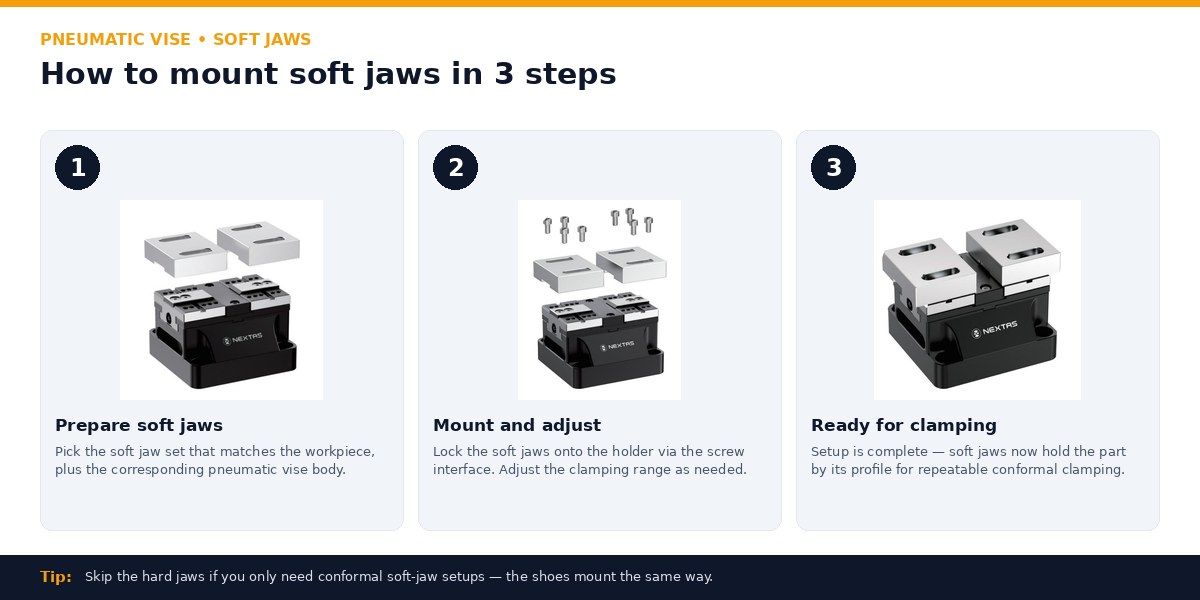
Soft jaws — 3 steps
Mount conformal soft jaws so the part is held by its profile — repeatable on irregular shapes.
Pneumatic centering vise views from the product photograph and from shop setups. Confirm the part, machine, and result for the actual job.
P75, P110 and P150 are three centering-vise sizes, each with a pneumatic V1 and hydraulic V2 version. They can be considered for repeat CNC production after checking the workpiece, jaws, machine, supply circuit and controls together. Automatic operation requires validation and acceptance of the complete cell.
Three body sizes — P75, P110 and P150 — with jaw opening from 0–125 mm up to 0–250 mm. Clamping force runs from 4,200 N (P75 pneumatic) to 45,000 N (P150 hydraulic), with repeatability under 0.01 mm. Pneumatic models run on 0.5–0.8 MPa shop air; hydraulic models run at 6 MPa.
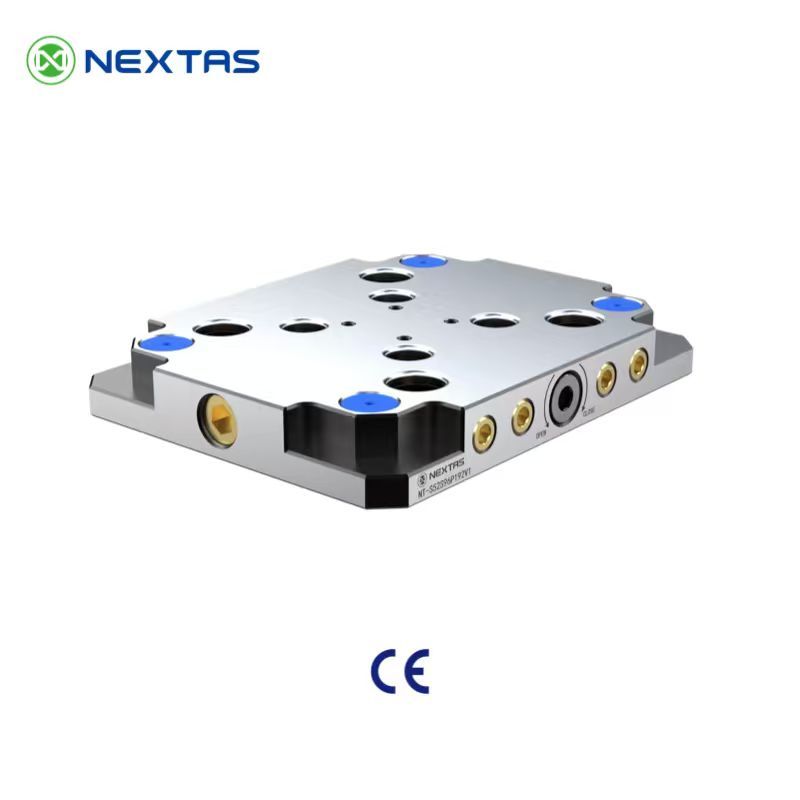
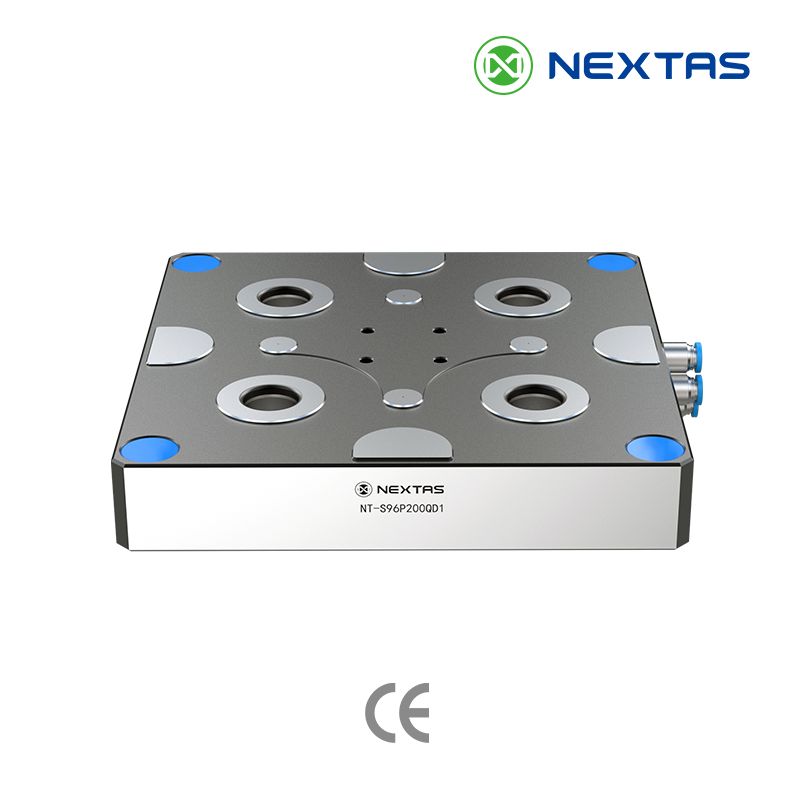
Compatibility with a CNC machining center, milling machine or pallet system depends on the mounting drawing, load, stack height, fluid connections, clearances and control interfaces. Confirm the selected vise and both sides of any ITS or zero-point interface; the family name alone does not establish compatibility.
Compare the selected model drawing with the machine table or pallet before defining keys, mounting holes, locating pins and pneumatic or hydraulic connections. Verify fastening, alignment, working pressure and clamp-state feedback during commissioning.
If you need STEP/IGES or 2D drawings, please Contact us.
A key advantage is that this vise family gives you both pneumatic and hydraulic choices in the same centering-vise format. That lets you balance plant utilities, target clamping force, and automation simplicity without changing the overall workholding concept.
Catalog-listed P75 / P110 / P150 models are specified at <0.01 mm repeatable clamping accuracy, which supports consistent automated changeovers.
The catalogue lists hardened stainless steel as a family feature. Confirm the body, jaws and other component material grades on the selected model drawing; stiffness and surface finish depend on the complete setup and machining conditions.
Fast quote
Three fields are enough — our engineers reply after reviewing the request with pricing and configuration advice.