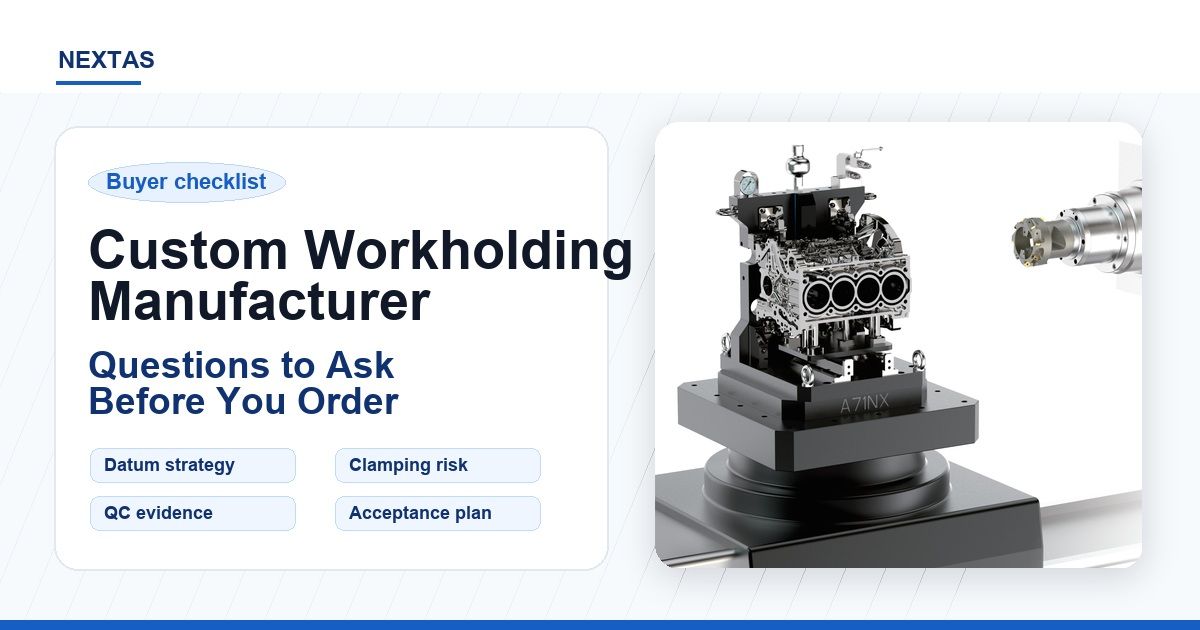
When a standard vise, chuck or modular plate cannot hold the part repeatably, a custom workholding manufacturer becomes part of your process engineering team. The fixture they build will define where the part sits, how force enters the workpiece, whether the tool can reach the cut, how operators load the part, and how quality is proven before the first production run. That is why the questions you ask before ordering matter as much as the price on the quote.
This guide is for buyers, manufacturing engineers and purchasing teams who already know they need something more specific than a catalog product. It does not repeat the basic RFQ checklist covered in our workholding quote guide. Instead, it focuses on the decision questions that separate a capable custom fixture partner from a supplier who can only machine a plate from a drawing.
What a good manufacturer should ask you
A serious custom workholding manufacturer should ask about the part before talking about hardware. If the first conversation jumps straight to clamping force, price or delivery without asking how the part locates, the supplier may be treating the fixture as a block of metal rather than a production tool.
Expect questions about part material, stock condition, machining sequence, datum surfaces, thin walls, casting variation, burr risk, coolant direction, tool access, operator loading and whether the same fixture must handle a part family. These questions are not delays. They are how the supplier avoids building a fixture that looks good on a bench but creates scrap on the machine.
The most useful first answer is often a clear statement of the production problem: "We need to machine three faces without re-indicating," "The current clamp distorts a thin wall," "Operators spend 12 minutes finding the datum," or "We need the same nest to run manually now and with a robot later." That business problem guides the fixture design more than a raw part drawing alone.
1. How will the fixture locate the part?
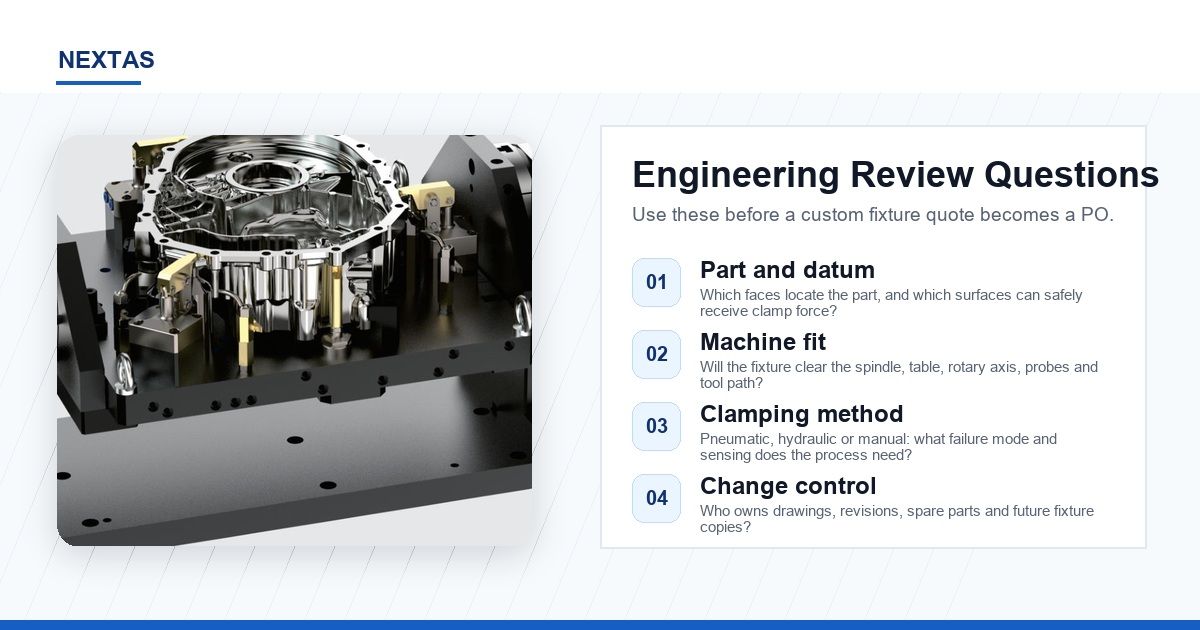
Datum strategy is the first question because every other decision depends on it. Ask which surfaces locate the part, which surfaces clamp it, and which features are allowed to float. If the supplier cannot explain the locating scheme in plain language, the fixture may rely on operator feel, extra shimming or inconsistent part contact.
For castings and forgings, ask how the design handles stock variation. For saw-cut blanks, ask whether the rough face becomes a locator or only a clamping surface. For thin parts, ask how the fixture avoids forcing the workpiece into a shape that springs back after unclamping. A good design often separates support, location and clamping instead of asking one jaw or pin to do everything.
Request a simple datum sketch or marked-up screenshot before approval. It does not need to be a finished drawing, but it should show fixed locators, adjustable supports, clamp points, clearance zones and where the part is free to grow or move. This one step catches more design misunderstandings than any quotation table.
2. What clamping risk does the design remove?
Custom workholding is usually justified by a risk that standard workholding cannot remove. That risk might be distortion, chatter, part slip, poor access, slow loading, unstable datum transfer, or unsafe manual handling. Ask the supplier to name the risk and explain how the design addresses it.
A hydraulic fixture may be right for high force, stable part families and controlled sequence clamping. A pneumatic fixture may be better for fast cycling, automation and repeatable operator loading. A manual custom nest may still be the right answer when volume is low but the datum is difficult. The actuation method should follow the part and production target, not the supplier's preferred product family.
Also ask about failure mode. What happens if air pressure drops? What happens if a chip lands on the locating face? Can the machine start while a clamp is not seated? Will the part be damaged if an operator loads it backward? These questions are especially important for lights-out work, robot loading and expensive parts where one bad cycle can cost more than the fixture.
3. Will it fit the actual machine and process?
A custom fixture can be technically correct and still fail because it does not fit the machine envelope. Before ordering, send the machine model, table drawing, T-slot or hole pattern, spindle clearance, rotary axis limits and any probe or tool changer restrictions. If a fixture will sit on a zero-point system or pallet, include that stack height and interface too.
Ask the manufacturer to check tool access, chip evacuation, coolant direction, hose routing, operator reach and lifting points. In 5-axis work, confirm that the trunnion or rotary table has clearance through the full program, not just at the setup position. In horizontal machining, confirm that the fixture can survive chip load and coolant exposure in the orientation it will actually run.
For part families, do not only send the easiest part. Send the largest, smallest, tallest, thinnest and most awkward variant. If the supplier quotes against the cleanest sample, you may discover later that the production mix needs a second fixture or a compromise jaw set.
4. What DFM feedback will you get before approval?
A useful custom workholding supplier should give design-for-manufacturing feedback, not just accept your requested fixture concept. Ask what they would change to reduce cost, shorten lead time, improve access, protect the datum or simplify future maintenance. A supplier who never challenges the concept may be avoiding engineering responsibility.
Good DFM feedback can include moving a clamp to reduce distortion, changing a nest detail to handle casting variation, adding hardened wear pads, splitting a fixture into a base plus replaceable top tooling, or standardizing hole patterns so the next fixture mounts to the same pallet. These changes may add small cost at the start but reduce scrap, downtime or future redesign.
If the supplier proposes a custom hydraulic fixture, ask whether a pneumatic or manual route would also work and why they recommend one over the other. If they propose a dedicated fixture, ask whether a modular base with replaceable nests would cover more part families. You are not looking for the cheapest answer. You are looking for a reasoned answer.
5. What quality proof ships with the fixture?
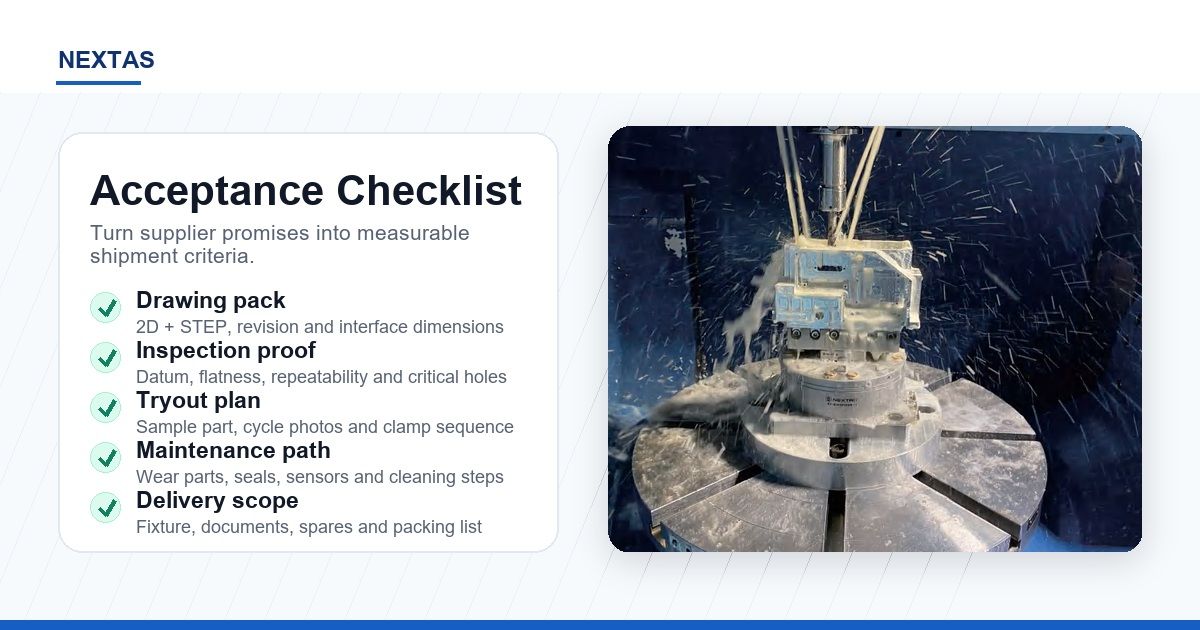
Inspection proof should be agreed before the purchase order. At minimum, ask for the final 2D drawing, STEP model, revision record, inspection report for critical locating features, and photos of the completed fixture. For higher-risk work, add tryout evidence, repeatability checks, clamp sequence photos, pressure test records and material or heat treatment certificates where relevant.
Define acceptance in measurable terms. "Works well" is not an acceptance criterion. Better criteria include part seating against defined locators, datum-to-feature measurements, flatness of the base, repeatability after repeated clamp/unclamp cycles, leak or pressure hold test, and confirmation that all fasteners, pins, hoses, sensors and wear parts match the drawing.
6. How will sampling and tryout be handled?
For complex fixtures, the first article plan is part of the purchase. Ask whether the supplier can test with a sample workpiece, simulate loading, check clamp sequence, or support remote tryout after delivery. If the part is expensive or confidential, ask whether you can provide a simplified dummy part that represents the critical datums and clamp surfaces.
Clarify who owns adjustments discovered during tryout. If the supplier designed from incomplete data, a change may be a customer revision. If the supplied fixture does not match the approved design or acceptance criteria, it should be a supplier correction. Putting that boundary in writing avoids a dispute when everyone is under production pressure.
For repeat orders, ask how the supplier records the approved revision. A fixture that works after two small modifications should not be reordered from the original drawing by mistake. Revision control is one of the quiet signs of a mature custom workholding manufacturer.
7. Who owns drawings, revisions and spare parts?
Before you order, ask what documentation you will receive and what the supplier retains. Some buyers need full manufacturing drawings. Others only need interface drawings, assembly drawings and maintenance information. Either can be acceptable if the expectation is clear before the price is agreed.
Spare parts also need attention. Custom fixtures often include wear pads, seals, pins, sensors, clamps, hoses or special screws. Ask which parts are standard, which are custom, and how quickly replacements can be supplied. If one small wear component can stop a production line, it belongs on the first purchase order as a spare.
If your team plans to build a fixture family, ask whether the supplier can keep a common base standard, shared spare parts and consistent documentation across future projects. That kind of standardization is usually worth more than a small discount on the first one-off fixture.
8. Is the quote scope complete?
Custom fixture quotes should be separated by scope. Look for engineering design, fixture base, custom nests or jaws, cylinders or clamps, sensors, hoses, fittings, inspection, tryout, documents, packaging and freight. A quote that only says "custom fixture" may hide missing work that appears later as an extra charge.
Compare lead time by milestone, not only by shipment date. Design review, drawing approval, machining, assembly, inspection, tryout and packing all consume time. If your project has a hard launch date, ask which customer inputs are needed by which date to protect the schedule. The supplier cannot hold a delivery promise if drawings, sample parts or machine details arrive late.
Finally, ask for the assumptions behind the quote. Assumptions about part variation, clamping surface, production volume, machine table, tolerance and automation plan should be visible. If those assumptions are wrong, the quote is not wrong by accident - it was built on the wrong job.
Where NEXTAS fits
NEXTAS is a practical fit when the buyer needs a custom fixture reviewed around real machining conditions: part geometry, datum transfer, clamp force, machine envelope, operator loading and future automation. The right starting point may be a dedicated hydraulic fixture, a pneumatic fixture, a custom nest on a zero-point base, or a modular route that leaves room for later pallets.
Send CAD/STEP files, a dimensioned drawing, machine model, current setup photos, production volume, tolerance targets and any automation plan. If the part is confidential, send a simplified model that preserves the clamp and datum surfaces. The goal is not to collect more files than necessary. The goal is to remove enough uncertainty that engineering can quote a fixture you can actually approve.
A custom workholding manufacturer should help you buy less risk, not just more hardware. The best partner can explain the datum, challenge weak assumptions, show what will be inspected, support tryout and keep the revision under control after shipment. Ask those questions before you order, and the final fixture is much more likely to perform on the machine instead of only in the proposal.
FAQ
What should I ask a custom workholding manufacturer first?
Start with the part datum, clampable surfaces, machine envelope, tolerance target, operation type, production volume and how the supplier will prove fixture performance before shipment.
Do I need CAD files before requesting a custom fixture quote?
A STEP file and dimensioned drawing are ideal. Clear photos and critical dimensions can start a budget review, but a firm quote normally needs CAD, datum information and machine details.
How do I compare two custom workholding suppliers?
Compare engineering review depth, DFM feedback, inspection evidence, sample acceptance plan, change control, spare parts support, lead time and total quote scope instead of comparing only fixture price.
What proof should a supplier provide before shipping?
Ask for final drawings, revision status, inspection report, key datum measurements, repeatability or tryout evidence, photos of the clamp sequence and a packing list that includes wear parts or spare items.
When is a custom fixture worth the cost?
It is worth considering when standard vises or chucks create distortion, poor access, long setup time, inconsistent locating, unsafe loading or too much operator adjustment across a recurring part family.
Need a custom fixture review?
Send your part drawing, STEP file, machine model, tolerance target and current setup photos. NEXTAS can review the datum strategy and return a quote-ready custom workholding plan.
Request Engineering Review →