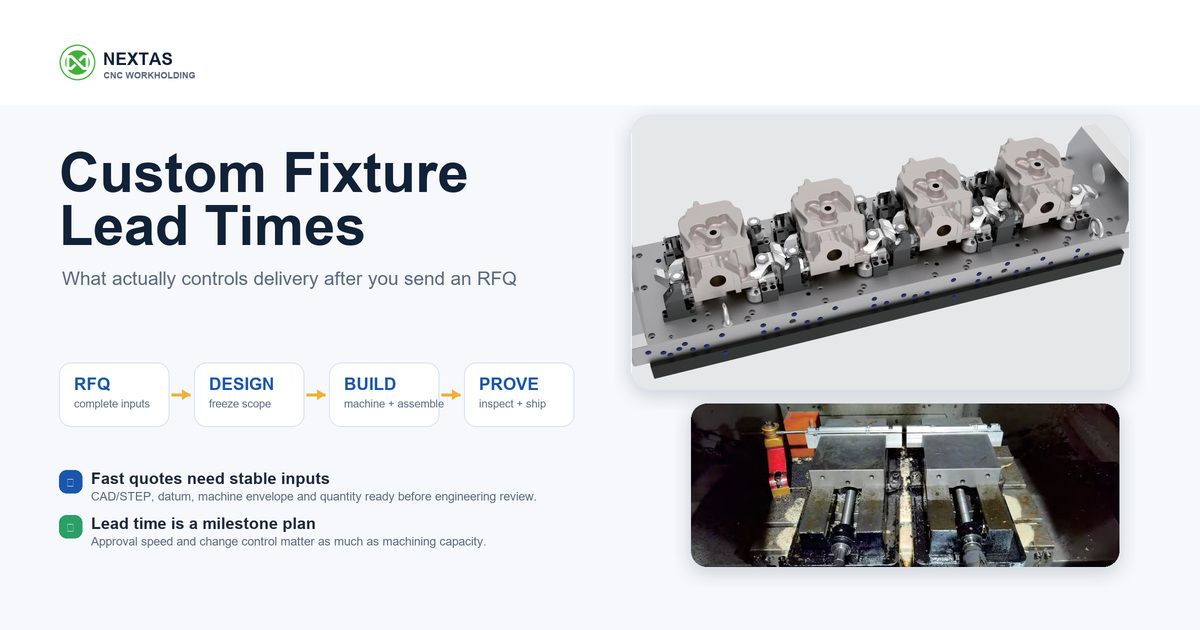
When buyers ask "How fast can you deliver a custom CNC fixture?", the honest answer depends on what has already been decided. A fixture with clear CAD, a stable drawing revision, known machine table details and simple manual clamping can move quickly. A hydraulic fixture with multiple stations, special cylinders, sensors, hardened wear parts, pressure testing and first-article proof needs more engineering time before it should be released to production.
This guide is for purchasing teams, manufacturing engineers and project managers who need a realistic schedule before they place an order. It is different from a general workholding RFQ checklist. Here the focus is how lead time is built, why some fixture projects slow down, and what you can do before the purchase order to protect a launch date.
What "lead time" really means
For a catalog vise or standard plate, lead time is usually availability plus shipping. For a custom fixture, lead time is a project path. It starts when engineering has enough information to review the job, not when someone sends a short message asking for price. It ends when the fixture is built, inspected, packed and ready to ship, not when the first concept is drawn.
That difference matters. If a supplier says "four weeks" but the drawing approval takes ten days, the real schedule is no longer four weeks from the first email. If the part revision changes after machining starts, the clock may reset for the affected components. If a sensor, cylinder, coating or special heat treatment has its own sourcing time, the fixture cannot ship just because the base plate is complete.
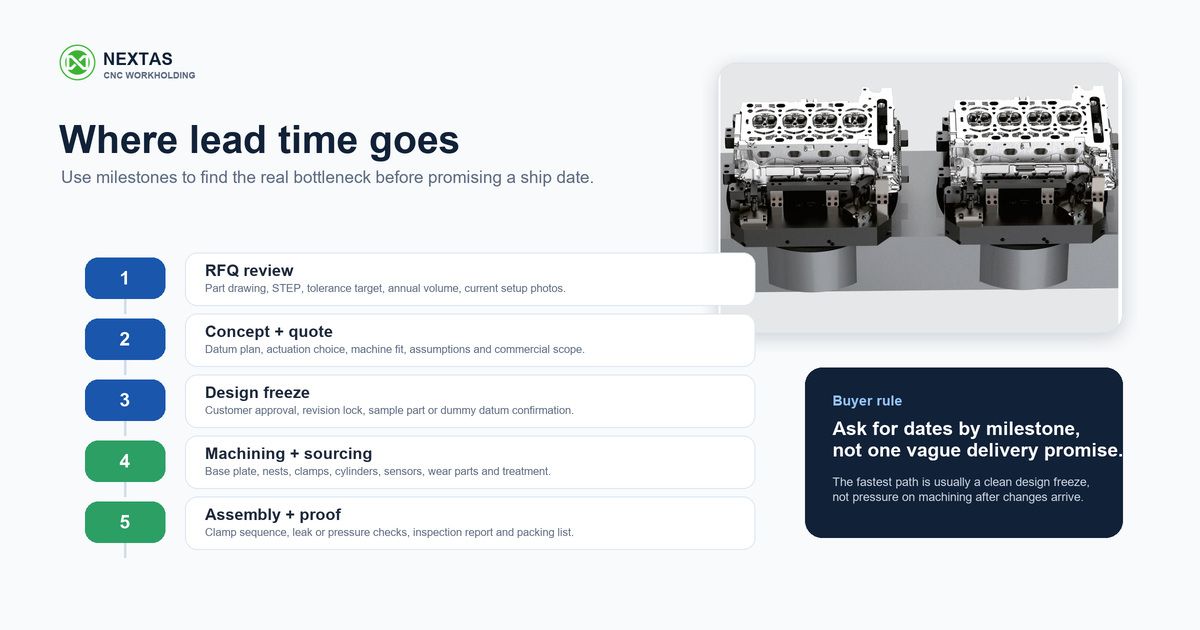
A better way to manage the schedule is to separate the project into milestones: RFQ review, concept and quotation, design freeze, machining and sourcing, assembly, inspection and shipment. When those milestones are visible, both sides can see whether the bottleneck is missing information, customer approval, supplier capacity, long-lead parts or final proof.
The five-stage schedule behind most custom fixtures
The first stage is RFQ review. The supplier checks the part drawing, STEP file, critical tolerances, machine model, table interface, current setup, part volume and production problem. If any of these are missing, the review can still begin, but the quote will carry assumptions. Assumptions are often where lead time problems begin.
The second stage is concept and quote. Engineering decides whether the project is a manual nest, pneumatic fixture, hydraulic fixture, modular top tooling on a zero-point base, or something closer to an automation-ready pallet. A useful quote should show the scope, key assumptions, what documentation is included and which customer inputs must be confirmed before design release.
The third stage is design freeze. This is the point where the buyer approves the fixture concept, machine interface, clamp sequence, datum strategy and major components. Design freeze does not mean no small detail can change. It means the part geometry, locating method and scope are stable enough for the supplier to order components and machine custom parts without guessing.
The fourth stage is machining and sourcing. Base plates, nests, risers, jaws, locators, manifolds, guards, handles and special adapters move through machining. Bought components such as cylinders, clamps, sensors, hoses, fittings, seals and fasteners are ordered or pulled from stock. If hardened pads, coating, black oxide or surface grinding are required, those operations need their own windows.
The final stage is assembly and proof. The fixture is assembled, clamp sequence is checked, leaks or pressure hold are tested where relevant, critical features are inspected, and photos or reports are prepared. This stage is not paperwork. It is where a supplier catches a hose conflict, missing spacer, wrong fastener length, bad seating point or unclear operator sequence before the fixture reaches your shop.
Inputs that shorten the first review
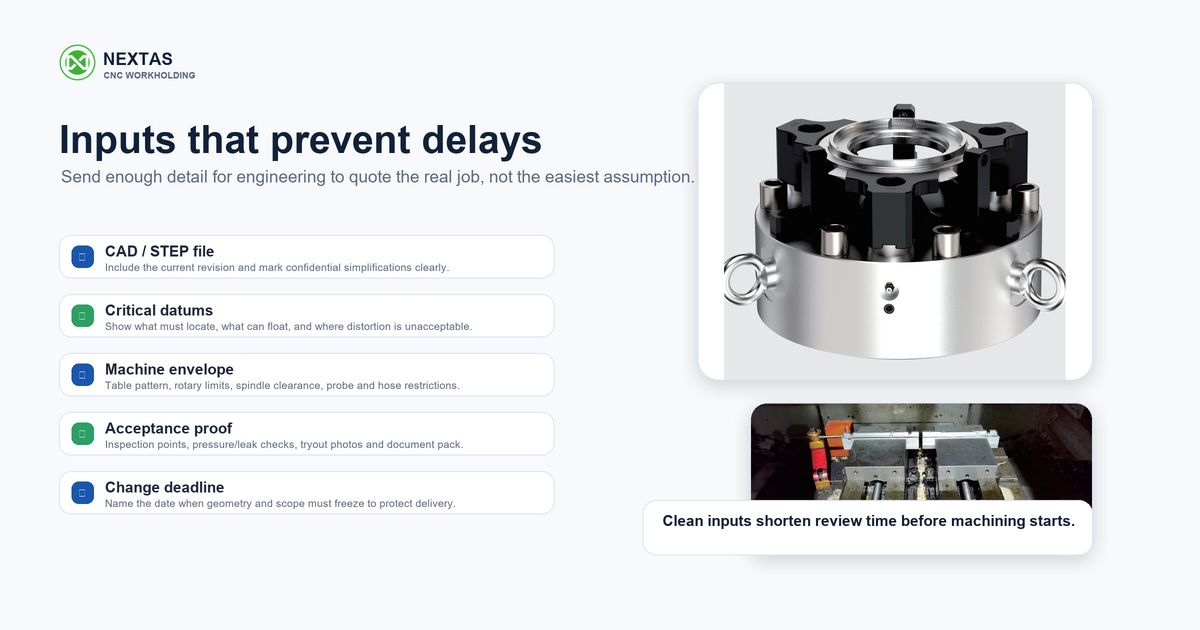
The fastest custom fixture projects usually begin with complete, practical information. A STEP file lets engineering study access and collisions. A 2D drawing shows tolerances and datum intent. A machine model or table drawing prevents a fixture that clears the part but not the spindle, probe, rotary axis or door. Current setup photos show how operators really load and unload the part.
Send the parts that define risk, not only the easiest sample. If the fixture must hold a family, include the largest, smallest, thinnest and most awkward variant. If stock varies, describe the variation. If the fixture must support future robot loading, say that during RFQ, not after the manual design is approved. Automation readiness changes space, sensing, chip protection and operator access.
Acceptance requirements also affect lead time. A simple fixture may need dimensional inspection and photos. A hydraulic fixture may need pressure checks, clamp sequence proof and documentation for cylinders, seals or manifolds. If you need a tryout with a real workpiece, a dummy part, a CMM report or video proof, include that before quotation so the supplier can plan it instead of adding it late.
Why custom fixture projects slow down
The most common delay is unclear datum strategy. If the supplier does not know which surfaces locate the part, which surfaces clamp it and which features are allowed to float, the fixture concept cannot be trusted. Engineering may need more drawings, sample measurements or a call with your process team before it can release design work.
Late part changes are another major cause. A new casting revision, moved hole, changed stock allowance or different machining sequence may look small to purchasing, but it can change locator positions, clamp reach, tool clearance and inspection points. If the fixture has already entered machining, the affected components may need to be redesigned or remade.
Machine uncertainty also creates delay. Custom fixtures are built around real machine constraints: table pattern, T-slot size, rotary envelope, spindle nose, tool length, coolant flow, probes, doors, chip conveyors and lifting access. Without these details, the supplier can either wait, make conservative assumptions or quote a design that may need changes later.
Special components can extend the schedule even when the design is clear. Standard screws and pins are rarely the issue. Custom cylinders, special sensors, imported fittings, uncommon seals, heat treatment, coating, engraving, precision grinding or customer-specific documentation can all create their own lead times. A good supplier will identify those items early so you can decide whether to accept them or use a more standard route.
Simple fixture, hydraulic fixture or automation-ready fixture?
Not every custom fixture should be treated as the same project. A soft-jaw set, simple nest, spacer plate or manual locating fixture usually has fewer approval steps and fewer sourced components. The schedule is driven by drawing clarity, machining time and inspection. If the datum is obvious and the machine interface is standard, the project can move with less back-and-forth.
A dedicated hydraulic fixture is different. It may need a hydraulic unit, cylinders, manifolds, sequence valves, pressure checks, hose routing, safety review and clear maintenance access. The fixture may also need to hold multiple parts or a part family. That adds engineering review because the fixture must clamp repeatably without distortion across real production variation.
An automation-ready fixture adds another layer. Robot clearance, gripper access, part present sensing, chip evacuation, air blow, pallet interface and unload confirmation all influence the design. The lead time is not longer because automation is mysterious. It is longer because the fixture must work as one part of a cell, not just as a standalone tool on a bench.
Questions to ask before you accept a lead time
Before approving a custom fixture quote, ask what the stated lead time is measured from. Is it from quote acceptance, deposit, drawing approval, design freeze, receipt of sample parts or receipt of all customer data? A delivery promise is only useful when the starting point is clear.
Ask which items are on the critical path. The answer might be engineering approval, a special cylinder, heat treatment, a tryout part, machine data, customer inspection standards or freight. Once you know the critical path, you can decide where to act. Sometimes the fastest improvement is not pushing the supplier; it is approving a drawing within one day or choosing a standard component instead of a special one.
Ask what changes after approval will do to the schedule. A mature supplier should be able to explain which changes are minor, which require a drawing revision, and which may restart machining. This is not about refusing changes. It is about making schedule impact visible before the team casually changes a datum or clamp surface.
Finally, ask what proof will be ready before shipment. Inspection reports, photos, pressure checks, clamp sequence notes, packing lists and spare part details all take time. They also reduce the risk that your team spends the first week after delivery asking what was built and how it should be accepted.
How to protect the schedule after the purchase order
After the purchase order, the buyer's job is not finished. Keep one owner for technical communication. Keep one drawing revision active. Confirm who can approve design changes. Send sample parts or dummy datum parts on the promised date. If your internal team changes the machining sequence, tell the supplier immediately, because tool access and clamp order may change.
Use a short change log. It does not need to be complicated: date, requested change, reason, affected drawing, owner and schedule impact. This prevents the common problem where purchasing, quality and manufacturing each remember a different version of the fixture scope.
Agree how remote review will work. Marked-up screenshots, short videos, photos of the clamp sequence and inspection snapshots can prevent long pauses. If a critical decision needs a live call, schedule it early. A supplier cannot protect a date if every clarification waits three days for a reply.
Where NEXTAS fits
NEXTAS is a practical fit when the buyer wants a custom workholding plan reviewed around the real process, not just a machined plate. The starting point may be a manual nest, custom hydraulic fixture, pneumatic fixture, zero-point base with replaceable top tooling, or a route designed for future automation. The right choice depends on part geometry, datum transfer, clamp force, machine envelope, part volume and acceptance proof.
To get a useful lead-time review, send CAD/STEP files, a dimensioned drawing, machine model, table or pallet interface, production volume, current setup photos and the date you need parts running. If the part is confidential, send a simplified model that preserves locating and clamping surfaces. You can also start from the NEXTAS product overview or share the project directly through the RFQ form.
A good lead-time conversation should not end with a single optimistic date. It should produce a milestone plan, a list of missing inputs, a design-freeze point, acceptance proof and a clear route for changes. That is how a custom fixture order becomes a controlled project instead of a delivery promise everyone hopes will survive the first revision.
FAQ
How long does a custom CNC fixture usually take?
Lead time depends on fixture complexity, approval speed, sourced components, treatment, inspection scope and whether the buyer supplies complete CAD, datum and machine information. Ask for a milestone schedule instead of one vague delivery date.
What information helps a custom fixture supplier quote faster?
Send the part drawing, STEP file, critical datums, tolerance target, machine model, table interface, current setup photos, production volume, automation plan and acceptance requirements.
What causes custom fixture lead time delays?
Common delays include missing CAD, unclear datums, late part revision changes, unknown machine envelope, no sample part, special cylinders or sensors, heat treatment, coating and acceptance criteria that are added after the fixture is built.
Can a custom fixture order be expedited?
Sometimes. The most reliable way is to freeze geometry early, use standard clamps or cylinders where possible, approve drawings quickly and avoid scope changes after machining starts. Expediting cannot remove inspection or safety checks.
When should I contact NEXTAS about lead time?
Contact NEXTAS as soon as the part geometry, machine model and production target are known. Early review can identify missing RFQ inputs, long-lead items and a realistic milestone plan before the launch date becomes tight.
Need a realistic fixture lead-time review?
Send your CAD/STEP file, drawing, machine model, target launch date and current setup photos. NEXTAS can review the schedule risk and return a quote-ready fixture plan.
Request Engineering Review →