

Enter your work email to open the 2026 product catalog immediately.
P150 / P220 floating four-jaw chucks with one lead screw coordinating X-then-Y contact; verify the machining datum after clamping
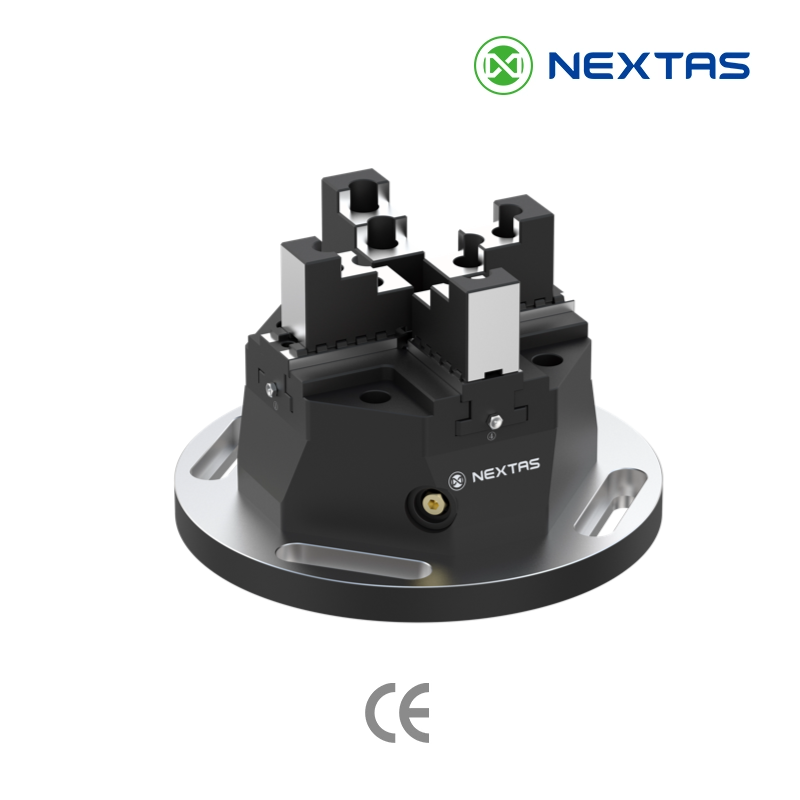
For irregular, asymmetric or round parts, the floating jaws adapt to four contact areas through coordinated X-then-Y movement. The resulting clamping center depends on the workpiece geometry and contact points; measure the required machining datum before cutting.
Compared with the two-jaw self-centering vise, the right call for prismatic blanks, this four-jaw floating chuck is built for shapes a parallel-jaw vise can't reference: castings, forgings, housings, and turned parts that need centering in both X and Y.
Best fit
Use it when the part has no parallel faces to clamp on
Castings, forgings, housings, and round or asymmetric parts that would otherwise need slow dial-in on a conventional four-jaw chuck.
Compare first
Start with clamping range: 0–150 mm or 0–220 mm
P150 offers 0–150 mm and 30,000 N; P220 offers 0–220 mm and 40,000 N. Confirm permissible workpiece mass, moments and cutting loads for the complete mounting stack.
Go next
Jump to specs, how it works, or downloads
The model matrix sizes the chuck. The clamping-sequence guide shows the X/Y self-centering action step by step.
We confirm whether P150 or P220 fits your part family, and how the chuck should mount to your table, pallet, or zero-point base, before you spend time comparing tables.
Fast RFQ paths
Share a part photo or drawing and the rough outside dimensions so engineering can reply with the right model.
The RFQ form will prefill Four-Jaw Floating Chuck for a faster reply.
Send part shape, outside dimensions, weight, material, and whether the clamping surfaces are rough cast or machined.
Tell us the smallest and largest parts in the family so we can confirm 0–150 mm (P150) or 0–220 mm (P220) with margin.
Direct T-slot mounting via the fixture mounting plate, or integration with a zero-point base for fast changeovers, include your machine model.
Two body sizes cover most irregular-part work: P150 for compact parts up to 150 mm across, P220 when the family runs larger or the cuts get heavier. Both share the same floating-jaw mechanism, 20 mm clamping stroke, and 0.02 mm repeat positioning accuracy.
| Model | Item No. | Clamping force | Clamping stroke | Clamping range | Repeat accuracy | Weight |
|---|---|---|---|---|---|---|
| P150 | NT-S00P150SZ | 30,000 N | 20 mm | 0–150 mm | 0.02 mm | 21.4 kg |
| P220 | NT-S00P220SZ | 40,000 N | 20 mm | 0–220 mm | 0.02 mm | 41 kg |
The lighter 21.4 kg body suits smaller machines and parts up to 150 mm across, easier to move between tables and pallets.
0–220 mm range and 40,000 N catalog clamping force. Confirm allowable mass, center of gravity, mounting capacity and cutting moments before selecting P220.
Hardened stainless steel jaws and body, high-strength structure with an integrated lubrication system on both models.
The floating-jaw mechanism coordinates contact around irregular, complex or round workpieces. Verify the resulting center and re-clamping repeatability for the selected part and mounting.
Floating jaw positions adjust freely to parts of different sizes and shapes. One chuck covers a mixed part family, which raises fixture utilization and cuts tooling cost.
Floating jaws can distribute contact across four areas. Thin walls, uneven surfaces and cutting loads still require a clamp trial to check deformation, slipping and full contact.
One lead screw coordinates the clamping sequence. Use the approved tightening method and check support, jaw contact and workpiece position before machining.
One lead screw drives X-direction pre-clamping followed by Y-direction contact. On irregular shapes, the resulting clamping center need not equal the geometric or machining center; verify it with the agreed measurement method.
STEP 1
Turn the self-centering lead screw on the fixture body with the hex wrench. The X-direction floating jaws move inward until they locate and pre-clamp the part at the X-axis center.
STEP 2
Keep turning the same screw. The Y-direction jaws now move inward, locate the Y-axis center, and apply pre-clamping force, completing the self-centering.
STEP 3
After both axes establish contact, tighten using the approved method for the selected model. Check contact, support, workpiece position and distortion before machining.
16-second product demonstration
See how a single lead screw coordinates the X- and Y-direction jaw movement in this vertical demonstration. Use it with the three-step explanation above to confirm the motion before discussing your part.
Continue to the Selection GuideUse the model-specific installation and inspection plan to verify the complete setup. The catalog lists 0.02 mm component repeatability; service intervals and achievable performance depend on the application.
It is a self-centering workholding chuck with four floating jaws that adapt to the workpiece shape. It suits shops machining irregular, asymmetric, or round parts, castings, forgings, housings, where manual dial-in on a conventional four-jaw chuck is the slowest step of every setup.
A single lead screw drives the floating jaws in X and Y. X-direction jaws pre-clamp first, then the Y-direction jaws establish contact. Tighten according to the selected model procedure and verify the resulting clamping center; an irregular outline does not automatically place its geometric or machining datum at that center.
Two catalog models: P150 (NT-S00P150SZ) with 30,000 N clamping force, 0–150 mm clamping range, and 21.4 kg weight; and P220 (NT-S00P220SZ) with 40,000 N, 0–220 mm, and 41 kg. Both have a 20 mm clamping stroke and 0.02 mm repeat positioning accuracy.
The catalog lists 0.02 mm repeat positioning accuracy for P150 and P220. Installed results depend on part geometry, jaw contact, tightening method, cleanliness, mounting and measurement method. Verify the agreed acceptance criteria on the intended workpiece.
Floating jaws can spread contact around an irregular part, but they do not guarantee zero deformation, slipping or incomplete contact. Validate the wall thickness, material, supports, jaw geometry, clamping force and intended cut on a representative part.
Confirm the base plate, bolt pattern, locating features, stack height, table capacity and load case against the approved drawing. A zero-point interface may support transfer between machines, but changeover time and centerline shift must be measured on the complete assembly.
The catalog lists hardened stainless-steel construction and integrated lubrication. Clean, inspect and lubricate according to the selected model manual and duty cycle, and measure repeatability periodically. No fixed service life or number of cycles is guaranteed.
Tell us the P150 or P220 model, the mounting face, quantity, and whether you need a 2D jaw drawing or a 3D body for the irregular outline. We say which files we can send, and when the chuck ships, in the quotation after that review.
Fast quote
Name, work email, and a note on the casting or odd shape are enough to open the quote. We'll say whether P150 or P220 fits, and what it costs, after we see the outline.