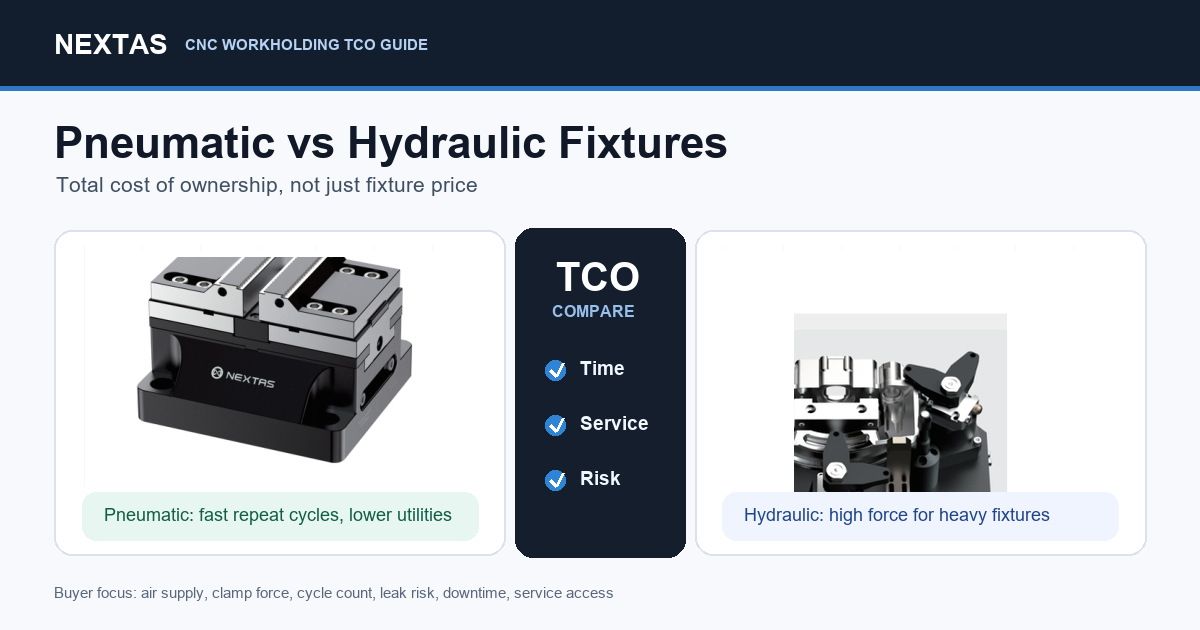
A pneumatic fixture and a hydraulic fixture may both look like automation upgrades on a quote sheet. In production, they behave like two different cost models. Pneumatic workholding usually wins on simplicity, cycle speed and lower utility burden. Hydraulic workholding wins when the part needs higher force, more clamp points, or a fixture stiff enough to survive heavy cutting without movement.
That is why the right question is not, "Which fixture is cheaper?" The better question is, "Which fixture has the lower total cost of ownership for this part family, machine and production plan?" A buyer who only compares fixture price can miss the larger costs: air preparation, pump units, leak troubleshooting, operator time, scrap, downtime, spare seals, engineering changes and whether the fixture will still fit an automation plan two years from now.
This guide compares pneumatic vs hydraulic fixtures TCO from a CNC buyer's perspective. It is intentionally different from a general fixture selection guide. If you have not yet screened the part load, support, utilities and control states, start with the manual, pneumatic or hydraulic technical selection guide. Use the cost model below only after air and oil are both technically workable routes.
Quick answer: where each fixture usually wins
Use pneumatic workholding when the part is moderate in size, clamp force requirements are reasonable, the machine already has clean compressed air, and speed or repeatability is the main reason for upgrading. A pneumatic vise for CNC machining is often the practical route for high-mix cells, light automation, soft-jaw work and repeatable clamping without adding hydraulic power units.
Use hydraulic workholding when the fixture must hold heavy parts, aggressive cuts, multiple clamp points, large castings, engine components, or any workpiece where movement under load would be far more expensive than the fixture. A customized hydraulic fixture is not bought because it is simple. It is bought because the process needs force, rigidity and controlled clamping sequence.
| Cost factor | Pneumatic fixture | Hydraulic fixture | Buyer note |
|---|---|---|---|
| Initial fixture cost | Usually lower for moderate force | Usually higher because of cylinders, circuits and custom design | Compare complete system price, not only the fixture body |
| Utility cost | Uses plant air; needs dry, stable pressure | Needs hydraulic pressure source, oil management and fittings | Existing utilities can change the decision |
| Cycle time | Fast actuation for simple clamp and unclamp cycles | Can be fast, but sequence and pressure build matter | Measure real part loading, not actuator speed alone |
| Maintenance | Air leaks, seals, filters and lubrication discipline | Oil leaks, seals, pumps, hoses, valves and contamination | Service access is part of TCO |
| Scrap risk | Risk rises if force is marginal for the cut | Lower risk on heavy cuts when fixture is correctly designed | Under-specification is often the most expensive option |
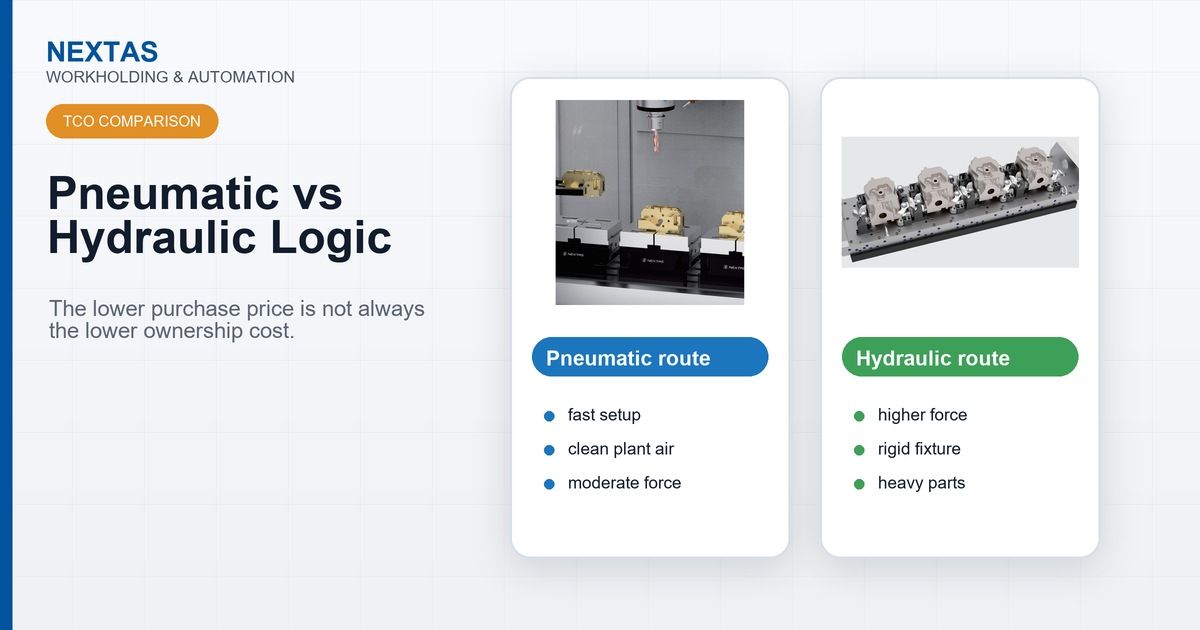
1. Initial fixture price: compare the full bill of materials
Pneumatic fixtures often look more attractive at the purchase stage. The actuation hardware is simpler, many shops already have compressed air, and standard pneumatic vises can be specified without a fully custom hydraulic circuit. For a job shop that wants faster repeat cycles, cleaner operator handling and consistent clamping force, that lower entry cost matters.
Hydraulic fixtures usually start higher because the quote may include custom base plates, cylinders, valves, manifolds, hoses, gauges, pressure switches, guarding, mounting interfaces and design time. If the fixture is built for a specific engine block, casting, gearbox housing or structural component, the custom engineering is not optional. It is the reason the fixture works.
The mistake is comparing a standard pneumatic vise against only the metal body of a hydraulic fixture. Ask suppliers to quote the working package: fixture, actuation, sensors, spare seals, recommended utilities, installation support and acceptance checks. That is the number that belongs in the TCO model.
2. Utilities: air looks simple until pressure quality is ignored
Pneumatic systems are attractive because compressed air is already available in most CNC shops. The hidden condition is air quality. Wet air, unstable pressure or undersized lines can create inconsistent clamping, slow release, sticky valves and premature seal wear. If a pneumatic fixture is installed on a long branch line with poor filtration, its low purchase price can be eaten by small stoppages and inconsistent operation.
Hydraulic fixtures need a pressure source and oil management. That can be a dedicated power unit, machine-integrated hydraulics, or a designed circuit in a production cell. The utility burden is higher, but hydraulic pressure gives compact force density. When a part needs several strong clamps in a controlled sequence, hydraulics can simplify the mechanical design even if the utility package is more complex.
For RFQ comparison, tell the supplier what utilities are already present: air pressure and flow, hydraulic availability, whether the machine has spare M-codes, and whether the fixture must run inside a robot cell. The utility answer can move the TCO more than a small price difference.
3. Cycle time: count loading time, not actuator time
Many buyers compare only clamp and unclamp speed. That is too narrow. Total cycle time includes opening the fixture, clearing chips, placing the part, confirming location, closing clamps, checking status, machining, unloading and any operator correction. Pneumatic fixtures often perform well here because the action is fast and simple. For repeated manual loading, the operator experience can be excellent.
Hydraulic fixtures can also cycle quickly, but complex fixtures may include clamp sequencing, pressure confirmation and additional safety checks. That extra logic is not automatically bad. If it prevents a heavy casting from lifting during a roughing cut, it is cheaper than a fast cycle that produces scrap. The value of hydraulic speed depends on whether the clamp sequence protects the process.
When comparing quotes, ask for a realistic fixture cycle estimate and define what it includes. A good supplier should be comfortable discussing part loading, chip escape, clamp access, sensor feedback and whether the fixture supports the target takt time.
4. Maintenance: the cheapest fixture is the one your team can service
Pneumatic maintenance is usually lighter, but it is not zero. Filters need attention, seals wear, fittings leak, valves stick and poor air quality causes avoidable problems. The advantage is that many maintenance teams understand pneumatic systems, spare parts are familiar, and troubleshooting can be straightforward if the fixture is designed with accessible fittings.
Hydraulic maintenance is more demanding. Oil cleanliness, seal condition, hose routing, leak points, pressure stability and valve function all matter. A hydraulic fixture that hides service points under the workpiece or requires excessive disassembly will cost more every time a seal fails. A well-designed hydraulic fixture should expose common service points and ship with a clear circuit diagram.
Ask every supplier the same maintenance questions: Which seals are wear items? What spare kit should be kept on site? How long does replacement take? Are fittings standard? Can the operator see pressure status? Is there a documented leak test? The answers tell you whether the fixture was designed for production or only for the first acceptance run.
5. Scrap risk and rigidity: under-powered clamping is expensive
The biggest TCO error is buying too little clamping system for the cut. A pneumatic fixture that is perfect for aluminum parts, light milling or high-mix soft-jaw work may not be the right choice for heavy interrupted cuts, large castings or parts with unstable geometry. If the workpiece moves, the cost shows up as scrap, rework, tool wear, machine downtime and lost confidence in the process.
Hydraulic fixtures earn their premium when they reduce that risk. Higher force, multiple clamp points and controlled sequencing can keep a difficult workpiece stable through roughing and finishing. The fixture may cost more, but the avoided scrap can justify it quickly if the part is expensive or the tolerance stack is tight.
This is why clamp force should not be guessed. Share part material, weight, operation type, tool engagement, tolerance target and current failure mode. If you already know the part lifts, chatters or shifts in a manual fixture, say so. That context helps the supplier avoid quoting a cheaper fixture that will fail in production.
6. Automation fit: pneumatic is flexible, hydraulic is powerful
For robot loading, pallet pools and repeatable production cells, pneumatic fixtures are often easy to integrate. They can be linked to machine logic, provide clamp and unclamp signals, and work well when the fixture is compact. A pneumatic vise on a zero-point clamping system can give a shop a practical route toward standardized, repeatable changeovers without a full custom hydraulic project.
Hydraulic fixtures fit automation when the workpiece demands it. Large components, multi-point clamping and high-force applications can be automated, but the project needs careful routing, safe pressure confirmation and clear service planning. Hydraulic automation is less about a simple actuator and more about a controlled production process.
The TCO question is therefore not "Which one is more automation-ready?" It is "Which one can run unattended without creating avoidable risk?" Pneumatic may win for flexible mixed work. Hydraulic may win for a dedicated heavy part that must be held the same way every cycle.
A simple TCO model for fixture buyers
Use this model before approving a fixture quote:
- Hardware and integration: fixture, actuation, sensors, utilities, installation and acceptance.
- Cycle savings: minutes saved per part or setup multiplied by annual volume.
- Quality impact: scrap reduction, rework reduction and improved repeatability.
- Maintenance cost: service hours, wear parts, leaks, filters, oil, seals and downtime.
- Flexibility value: whether the fixture can support future part variants, jaws, pallets or automation.
If pneumatic saves enough time and holds the part safely, its lower system cost often produces the better ROI. If hydraulic prevents part movement, tool damage or recurring scrap on a high-value component, the higher initial price may be the cheaper lifetime choice.

RFQ checklist: what to send for a real TCO comparison
To compare pneumatic and hydraulic options properly, send the supplier more than a part name. Include the part drawing and STEP file, material, weight, contact surfaces, annual volume, current setup time, cycle target, machine model, table size, available air pressure, hydraulic availability, tolerance target, cutting operation, chip and coolant conditions, automation plan and preferred delivery date.
If you want a cost comparison, say so directly: "Please quote a pneumatic option and a hydraulic option if both are technically suitable, and note the maintenance and utility assumptions." This tells the supplier not to force a single answer too early.
NEXTAS can review CAD/STEP files, fixture concept sketches and production goals before recommending pneumatic, hydraulic or a hybrid route. For many projects, the best answer is not the most expensive fixture. It is the fixture that protects tolerance, keeps the operator moving and can be maintained without turning every small leak into a production stop.
Before you approve a fixture quote
- Confirm required clamp force and whether it is calculated or assumed.
- Check whether utilities, sensors and spare wear parts are included.
- Ask how the fixture will be cleaned, inspected and serviced.
- Confirm acceptance criteria: repeatability, leak test, pressure test and sample-part result.
- Ask whether the design leaves room for future jaws, part variants or automation.
Bottom line
Pneumatic fixtures usually deliver the lower TCO when the job needs fast repeat clamping, moderate force, clean integration and flexible production. Hydraulic fixtures usually deliver the lower TCO when the job needs high force, stable multi-point clamping and protection against expensive movement under load.
Do not buy the actuator. Buy the process result. If the fixture cuts setup time, holds tolerance, avoids scrap and can be serviced by your team, it is the cheaper fixture over its life even when the initial quote is not the lowest.
Need a pneumatic vs hydraulic fixture quote?
Send the CAD/STEP file, workpiece weight, operation, volume and utility details. NEXTAS engineering can compare pneumatic and hydraulic fixture routes against cost, force, service and automation fit.
Request Engineering ReviewFrequently Asked Questions
Are pneumatic fixtures cheaper than hydraulic fixtures?
Pneumatic fixtures usually have a lower system cost when the workpiece is moderate in size, the required clamp force is modest, and clean shop air is already available. Hydraulic fixtures cost more to design, build and maintain, but they can be the better value for heavy parts, high cutting loads, multi-point clamping and applications where lost rigidity would create scrap or downtime.
When should I choose a hydraulic fixture instead of a pneumatic fixture?
Choose hydraulic when the part is heavy, cutting forces are high, the fixture needs several synchronized clamps, or the process cannot tolerate part movement under load. Automotive, energy and large casting work often justify hydraulic power because stable clamping protects tool life, tolerance and operator safety.
What hidden costs should I compare before buying?
Compare utilities, air or oil preparation, cycle time, leak troubleshooting, seal replacement, spare parts, machine downtime, operator handling, scrap risk and the engineering time needed to support the fixture. The cheapest fixture body can become expensive if it is slow to actuate, difficult to service or under-powered for the cut.
Can pneumatic and hydraulic fixtures be used in the same shop standard?
Yes. Many plants standardize pneumatic vises or fixtures for flexible machining cells and reserve hydraulic fixtures for heavy, repeatable, high-force work. The important point is to keep common locating datums, documentation and acceptance checks so operators are not managing two unrelated systems.
What information should I send for a TCO-based fixture quote?
Send the part drawing or STEP file, material, weight, cutting operation, annual volume, current setup time, target cycle time, machine model, available air or hydraulic utilities, required clamp force if known, tolerance targets, automation plans and any maintenance constraints. Those inputs let the supplier quote the fixture and the operating risk, not only the metal.