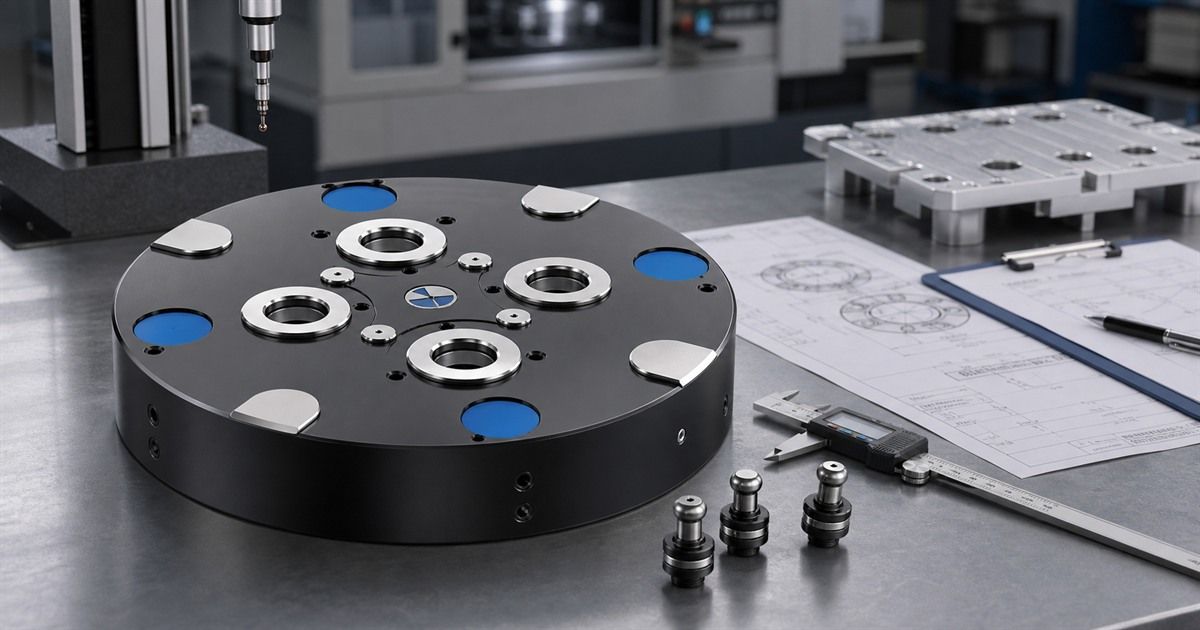
Supplier checklist snapshot
Choosing a zero-point clamping system supplier is not the same as buying a standard vise from a catalog. The receiver module, pull stud, pallet, adapter plate, air routing and inspection method all become part of your machine datum. A low price can look attractive on the first quote, but it becomes expensive if the plate does not seat cleanly, the stud interface is unclear, or your automation integrator has to redesign around missing details.
Use this guide when you already know that zero-point workholding is the direction and you are comparing suppliers. The goal is to separate a supplier who can support a real CNC installation from a seller who only lists product photos and generic repeatability claims.
| Checklist area | What a strong supplier can show | Why it matters before you order |
|---|---|---|
| Repeatability proof | Inspection method, sample report, datum check process and stated test condition. | Repeatability without a test setup is only a claim. You need to know how it was measured. |
| Interface engineering | Receiver size, pull-stud drawing, pallet thickness, grid pattern and mounting layout. | The interface determines whether your existing fixtures can be reused safely. |
| Application review | Questions about machine model, table size, part load, cutting load, coolant and chip flow. | Good suppliers prevent misapplication instead of quoting the closest catalog part. |
| Documentation | CAD/STEP, 2D drawings, inspection report, material certificate and maintenance guidance. | Your engineering, purchasing and QA teams need evidence, not just a product name. |
| Integration support | Advice on air routing, sensor feedback, robot loading clearance and subplate design. | Zero-point systems often become automation infrastructure, not just a fixture accessory. |
| Commercial clarity | Separated pricing for modules, pull studs, plates, custom machining, inspection and freight. | Line-item clarity makes competing quotes easier to compare. |
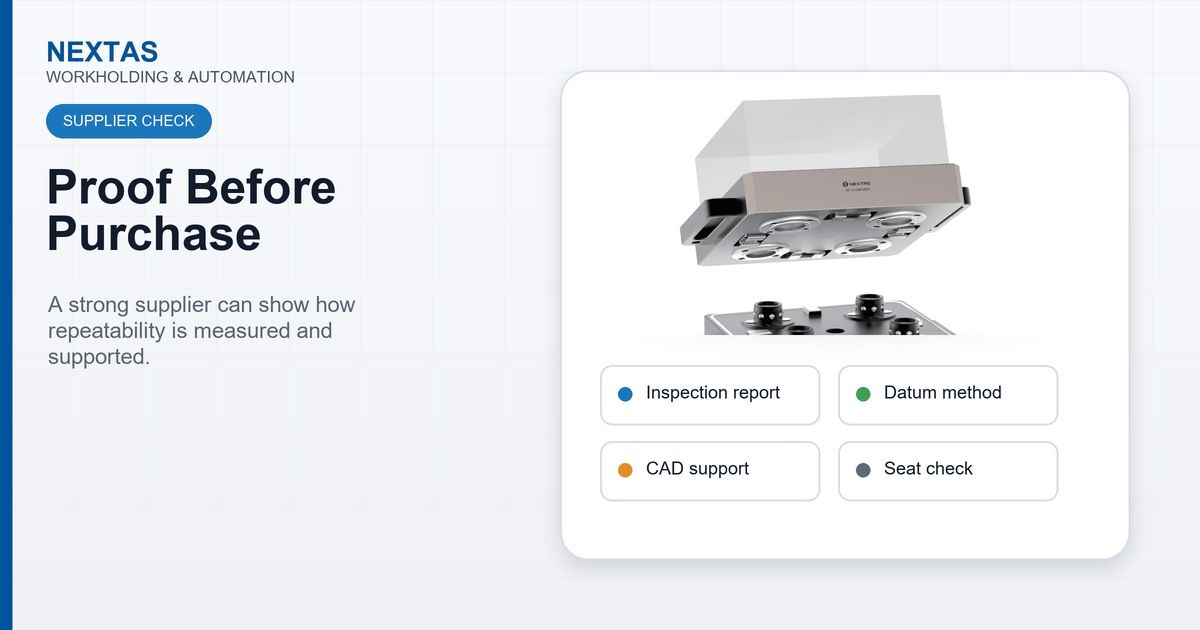
Start with the interface, not the catalog photo
The first supplier test is simple: do they ask about the interface before they quote? A zero-point system works because every component in the stack returns to the same datum. That stack may include the machine table, base plate, receiver module, pull stud, pallet, vise, custom fixture and part nest. If one layer is assumed incorrectly, the whole installation can lose accuracy or become difficult to maintain.
For a modular setup, ask the supplier to identify the receiver family, module diameter, locating geometry, pull-stud style, unlocking pressure and recommended mounting method. For a plate-based setup, ask whether the supplier is quoting a finished zero-point clamping plate, loose receiver modules for your own subplate, or a hybrid adapter plate. These are different projects even when the product photos look similar.
On NEXTAS zero-point projects, the early choice is usually between loose receiver modules for a custom subplate, a finished zero-point system layout, or a quick-change plate for vises and pallets. A supplier should be comfortable explaining which layer is the buying decision. If they cannot explain the difference between a receiver module and a finished fixture plate, slow down before you place the order.
Verify repeatability claims with test conditions
Most zero-point suppliers publish a repeatability number. The number is useful only when the test condition is clear. Ask how the value was measured, how many clamp/unclamp cycles were checked, whether the measurement was taken at the receiver, at the pallet, or at a part datum, and whether the system was clean, lubricated and loaded.
For a buyer, the practical question is not only whether the system can repeat under ideal inspection conditions. You need to know whether it can keep seating after coolant, chips, operator handling and fixture weight enter the process. Ask about surface hardening, sealing, chip protection, air blow or cleaning options, and the inspection steps used before shipment.
A serious supplier should also be willing to explain the difference between positioning repeatability and machining accuracy. A receiver can return a pallet to a tight datum, but the finished part still depends on fixture rigidity, part support, tool load, thermal condition and how the part is clamped. Suppliers who promise that a zero-point system alone will solve every tolerance problem are creating risk for your engineering team.
Look for application engineering, not just fast quoting
Fast quoting is helpful, but fast quoting without technical review is not enough for a zero-point system. A good supplier asks practical questions: What machine will use the system? Is it a VMC, HMC, 5-axis table, EDM, CMM station or robot-tended cell? What is the part envelope? How heavy is the pallet plus fixture? Do you need side air inlet, bottom air inlet, manual unlocking, pneumatic release, sensor feedback or a simple manual plate?
This review protects both sides. For example, a shop may ask for the smallest receiver because it fits the table, but the cutting load and pallet height may point to a larger module. Another shop may request a multi-station plate, but chip evacuation between stations may become the real limiting factor. In automation, the air and sensor routing may matter more than the receiver count.
When you compare suppliers, look at the quality of the questions they ask. A weak supplier asks only for quantity. A stronger supplier asks for the machine table drawing, current fixture base, part family, target changeover time, cleaning method and whether the cell will be manual or automated. Those questions may add one email at the start, but they prevent expensive changes after the PO.
Ask for documentation before you need it
Documentation is where many low-cost quotes separate themselves from production-ready supply. Before ordering, ask what ships with the system and what can be provided on request. At minimum, a buyer should expect 2D drawings for mounting and interface checks, CAD or STEP models for collision review, basic operation and maintenance instructions, and a shipment inspection record.
For regulated or higher-risk production, ask for material certificates, heat-treatment information, calibration traceability for inspection equipment, and a simple statement of the measured checks performed before shipment. You may not need every document for every order, but the supplier should be able to explain what is available and how it is tied to the delivered parts.
Early drawings let your team check bolts, slots, vise pattern, robot access and spindle clearance before hardware arrives. Without them, your team absorbs the integration risk.
Compare price by system scope
Zero-point system pricing should be compared by scope, not by the first number on the quote. One supplier may quote only receiver modules. Another may include pull studs, a finished subplate, hardened locating surfaces, inspection, CAD support and packaging. A third may include custom machining, sensor-ready ports and air plumbing. Those quotes are not equivalent.
| Quote line | What to clarify | Common cost driver |
|---|---|---|
| Receiver modules | Size, quantity, locking method, release pressure and inlet direction. | Module diameter, load class, sealing and feedback options. |
| Pull studs | Stud style, shoulder geometry, quantity and spare parts. | Precision grinding, material, hardening and anti-rotation features. |
| Base or adapter plate | Plate material, thickness, grid, surface treatment and machining tolerance. | Custom drilling, grinding, hardening and inspection time. |
| Engineering support | CAD/STEP, layout recommendation, drawing review and installation guidance. | Custom layout complexity and number of design revisions. |
| Inspection package | Report format, measured points, certificate needs and pre-shipment check. | QA depth, documentation requirements and traceability level. |
| Logistics | Packaging, export documents, delivery term and spare shipment plan. | Weight, destination, urgency and import requirements. |
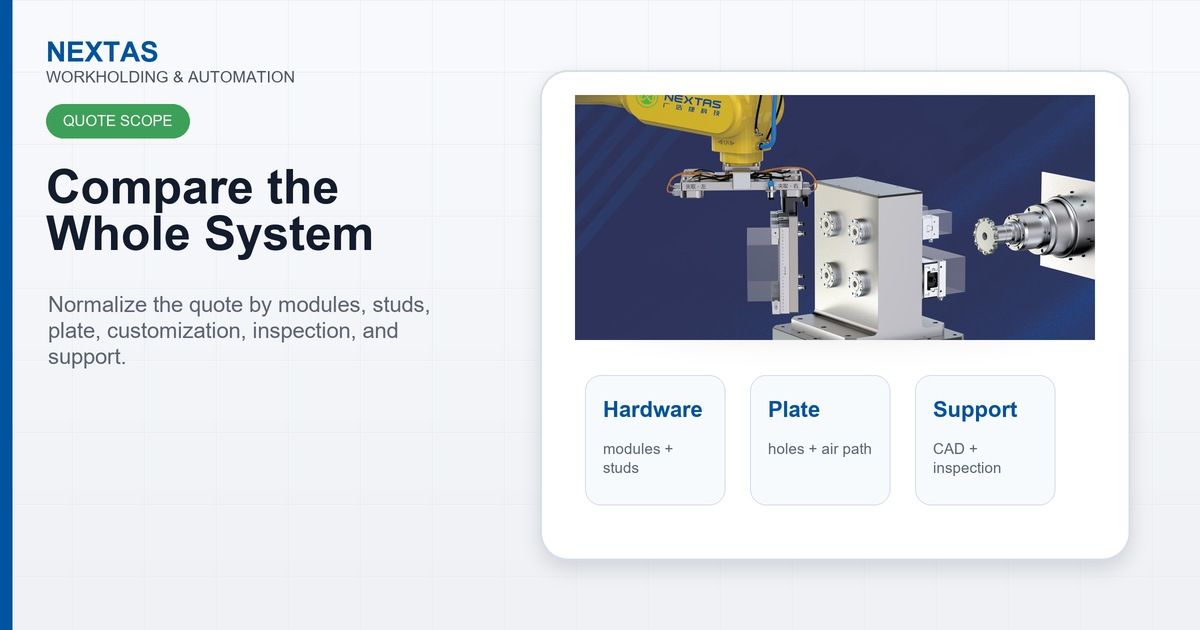
If you are building an internal purchasing comparison, use a scope-normalized table. Put every supplier into the same columns: modules, studs, plate, custom machining, inspection, CAD support, lead time and freight. This makes the decision clearer than arguing over one lump-sum number. For deeper cost planning, compare this page with the scope-based zero-point budget guide. For cross-regional bids, add the China vs European supplier landed-cost framework.
Check customization and production capacity
Many zero-point projects start as standard product requests and become custom layouts after the machine table, part family and fixture library are reviewed. A supplier should know where customization is safe and where it creates risk.
Useful customization includes hole patterns, receiver spacing, adapter plates, side-inlet layouts, sensor-ready details and pallet features that help operators load consistently. Risky customization changes precision interface geometry without a test plan.
Capacity matters too. Ask whether the supplier can support repeat orders, spare pull studs, replacement modules and future expansion. A low-volume prototype supplier may be fine for one fixture, but a production cell needs stable supply and revision control. If your first order is a pilot, say that clearly and ask how the supplier will keep the next batch consistent with the first. To test that promise with records and bottleneck math, use the workholding factory audit playbook.
Evaluate integration support for automation
If your zero-point system will feed an APC, robot cell or FMS, integration support becomes part of the product. The supplier should discuss air quality, unlocking pressure, clamp/unclamp confirmation, cable or hose routing, cleaning strategy, manual override and safe failure behavior. A system that works on a manual bench can still be awkward in automation if the robot cannot access the pallet, chips collect on the seating face, or the controller has no confirmation signal.
Ask for CAD models early so your integrator can check reach, clearance and collision envelopes. Also ask whether sensor feedback is available or whether the mechanical layout can accept sensors later. Even if you start manually, planning for feedback ports, air routing and pallet orientation can make future automation cheaper.
For buyer teams, a good test question is: What would you need from us to recommend the receiver layout for a robot-tended cell? A capable supplier will ask for machine model, table drawing, pallet size, robot approach direction, load weight, air supply, chip/coolant condition and expected changeover sequence. A weak supplier will only repeat the catalog repeatability number.
Red flags when comparing suppliers
- No interface drawing: The supplier cannot provide mounting dimensions, pull-stud data or CAD/STEP models before order confirmation.
- Vague repeatability claim: The quote lists a number but cannot explain test location, method or condition.
- One-size-fits-all recommendation: The same module is recommended for every table, pallet weight and cutting condition.
- No inspection evidence: The supplier cannot provide a sample report or explain what is checked before shipment.
- Unclear scope: The quote does not separate modules, studs, plates, customization, inspection and freight.
- No support after shipment: There is no answer for installation questions, spare pull studs, maintenance or future expansion.
None of these red flags means the supplier is automatically wrong for every project. They mean you should slow down and ask for evidence before committing to a precision datum system.
RFQ inputs that help a supplier respond well
A supplier can only recommend the right zero-point system when the request includes enough engineering context. Before you send an RFQ, collect the machine model, table size, T-slot or hole pattern, current fixture drawings, part envelope, maximum pallet plus part weight, target changeover time, manual or automated operation, coolant/chip condition and any required inspection documents. If you already have CAD/STEP files, include them.
Also tell the supplier what decision you are making. Are you comparing suppliers for a new cell? Retrofitting existing vises? Standardizing a fixture library? Replacing slow indicating work? Preparing a robot loading project? The same hardware may be quoted differently depending on the business goal.
If you want a practical next step, send NEXTAS your part, fixture or table details through the RFQ form. Include CAD/STEP when available, plus the machine and quantity. For a broader view of why buyers use NEXTAS for workholding projects, read Why Choose NEXTAS Workholding Solutions.
Bottom line
The best zero-point clamping system supplier is not simply the lowest module price. It is the supplier who can prove the interface, explain limits, provide drawings and inspection evidence, support integration, and quote a scope your engineering and purchasing teams can compare fairly.
FAQ
What information should I ask a zero-point system supplier for first?
Ask for receiver module dimensions, pull-stud details, mounting drawings, repeatability test method, CAD or STEP files, inspection report availability and a clear quote scope. Those items tell you whether the supplier can support a real installation.
How do I compare two zero-point system supplier quotes?
Normalize the scope. Compare module quantity, pull studs, base plate or subplate, custom machining, inspection documents, CAD support, lead time, spare parts and freight separately. A lower total price may exclude items your project still needs.
Is repeatability the only important specification?
No. Repeatability is important, but fixture rigidity, pull-down force, interface geometry, chip protection, air routing, pallet weight and inspection method all affect real production performance.
Should I choose a standard zero-point plate or custom receiver layout?
Choose a standard plate when it fits your vise pattern, machine table and part family. Choose a custom receiver layout when pallet size, automation flow, existing fixtures or table constraints require a specific arrangement.
What should I send to NEXTAS for an engineering review?
Send the machine model, table drawing, part or fixture CAD/STEP, current workholding photos, target quantity, changeover goal, automation plan and any documentation requirements. That gives the engineering team enough context to recommend a safe configuration.
Need a zero-point supplier review?
Send your machine table, fixture drawing, pallet size, CAD/STEP files and target changeover goal. NEXTAS can review the interface and recommend a quote-ready zero-point layout.
Request Engineering Review →