Suppose one quotation is EXW with basic inspection, while another includes a finished adapter, local delivery, documentation and support for a validated interface. The totals are different because the scopes are different—not because a continent has won. Purchasing teams should run the same RFQ through both routes and compare product-matched quality evidence, the date the machine can actually cut, and risk-adjusted landed cost.
This is a commercial sourcing framework for zero-point systems, vises, pallets and custom fixtures. It does not assume that Chinese suppliers are automatically cheaper or that European suppliers are automatically better. It turns geography into specific questions about interface risk, engineering ownership, logistics, service and continuity.
The short answer: choose by buying case, not country
The incumbent or locally supported platform often starts with an advantage on an existing validated cell because switching can trigger adapter work, inspection correlation, software or automation changes, spare duplication and revalidation. For a new cell, neither route deserves that assumption. The better offer is the one that proves the complete kit, acceptance method, committed date and delivered scope.
| Buying case | Route that may begin with an advantage | What must be verified |
|---|---|---|
| Existing validated interface | Incumbent or genuinely local-supported platform | Exact interface, conversion/revalidation work, reserved spares |
| New standard vise or plate package | Either sourcing route | Complete kit, real stock, inspection scope, delivered date |
| Custom fixture | Factory with the strongest engineering proof | Datum plan, CTQs, design freeze, tryout and milestones |
| Automation-critical cell | Supplier/integrator with proven responsibility | I/O, sensing, FAT/SAT, spares and recovery route |
Quality: make both suppliers prove the same five gates
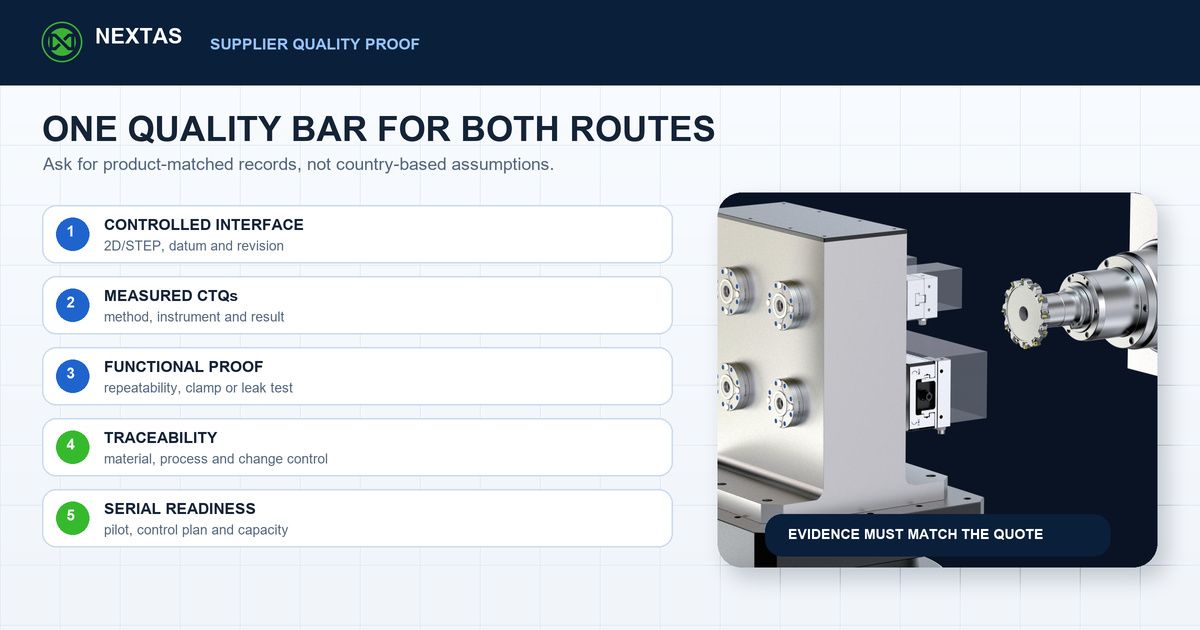
Country of origin is not quality evidence. Put both suppliers against the controlled drawing and the same acceptance plan. The first gate is the complete interface: mounting pattern, datum, pull stud or locating features, stack height, utility routing and revision. A word such as “compatible” or a catalog photo is not enough. For zero-point workholding, use the detailed selection and verification guide to define the test conditions rather than copying a repeatability number.
The second and third gates are CTQ measurement and functional proof. Every critical result should identify the characteristic, tolerance, method, instrument and result. Functional evidence may include clamp/release, pressure or leakage testing, repeated seating, or another agreed protocol appropriate to the product. Positioning repeatability is not finished-part accuracy, and a generic CMM photo is not a report for the item being quoted.
The fourth gate is traceability and controlled change: drawing revision, material or lot, special process and approved source must connect to the delivered item. The fifth is serial readiness. One good sample shows that one item can be made; a pilot, control plan and change-notice route show whether the result can be repeated. ISO 9001 can support confidence in a management system, but it does not prove a particular tolerance, lead time or capacity. For a deeper evidence review, use the workholding factory audit playbook.
Lead time: compare two clocks, not one promise
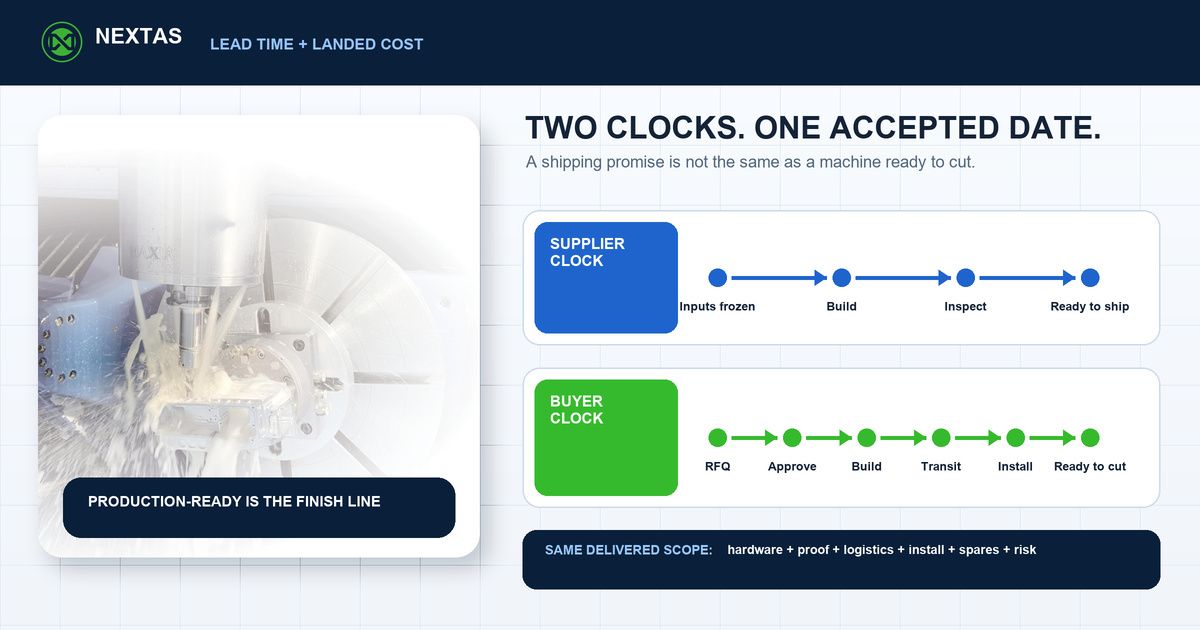
A supplier clock usually begins when complete inputs or a design freeze are received and ends at “ready to ship.” The buyer clock starts earlier and ends later: RFQ clarification, approval, build, inspection, international or regional transport, receipt, installation, acceptance and readiness to cut. The second clock is the one that production cares about.
Break every bid into the same critical path: RFQ completeness, concept and drawing approval, bought-out components, machining and special processes, inspection and packing, transport and border formalities where applicable, then local installation and acceptance. Name the customer approval days separately; an unanswered drawing review is not supplier manufacturing time. Compare a committed date at the same named delivery point, not “three weeks” in one quote and “ex stock” in another.
A European supplier has a local-stock advantage only when the exact configuration and reservation are confirmed. A China-based supplier has a speed advantage only when the actual configuration, documentation, production slot and shipping route are confirmed. Do not assign fixed lead times by country. For engineered milestones, see the custom fixture lead-time guide.
Cost: normalize landed cost and the cost of disruption
The first hardware total is not a sourcing decision. Use a common first-year basis:
Comparable first-year cost = accepted hardware + NRE/tooling + qualification documents + adapters + freight/insurance + destination charges + installation + initial spares + buyer-defined disruption allowance
Use the same quantity, configuration, currency date, delivery term and named destination. Keep taxes, duties, tariff treatment, HS classification and recoverable tax decisions with the buyer or broker for the actual destination; a universal percentage is not responsible. The disruption allowance should also come from a scenario, not a country stereotype. For example, multiply a planned qualification stop or a credible recovery delay by the buyer's own cost of downtime, then show the assumption separately.
| Cost line | China-based bid | Europe-based bid | Evidence or owner |
|---|---|---|---|
| Hardware and matched components | Record amount + BOM | Record amount + BOM | Supplier quotation |
| Engineering/NRE and adapters | Included or separate | Included or separate | Approved scope/drawing |
| FAI/CMM/functional proof | Defined deliverables | Defined deliverables | QA plan |
| Packing, freight and insurance | Named route/term | Named route/term | Supplier/forwarder |
| Destination and local delivery | Buyer/broker entry | Buyer/broker entry | Buyer/broker |
| Install, integration and acceptance | Hours + responsibility | Hours + responsibility | Integrator/buyer |
| Initial spares and wear parts | Approved spare list | Approved spare list | Supplier/buyer |
| Qualification/disruption scenario | Buyer-modeled exposure | Buyer-modeled exposure | Operations/finance |
For zero-point hardware line items, compare this ledger with the scope-based zero-point budget guide. A lower piece price can still be the better bid—but only after missing studs, subplates, inspection, freight or spares are visible.
When each sourcing route makes commercial sense
A China-based supplier deserves the shortlist when…
- The actual quotation—not a market average—shows a useful advantage in custom layout, direct engineering, complete documentation or comparable landed cost.
- The buyer can manage design approvals, cross-border milestones and a local spare or service plan.
- The quantity, repeat program or future expansion justifies qualification work.
This route is often worth testing for a planned new program where the buyer can freeze the interface and run a proper pilot. It is a poor fit if purchasing expects a low unit price to compensate for an incomplete drawing or no acceptance method.
A European supplier deserves the shortlist when…
- An existing validated platform, proprietary interface or installed automation makes conversion and revalidation material.
- The exact item is regionally stocked, or a named integrator has documented responsibility and response scope.
- A small urgent replenishment makes logistics and downtime larger than the hardware difference.
“Local” should still be verified. Ask where the configuration is stocked, how many are reserved, who can install it, which spares are held and what the service commitment covers.
A hybrid or dual-source plan makes sense when…
Continuity can justify qualifying a second source, but only after each configuration has its own approved drawing, acceptance result, revision and spare list. Dual sourcing should mean two approved configurations—not an unverified mix of precision components. Never assume receivers, studs, pallets, vises or sensors can be mixed because their families sound similar.
Use a sourcing scorecard that reflects the program
Set weights before seeing prices. A practical starting point is quality evidence 25, production-ready date 20, comparable first-year cost 20, interface/integration risk 15, service/spares 10, and capacity/change control 10. Score each bid 0–4 against written evidence and multiply by its weight. For a stopped legacy cell, spares and recovery may deserve more; for a custom fixture family, engineering and repeat production may dominate. A mandatory interface or acceptance gate should override the total score.
Run a same-scope RFQ and pilot before deciding
Send every supplier the controlled 2D drawing and STEP file, machine table and fixture stack, CTQs, the repeatability or functional acceptance method, cutting and coolant conditions, quantity and peak demand, spare requirement, required documents, allowed outsourcing, named delivery point and required production-ready date. Require a line-by-line list of assumptions, exclusions and deviations.
Use the workholding RFQ input guide when the package is incomplete, and the custom fixture supplier questions for design ownership and sampling. For a high-risk program, approve the interface first, then a prototype or FAI, repeated clamp/release or seating proof, a pilot lot and—when justified—an on-machine acceptance. Compare scale pricing only after the proposed process has passed the release gate.
Bottom line
The better workholding supplier is not defined by a passport. It is the supplier that reaches your accepted production state at the lowest defensible total cost. Normalize the RFQ, make both routes prove the same gates, and let the program—not a regional assumption—set the weights.
Compare a real program
Request an itemized NEXTAS workholding quote
Send the machine/table interface, controlled drawing or CAD/STEP, CTQs, quantity, named destination, documentation scope and required production-ready date. NEXTAS can return an engineering-reviewed scope with assumptions, exclusions and quote lines visible.
FAQ
Are Chinese workholding suppliers lower quality than European suppliers?
Country of origin does not prove product quality. Apply the same drawing revision, CTQs, measurement method, functional test, traceability and pilot acceptance criteria to every supplier, then decide from product-matched evidence.
Are European workholding suppliers always faster?
No. A regional supplier may be faster when the exact configuration is physically in stock and local integration is ready, but an unstocked or engineered item can still have a long critical path. Compare the committed production-ready date, not a general location claim.
How should I compare China and Europe workholding prices?
Use the same quantity, configuration, currency date, delivery term and named destination. Add NRE, qualification documents, adapters, packing, freight, destination charges, installation, initial spares and a buyer-defined disruption scenario before comparing totals.
Can a China-made zero-point system replace a European platform?
Only after the complete interface and operating conditions are verified and the proposed configuration passes your qualification plan. A compatible-style description is not proof of a drop-in replacement, and precision components should not be mixed without approval.
Is dual sourcing worth the qualification cost?
It can be when the value of continuity and recovery exceeds the cost of qualification, controlled drawings, spares and inventory. Dual sourcing should mean two approved, revision-controlled configurations rather than an unverified mix of receivers, studs, pallets or vises.