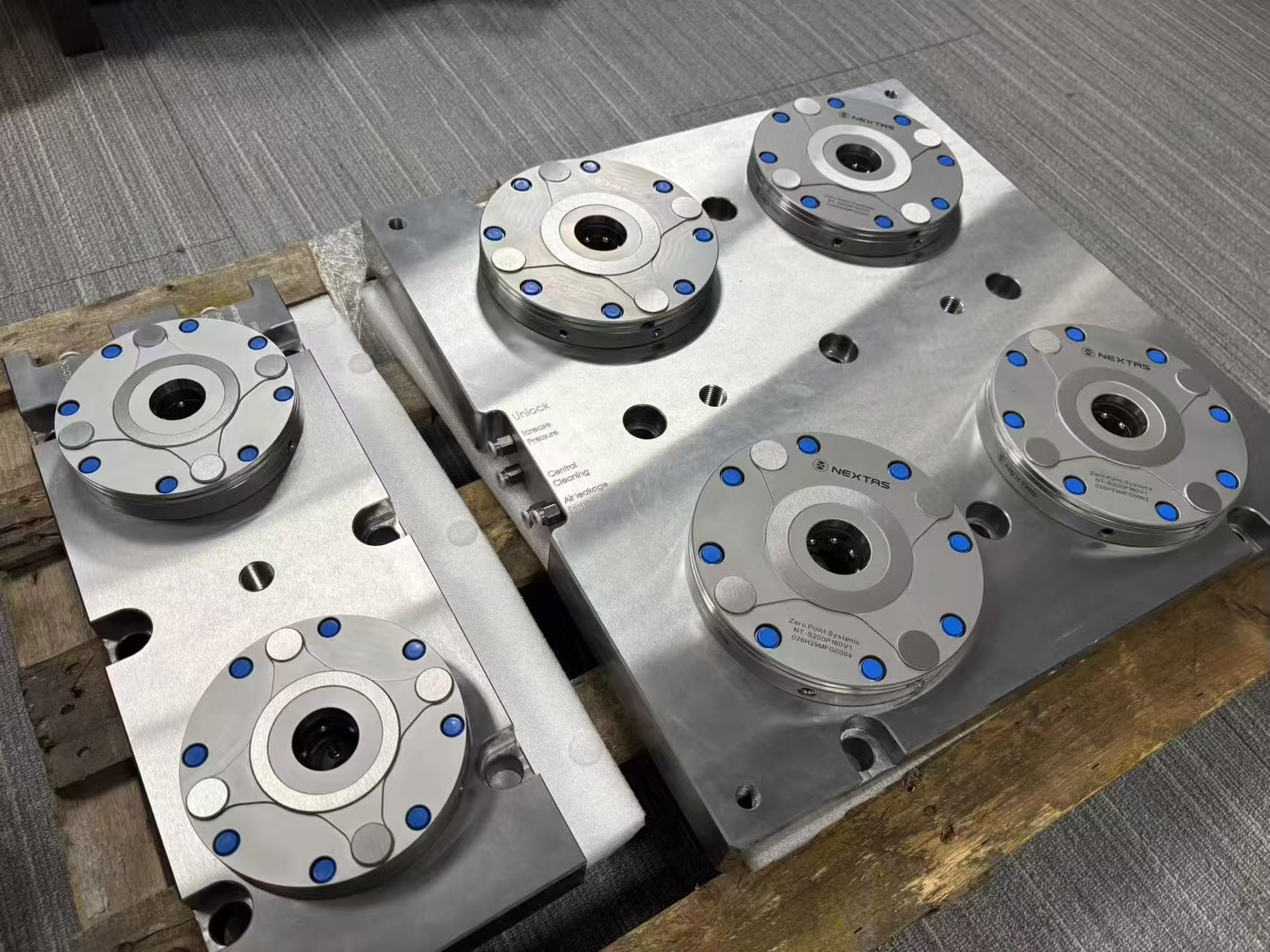
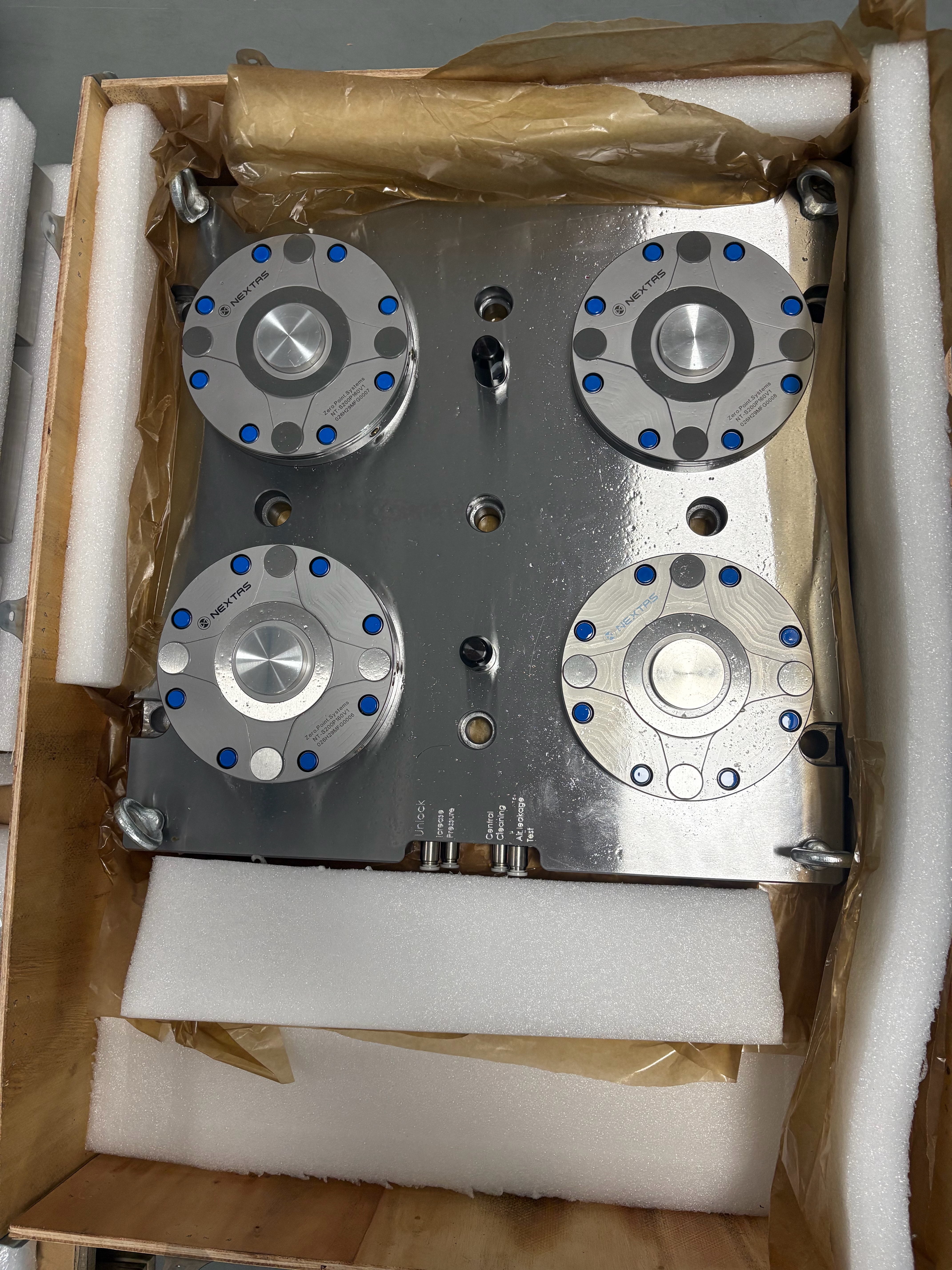
Investing in a high-performance 5-axis vertical machining center is supposed to consolidate operations and keep the spindle turning. Yet for many high-mix precision shops, the rotary trunnion table quickly becomes the biggest scheduling bottleneck on the floor.
Switching from a small, single-vise 5-axis job in the morning to a heavy, full-table mold base or structural housing in the afternoon typically requires unbolting subplates, cleaning T-slots, sweeping indicators, and re-probing work offsets. Worse yet, when clamping large-footprint fixtures strictly around the perimeter of a rotary table, heavy roughing cuts at the center of the part often induce harmonic chatter and micro-deflection.
To bridge the gap between nimble 5-axis access and heavy-duty full-table rigidity, the customer partnered with NEXTAS to engineer a custom 5-Station (4+1) Pneumatic Zero-Point Rotary Base Plate.
Engineered for the Rotary Envelope: The "4+1" Quincunx Architecture
Captured straight out of its protective export crate prior to table mounting, the NEXTAS rotary subplate showcases purpose-built engineering tailored to the kinematics of a 5-axis trunnion:
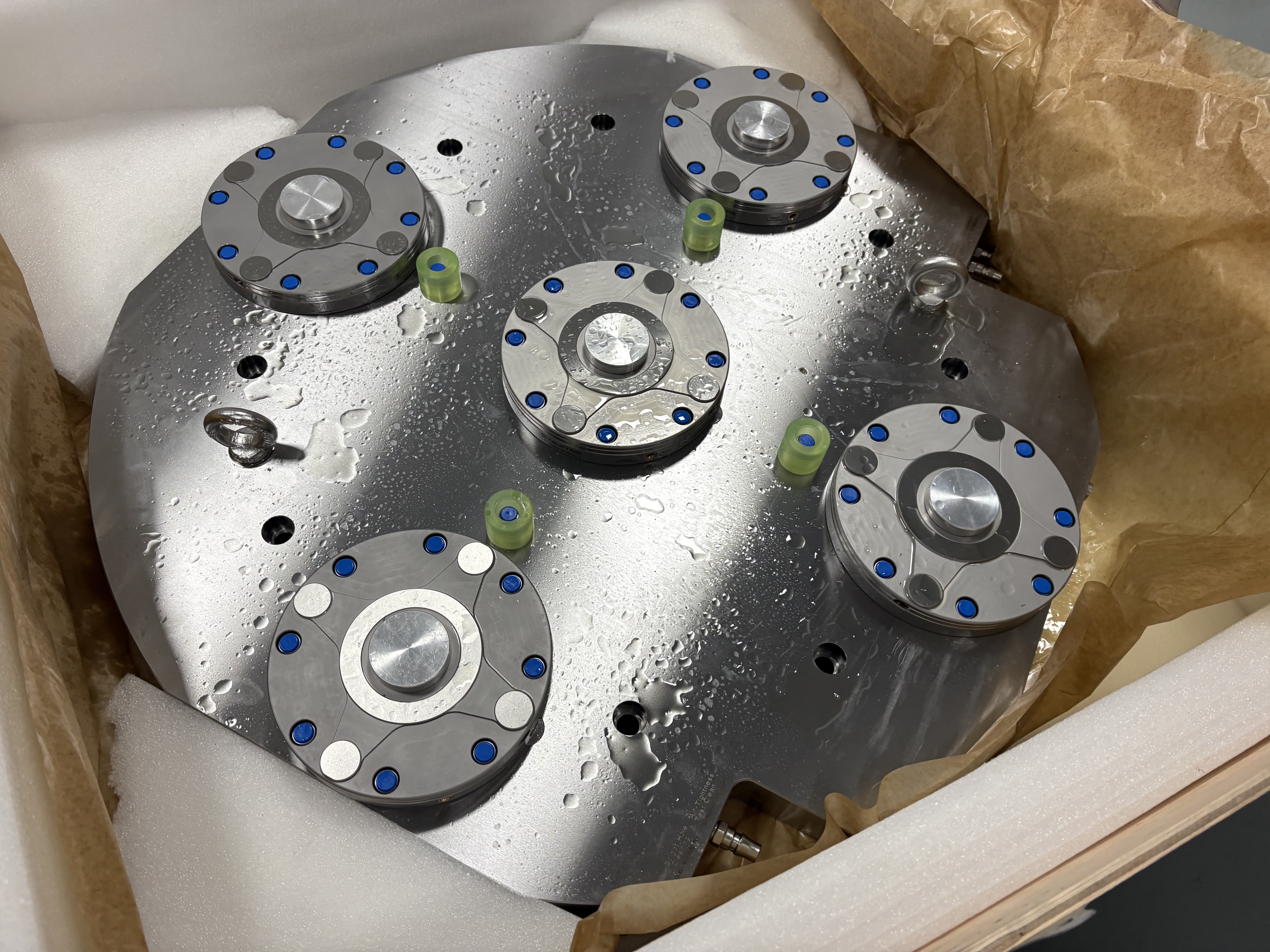
- Clearance-Optimized Chordal Flats: Rather than a standard square plate or a full-diameter disc that risks colliding with the machine enclosure during steep A/B-axis tilts, the hardened steel base features precision-milled side flats. This geometry maximizes the usable swing diameter while stripping away parasitic rotational mass on the outer edges.
- Three Clamping Modes from One Datum: The 4+1 receiver layout—four perimeter zero-point modules surrounding a dead-center fifth receiver—gives programmers total freedom:
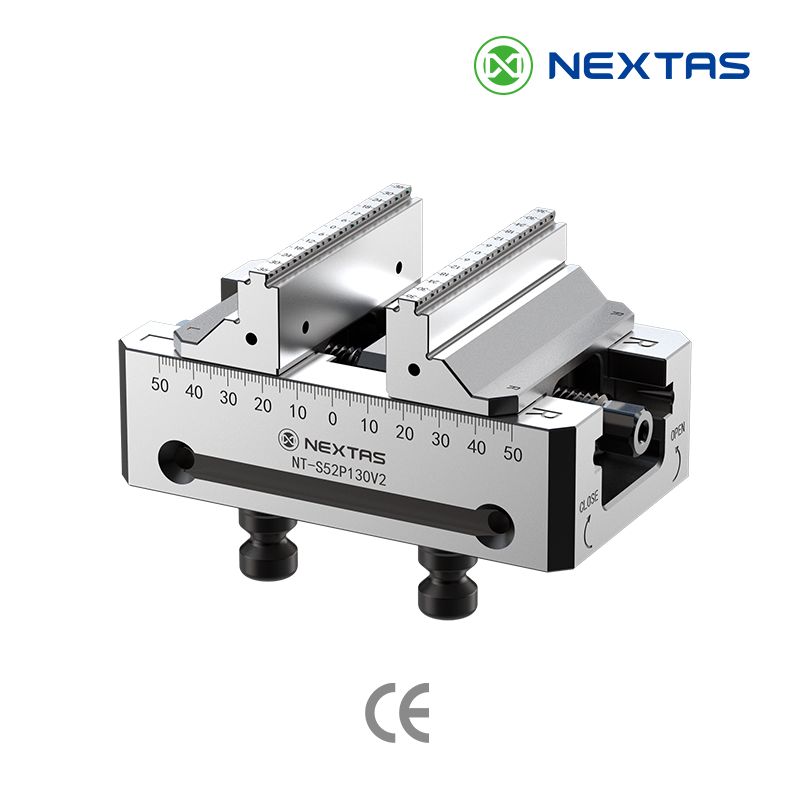
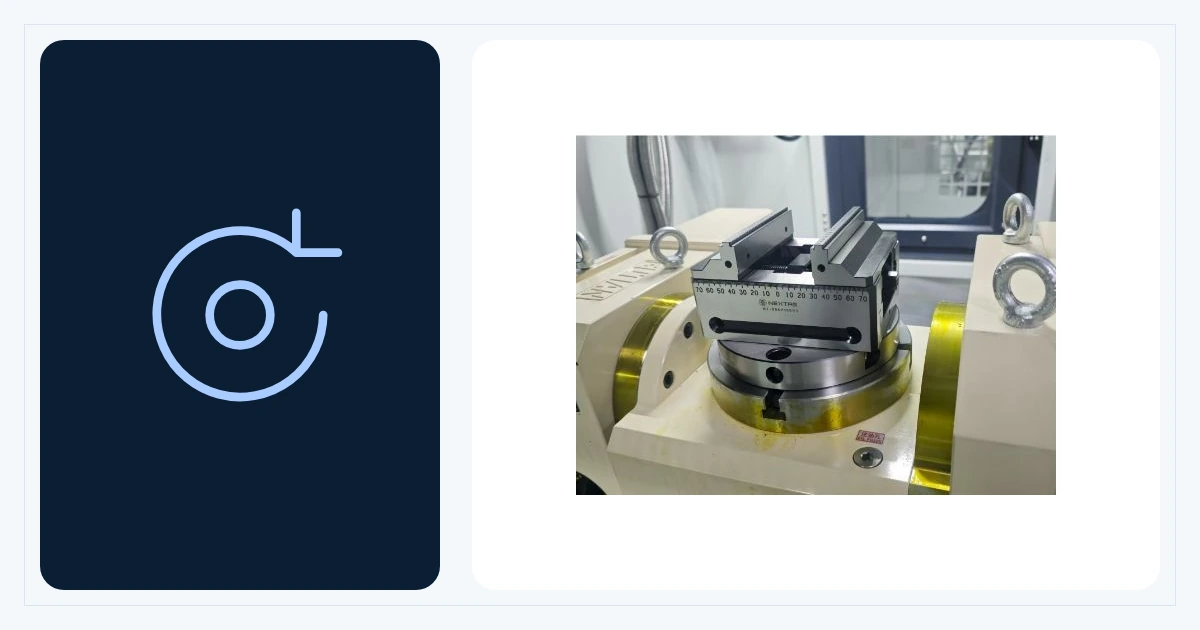
- 360° 5-Face Access: For small complex impellers or manifolds, operators mount a single NEXTAS Self-Centering Vise or riser on the center receiver, granting short-projection toolholders complete clearance around the part.
- Anti-Deflection Heavy Milling: When spanning a large pallet across the full table, the central fifth receiver pulls the middle of the fixture down with tens of thousands of Newtons of locking force—completely eliminating the "drumhead" vibration common on four-corner setups.
- Multi-Station Batching: The four outer receivers can independently hold four compact fixtures for high-density family machining.
- Crane-Safe Urethane Impact Buffers: Lowering a 500-kg mold fixture onto precision-ground zero-point tapers via an overhead hoist is always a high-risk moment. To protect the martensitic stainless steel receivers, NEXTAS integrated four high-durometer green polyurethane crash pads directly into the plate surface. During loading, the urethane bumpers absorb the initial contact weight before the pallet settles smoothly into the tapered receivers.
- Hose-Free Internal Manifolding: All five pneumatic receivers are internally plumbed through deep-drilled channels to recessed quick-disconnect air ports along the notched edge. Operators connect shop air for just a few seconds to trigger the pneumatic unlock, auto-lift, and radial air-blast chip cleaning functions. Once seated, the mechanical spring pack locks the pull studs with < 0.003 mm to < 0.005 mm repeat positioning accuracy—allowing the rotary table to spin and tilt continuously with zero trailing air hoses.
Shop Floor Impact: From Crate to Cut
Shipped with machined metal bore plugs to seal the internal locking mechanisms during transit and pre-installed hoist eyebolts for immediate table mounting, the plate went from the shipping crate onto the rotary platter in less than an hour. Today, the shop swaps between single-piece 5-axis prototyping and heavy multi-station production in under 90 seconds, pushing 5-axis spindle utilization past 85%.
One rotary datum
Send the trunnion envelope and the fixture weight
If changeover on the rotary table still starts with T-slots and an indicator sweep, send the swing envelope, the heaviest fixture the crane sets down, and which of the three modes has to share that datum: a vise on the center, a plate across the full table, or four outer stations.
Contact engineering