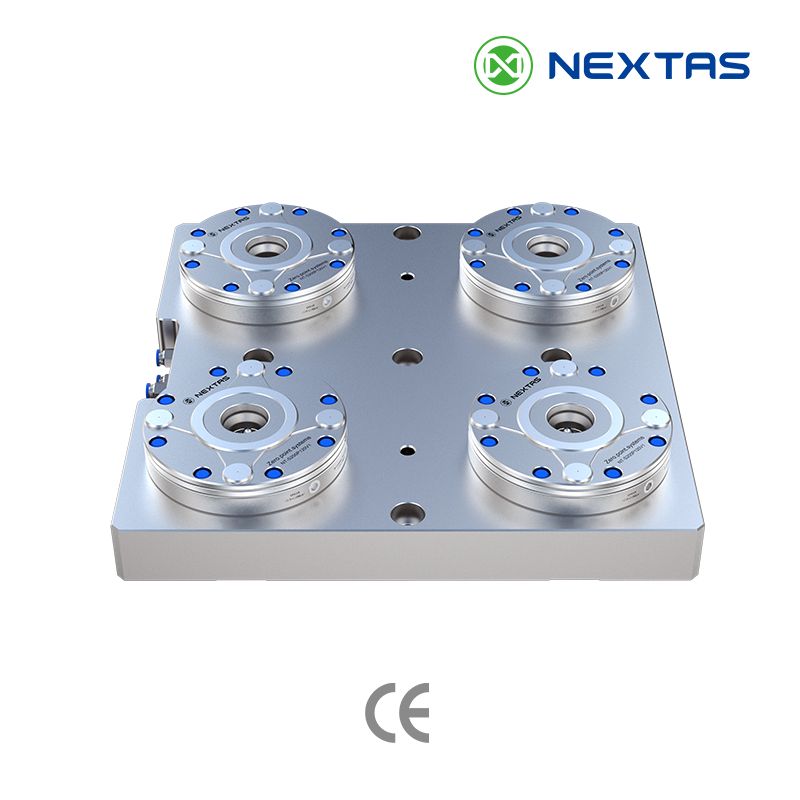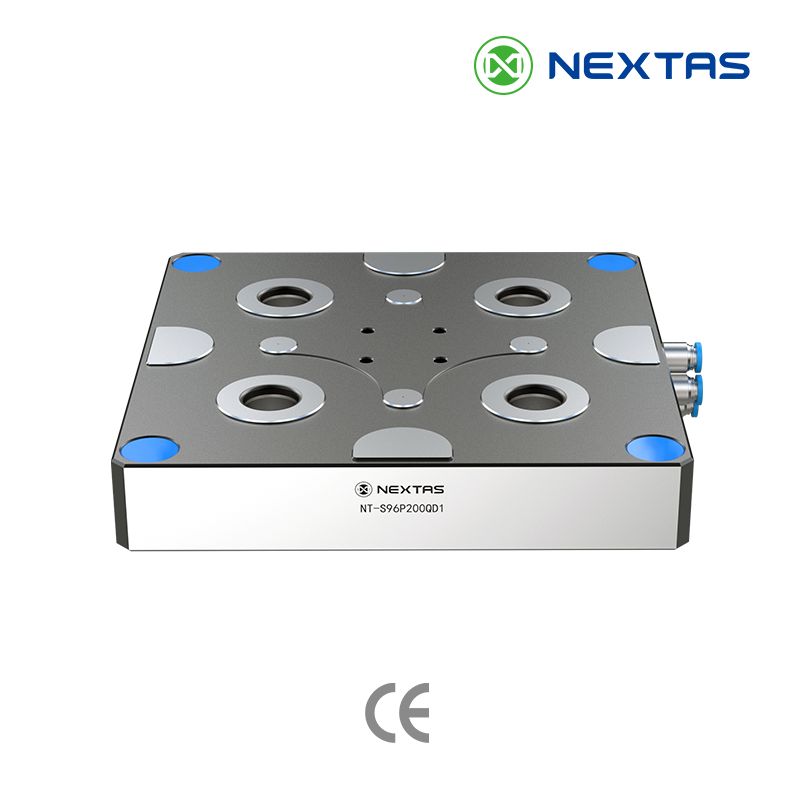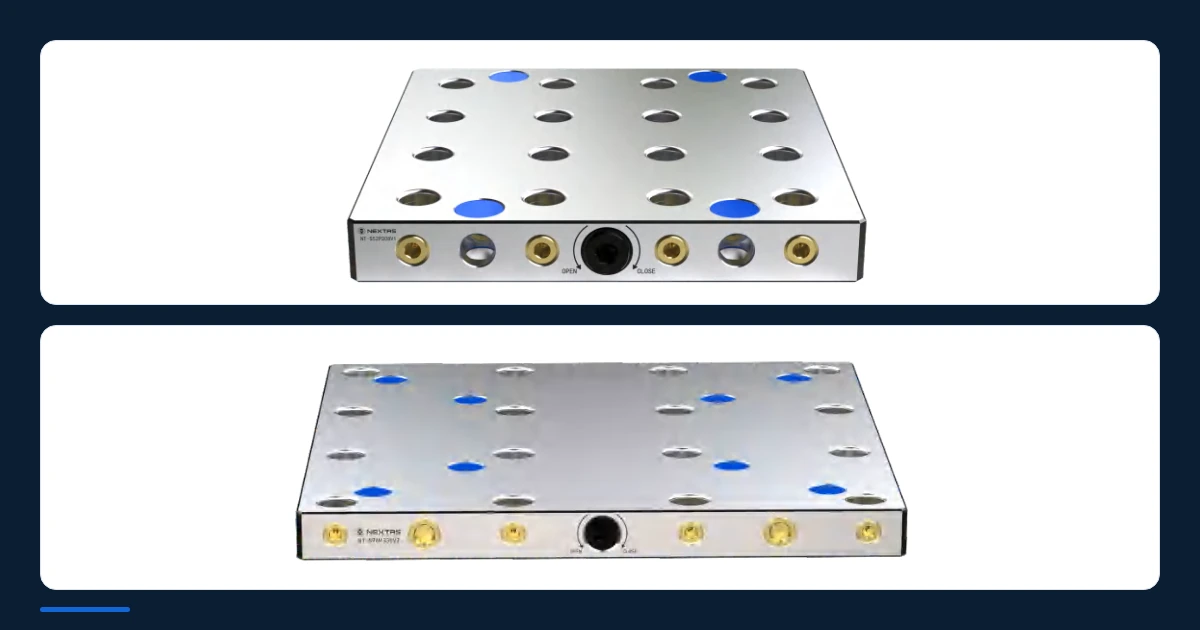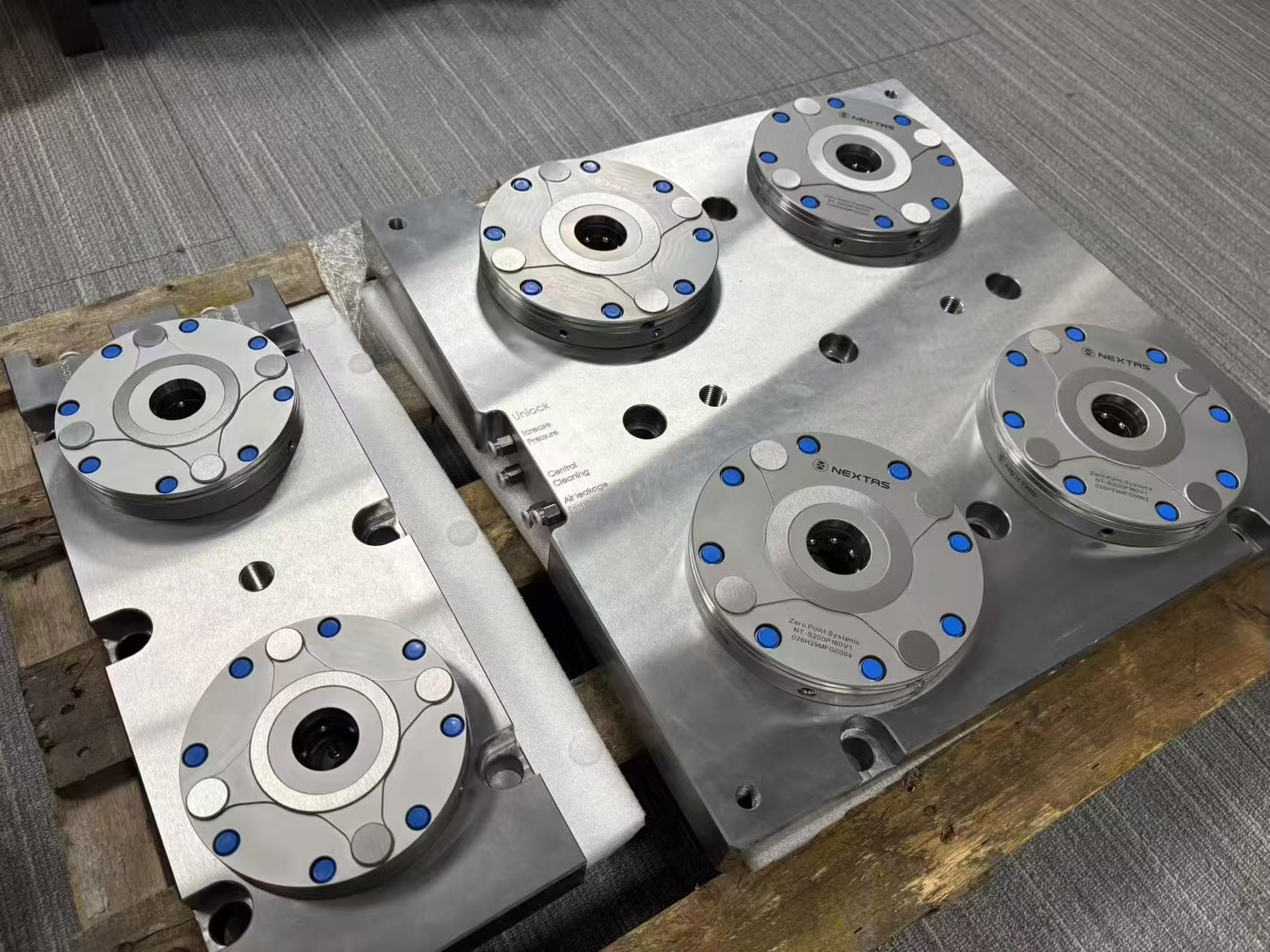
The photograph above is a shipping-pallet product photo. It was taken on a wooden pallet with foam, after an air hold test and before packing. It shows the 4-station square plate and the 2-station bar plate, with NT-3200 nameplates and side ports marked Unlock, Increase Pressure, Control Cleaning, and Air Leakage Test. It is not a photograph of cutting on the machine.
Why split one full plate into two?
When a shop adds zero-point clamping to a three-axis vertical machining center, the first sketch is often one steel plate that covers the whole table. On the drawing that plate looks tidy. On the floor it needs a crane to lift, coolant collects underneath, and the table stays locked to one hole pattern for a large part and a small part alike.
The pair in the photograph was built for an unnamed precision hydraulic valve and manifold shop. The engineering choice was a 4-station square plate plus a 2-station bar, fitted with NEXTAS NT-3200 pneumatic locators.
Changeover was 35 to 50 minutes
The shop runs a mid-size three-axis VMC with about 1,000 mm of X travel. Batches are usually 15 to 40 pieces, in aluminum and ductile-iron hydraulic housings.
Before the table had one machine-side datum, each batch took 35 to 50 minutes. The operator stripped the T-slot clamps, stoned the table, indicated the fixture plate, and picked up the origin again. The spindle stayed stopped through that work. Three or four short jobs in one shift lost nearly two hours of cutting.
A pallet pool can wait. The shop needed a rigid datum on the machine, so the next fixture can be staged offline while the spindle is still cutting, then swapped on the table. The need was a swap in about two minutes. The recorded swap is under 90 seconds.
Why a 4+2 split beat one six-station plate
Early drawings compared three ways to place six stations: loose receivers bolted to the table, one 6-station monolith, and a 4+2 split. The split stayed, for three shop reasons.
- Two people can lift the 2-station bar without a crane when the plates come off for chip cleaning, or when a very large weldment needs the T-slots for a day.
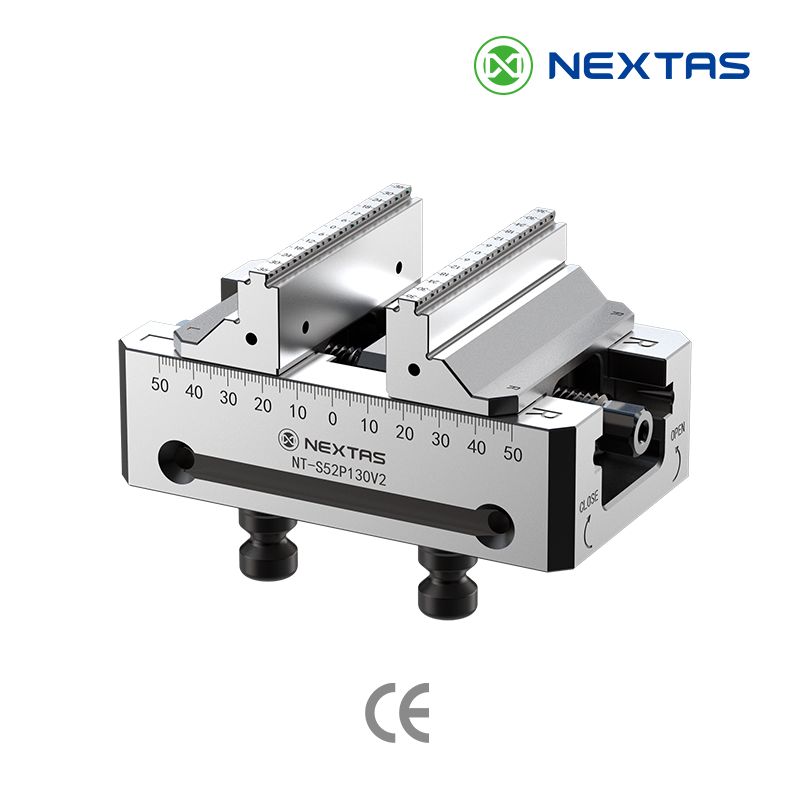
- The 4-station plate carries the heavy OP10 fixture, or a casting that needs four pull studs against twist. The 2-station bar holds a five-axis self-centering vise or the OP20 fixture. The 2-station side can change while the 4-station datum stays in place.
- The air passages are drilled inside the two plates. Six loose receivers would leave hoses on the table, where hot chips cut them.
What the four engraved ports do in a roughing cut
On the edge of the 4-station plate, the block is engraved Unlock, Increase Pressure, Control Cleaning, and Air Leakage Test.
Many entry plates offer one port or two. On a roughing VMC, especially in cast iron or a heavy aluminum cut, each of these four has a job.
- Unlock sends shop air against the disc springs, opens the lock, and lets the upper pallet or fixture come off.
- Increase Pressure is the extra pull-down. With the air off, the springs still hold the pull stud. Air at this port raises the pull-down force, which helps when a long end mill takes a full radial depth on a tall fixture.
- Control Cleaning blows from small ports around the seat as the fixture comes down, and clears coolant and chips before the pallet lands.
- Air Leakage Test reads back-pressure on the hardened seat. One small chip under the seat can throw flatness by about 0.05 mm. If the pallet sits off the seat, the leak can alarm, so the operator, or a later PLC, lifts and wipes before cycle start. The shop left this port for a future robot.
What changed after the plates were on the table
After the 4+2 pair was bolted and aligned on the VMC, the customer kept 60 days of run data before treating the job as in production. The times in the table are that shop record. The repeatability cell is the catalog figure for the receiver-module family. The field result follows the customer's production record.
The times are the customer's record. The repeatability cell is the catalog figure for the receiver-module family.
| What was measured | Before, with T-slot clamps | After, with the NEXTAS 4+2 plates |
|---|---|---|
| Changeover and clamp time | 35 to 50 minutes | Under 90 seconds |
| Indicating the fixture | Required at every changeover | Once, when the plates were first installed |
| Repeatability | It depended on the operator | < 0.003 mm for the receiver-module family in the catalog; the field result follows the customer's production record |
| How the table is split | The whole setup came off | Independent 4-station OP10 and 2-station OP20 zones |
| A later robot | No spare test port | An Air Leakage Test port is open for a robot |
When a split plate helps little
A 4+2 split is a weak fit in four situations. Measure the current loss before the plates are ordered.
- Changeovers are rare and the jobs run long, so the spindle is rarely waiting on a new origin.
- Programming, tool life, or load and unload is the limit, and rebuilding the machine datum is not.
- Fixture bottoms still lack one pull-stud pattern, so each new plate would need its own holes.
- Batches are very short and the parts are very small, so the time to install the plates and keep the air circuit up is larger than the time the split saves.
What to send before a similar plate is quoted
A catalog plate often misses the T-slot pitch or the travel limit of the machine in front of you. A similar split can start from three facts. A full 3D model of every fixture is not required to open the review.
With those facts, engineering can match the span and the ports. The related pages are the zero-point system, the pneumatic zero-point plate, and the self-centering vise when OP20 uses one. The 2026 catalog is the full PDF, not a single chapter.
- Machine model and the table drawing, including T-slot width, pitch, and the usable X and Y travel.
- The largest and the smallest fixture-plate footprint, so the locator span does not leave a heavy cut hanging past the studs.
- How the air will be controlled: a manual valve at the machine, or a solenoid later on an M-code.
Zero-point systems · Pneumatic zero-point plate · Self-centering vise · Full 2026 catalog PDF
With the quote
Send the table drawing
Attach the machine model, the T-slot pitch, the fixture footprints, and whether the air valve stays manual.
Contact engineering