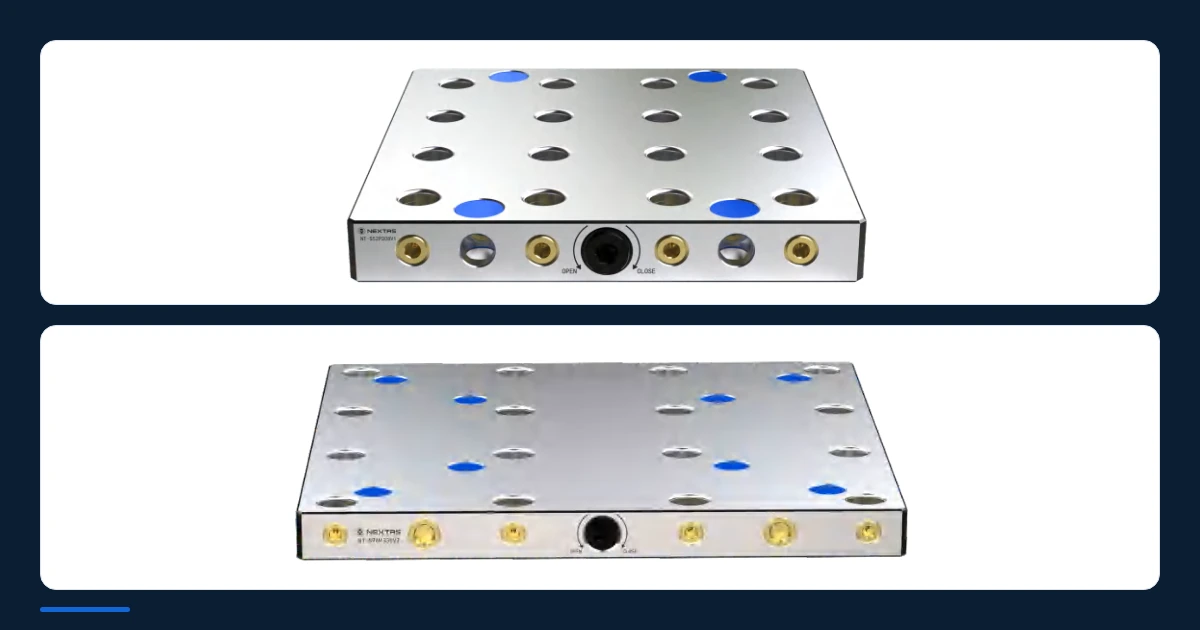
Every contract manufacturer running a medium-to-large 3-axis vertical machining center (VMC) faces a familiar table-space dilemma. On Monday, you need the entire X-axis travel to rough a heavy structural plate or die block. By Wednesday, you are running two separate operations (OP10 and OP20) on smaller cast housings that require independent fixture swaps. Bolting a massive, single-piece subplate across the entire table locks you into one footprint, while traditional T-slot clamping bleeds spindle hours every time operators indicate a new setup.
To solve this without sacrificing rigidity or table versatility, the shop partnered with NEXTAS to implement a modular 2+4 Pneumatic Zero-Point Clamping Plate system.
The Modular 2+4 Footprint: Built for Split-Table or Full-Table Runs
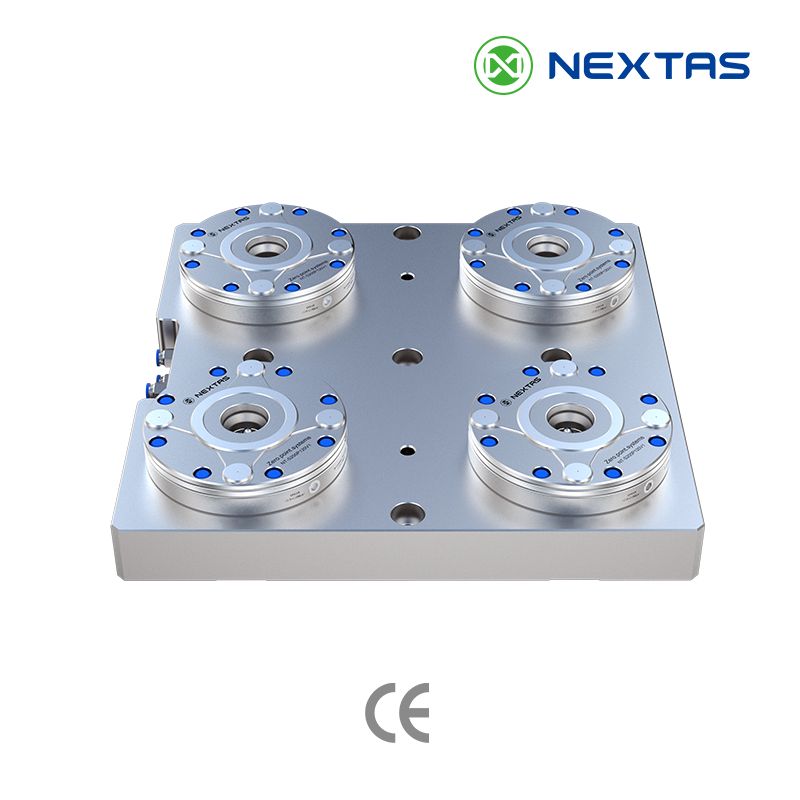
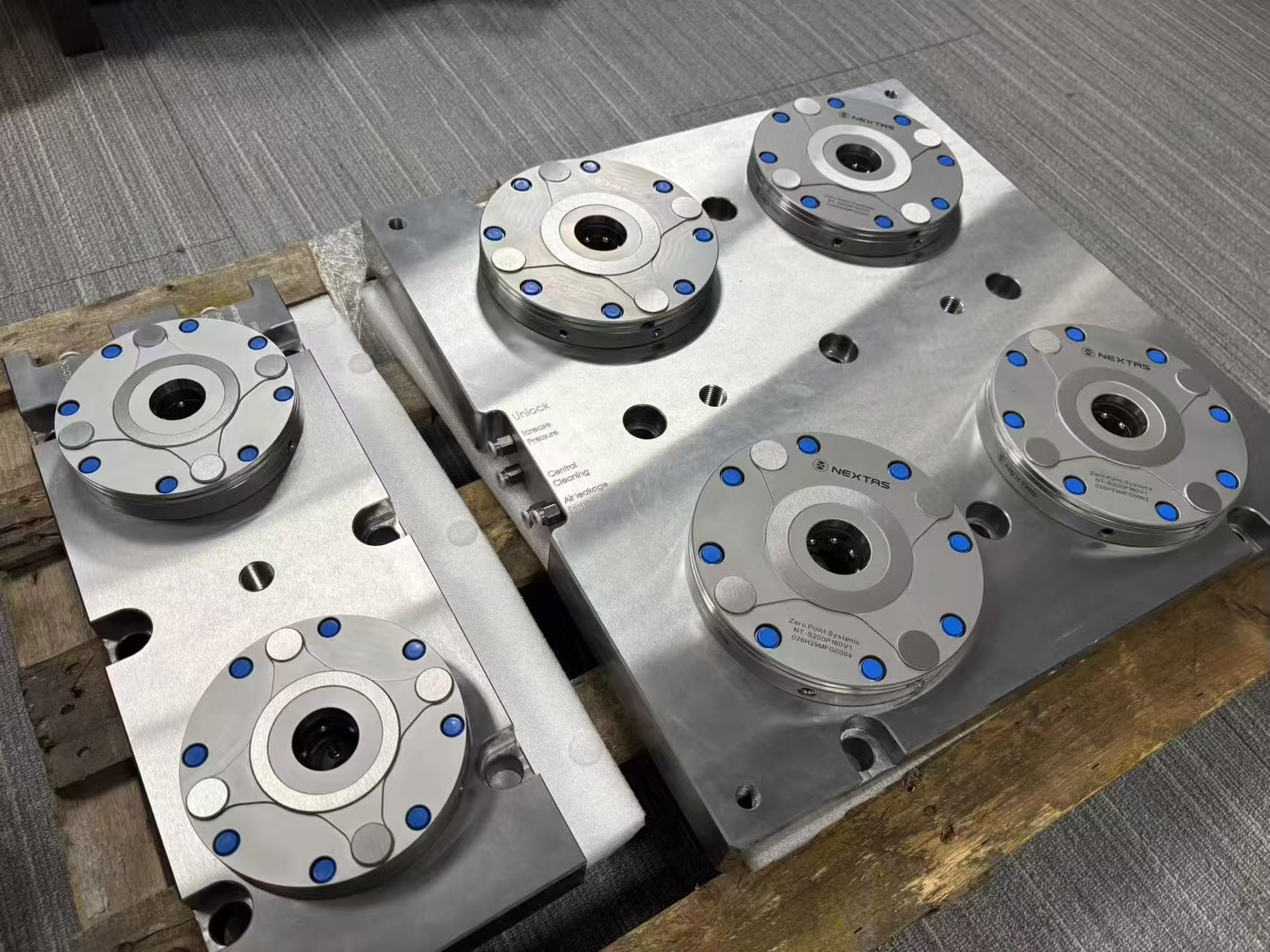
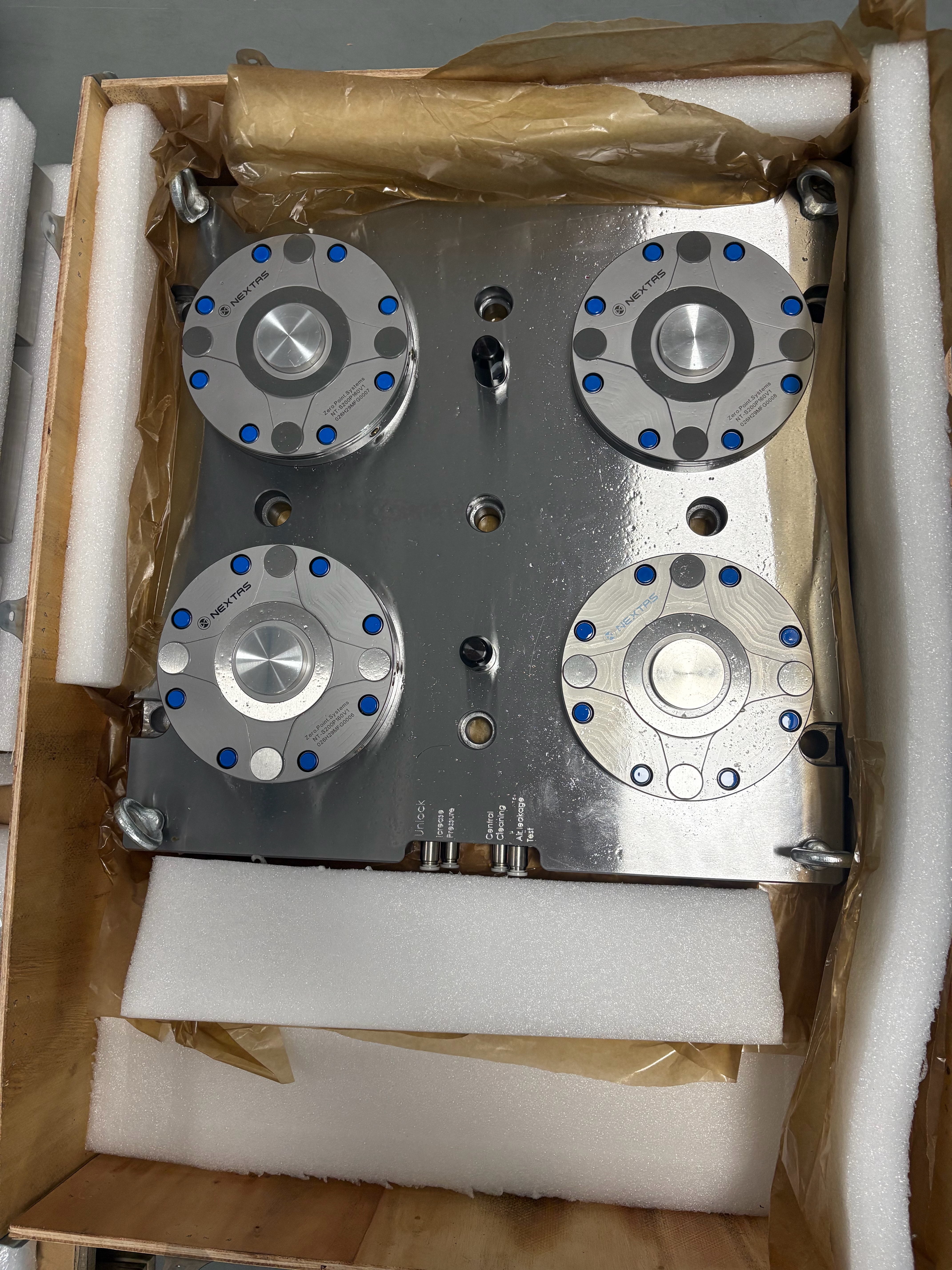
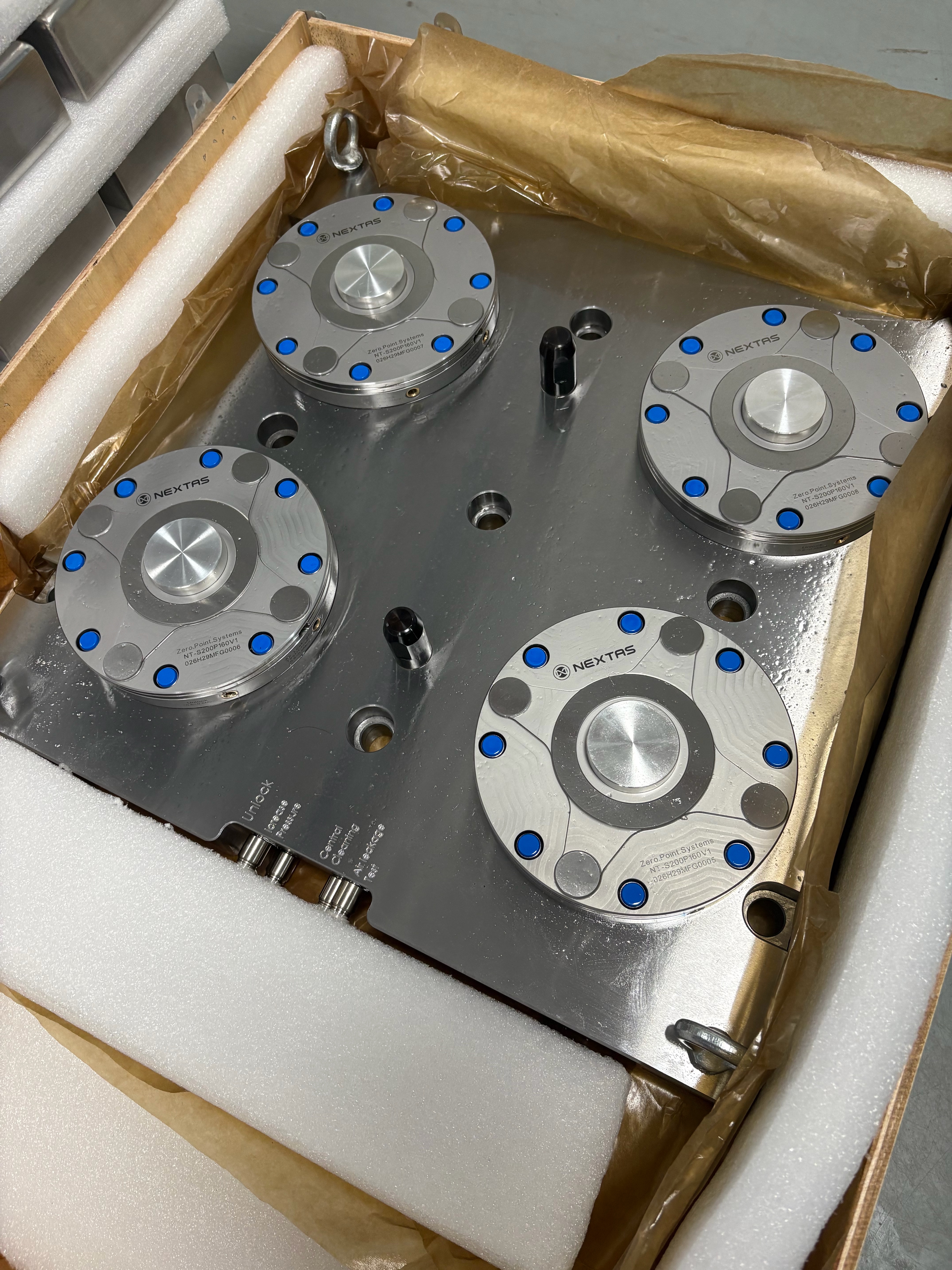
Fresh out of the crate, the architecture of the NEXTAS solution immediately stands out. Rather than a single monolithic slab, the system pairs a 4-station square receiver plate alongside a 2-station rectangular receiver plate, both populated with NEXTAS NT-S200P160V1 zero-point receiver modules.
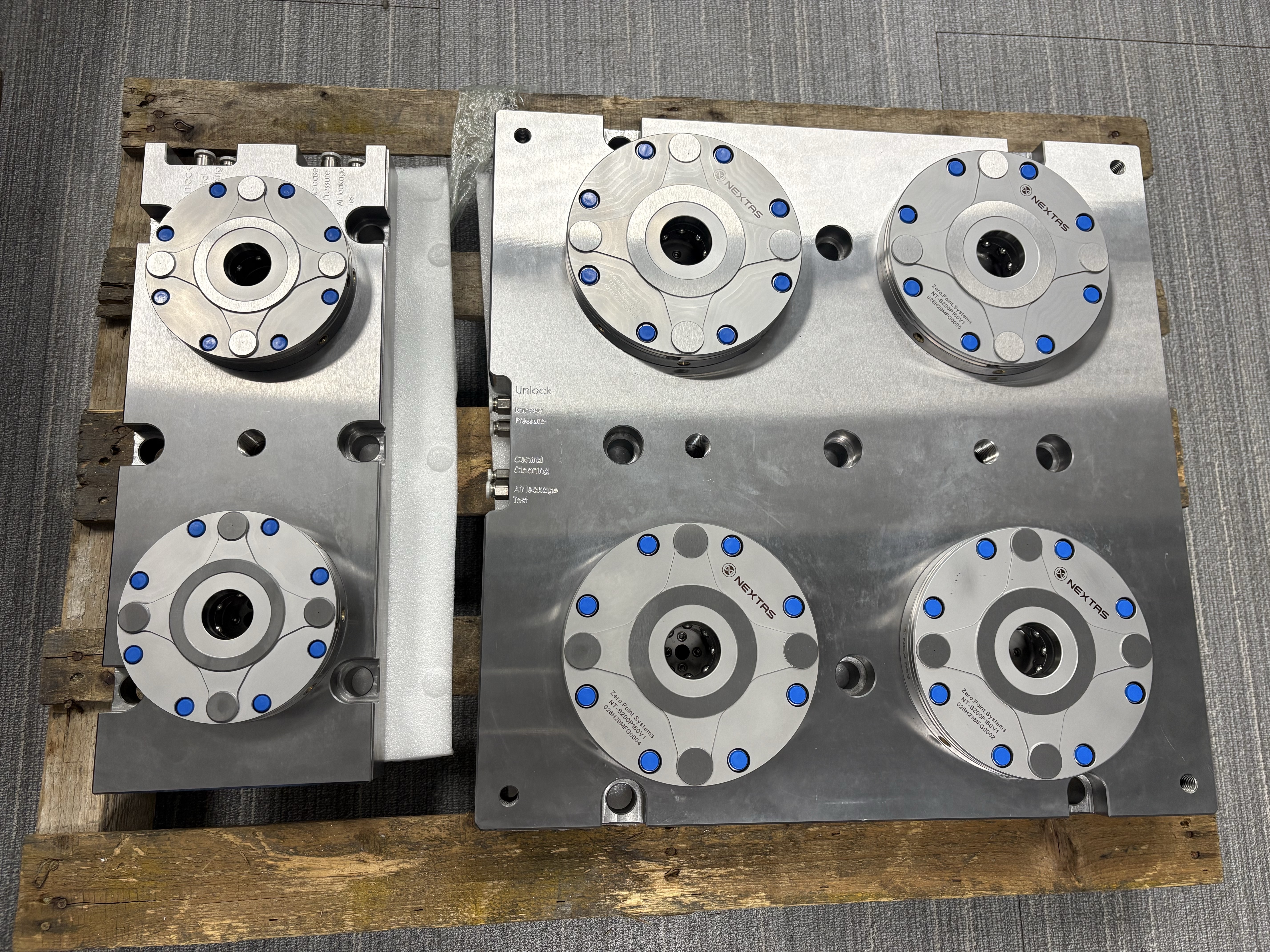
This split-plate strategy gives the shop three distinct operating modes on a single VMC:
- Asynchronous OP10 / OP20 Machining: The 2-pot plate on the left side of the table holds raw stock for OP10 roughing, while the 4-pot plate on the right holds a larger multi-part fixture for OP20 finishing. Because each plate has its own independent pneumatic manifold, the operator can release and swap the 2-pot fixture without disturbing the clamped datum on the 4-pot plate.
- Full-Table Spanning for Large Parts: Because all six NT-S200P160V1 receivers are ground to the exact same Z-axis height datum and pitch grid, an oversized pallet or mold base can span across both plates simultaneously, locking into all six receivers as a unified platform.
- Rapid Subplate Removal: Equipped with corner hoist eyebolts and protective shipping plugs for the receiver bores, either plate can be lifted off the machine table in minutes if an unusual job requires raw T-slot access.
Four-Port Pneumatic Intelligence & Crane-Proof Loading
Looking closely at the manifold edge of the NEXTAS plates reveals four laser-engraved pneumatic ports that bridge the gap between manual quick-change and automated cell integration:
- Unlock & Increase Pressure (Turbo Lock): Shop air compresses the internal spring pack to release the pull studs (Unlock). Once the new pallet drops in, applying air to the Increase Pressure port boosts the mechanical clamping force far beyond spring force alone—eliminating micro-fretting during aggressive hogging cuts in steel or titanium.
- Central Cleaning: During changeover, air is routed through the receiver center and across the three radial face grooves to blast away coolant and fine swarf before the pallet seats.
- Air-Leakage Test (Seat Verification): By monitoring backpressure through the Air-leakage Test port, the system verifies that the pallet sits flush against the hardened receiver contact pads. If a stray chip holds the pallet up by even a few microns, pressure drops immediately, preventing an out-of-tolerance cut before the spindle ever starts.
To protect those precision contact surfaces during overhead crane loading, the 4-station plate integrates two heavy-duty black-oxide guide pillars down the centerline. As the operator lowers a 400-kg fixture from a hoist, the coarse guide pillars catch the pallet first—preventing the pull studs from slamming into the NT-S200P160V1 receiver tapers and guaranteeing a foolproof (poka-yoke) orientation every time.
Shop Floor Impact
- Under 2 Minutes from Crane to Cut: Heavy fixture plates that previously took 45 minutes to bolt down, tram, and probe now drop onto the guide pillars and lock in under 120 seconds with < 0.003 mm repeat positioning accuracy.
- Zero Chip-Induced Scrap: Integrated Central Cleaning and Air-leakage Test verification completely eliminated Z-height taper errors caused by trapped chips during wet machining.
- Automation-Ready Infrastructure: With the 4-port pneumatic interface already built into the plates, the shop can connect solenoid valves and pressure switches directly to the VMC's M-codes whenever they are ready to add an overhead robot or pallet loader.
System Specifications & Performance Overview
Project Title: Modular 2+4 Pneumatic Zero-Point Subplate System for 3-Axis VMCs and HMCs. Product Series: Pneumatic Zero-Point Plate (NT-S200P160V1 Receivers). Key Industries: Mold & Die / Automotive / Aerospace Structural Components.
| Parameter | NEXTAS 2+4 Pneumatic Plate Configuration |
|---|---|
| Receiver Module Model | NT-S200P160V1 (Hardened Stainless Steel) |
| Plate Layout | Modular 2-Station Plate + 4-Station Plate (6 Receivers Total) |
| Repeat Positioning Accuracy | < 0.003 mm (Selected Series) / < 0.005 mm |
| Pneumatic Interface Ports | Unlock / Increase Pressure / Central Cleaning / Air-leakage Test |
| Mechanical Protection | Dual central poka-yoke guide pillars + radial chip-evacuation grooves |
| Automation Compatibility | Direct integration with machine M-codes, APC, or robotic pallet loading |
With the quote