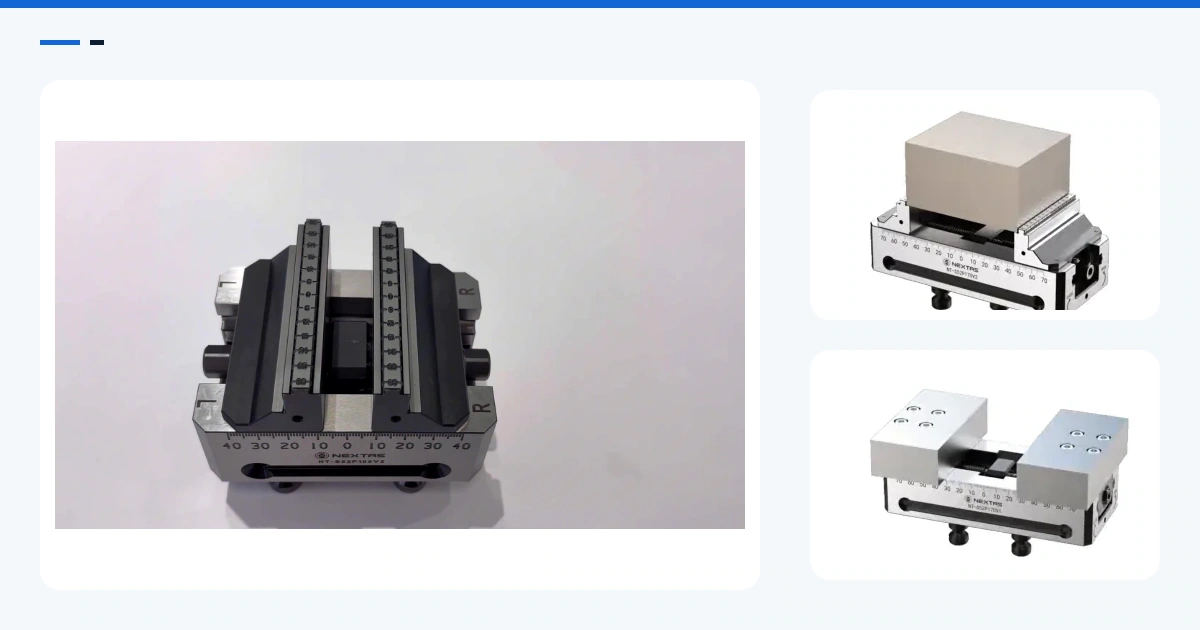
Ask any 5-axis programmer what kills cycle times on complex aerospace or medical components, and they will rarely blame the spindle horsepower. More often, the culprit is the workholding stack.
To get a small prismatic billet high enough off the rotary trunnion table so the spindle nose doesn't collide with the platter at a 90° tilt, machinists routinely stack a vise on top of a modular riser block, which sits on top of an adapter plate. Every bolted interface in that tower adds cumulative runout, robs Z-axis rigidity, and acts like a tuning fork the moment an end mill engages titanium or precipitation-hardened stainless steel. Worse yet, bulky conventional vise jaws force programmers to use extended-reach toolholders just to reach the lower sidewalls—inviting tool deflection and premature insert failure.
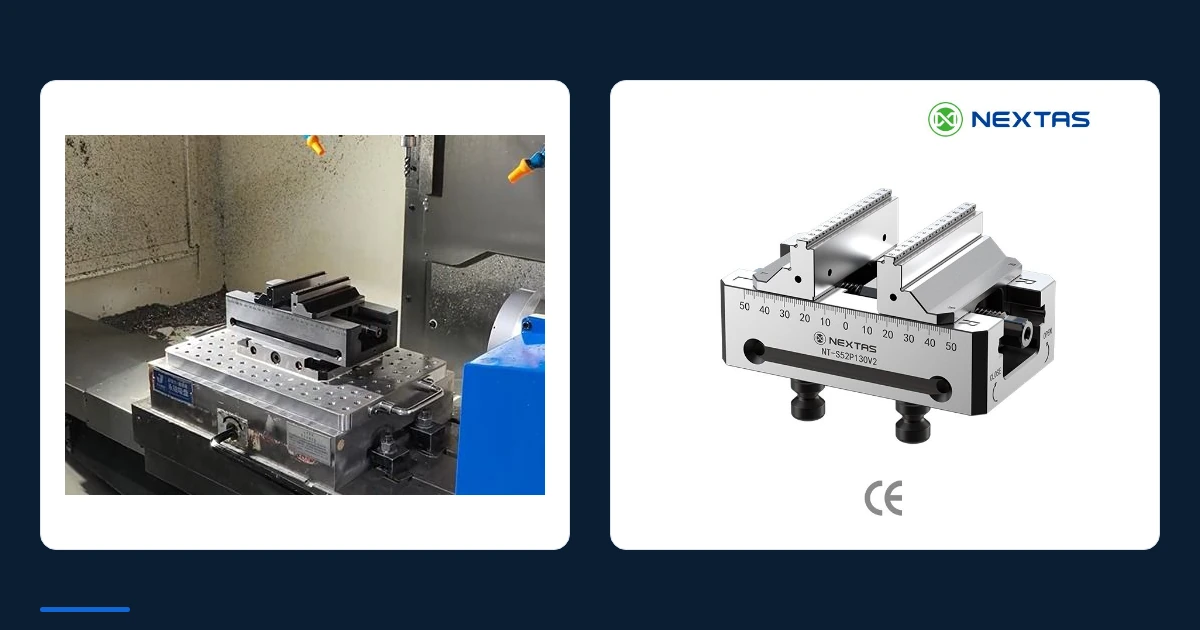
When a precision contract manufacturer specializing in 5-axis structural brackets audited its milling department, the engineering team realized their workholding stack was costing them 30% of their potential feed rate. Their solution was to strip away the intermediate blocks and standardize on an elevated, high-rigidity NEXTAS Self-Centering Vise.
The Engineering Fix: One-Piece Elevation and Form-Closure Grip
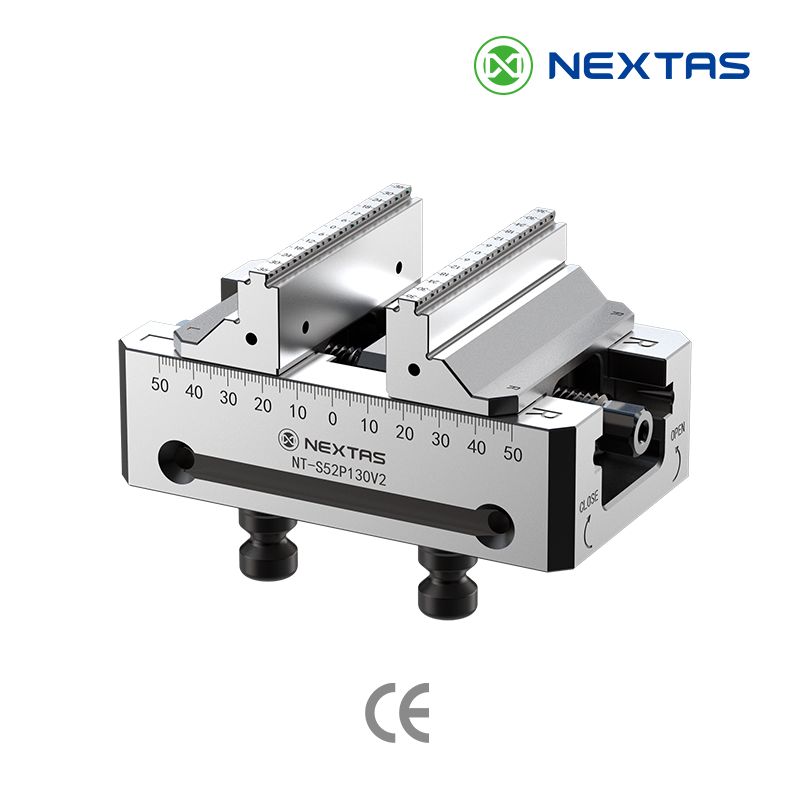
Rather than cobbling together separate risers and flat-jaw vises, the shop deployed the compact NEXTAS 70-mm elevated 5-axis self-centering vise directly onto their rotary tables and zero-point pallets. Three specific mechanical details in the vise's architecture immediately changed how the shop programmed its 5-axis roughing cycles:

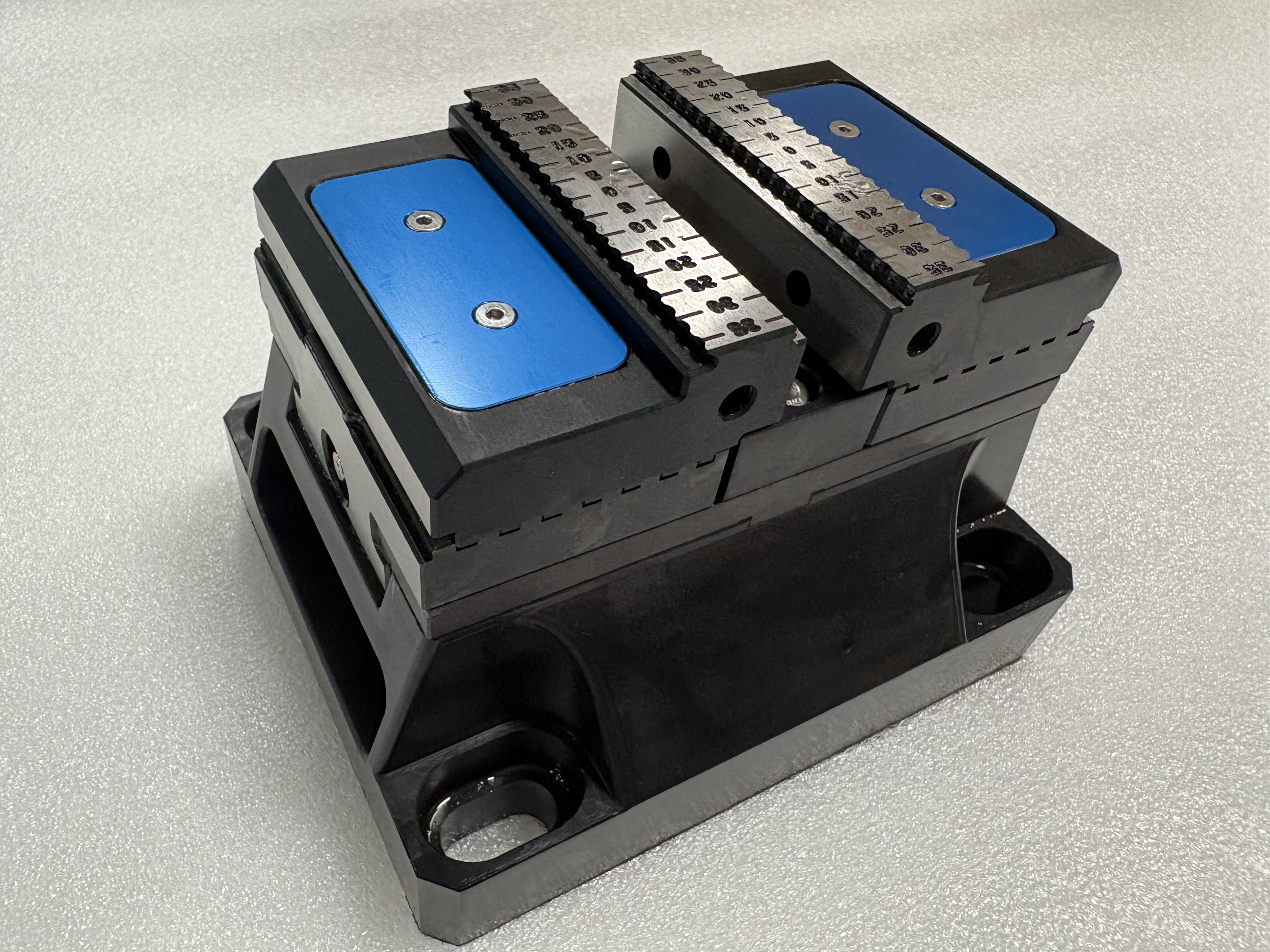
- Scalloped monoblock riser geometry: Instead of bolting a low-profile vise onto a separate riser column, the NEXTAS vise integrates the elevation directly into its blackened, hardened steel base. Deep, radiused clearance scallops machined into the front and rear flanks of the base allow the spindle housing and shrink-fit holders to swing cleanly into steep negative tilt angles. By eliminating two bolted joints underneath the workpiece, the setup retains full torsional stiffness during aggressive trochoidal roughing, while the four elongated corner mounting slots and side handling pockets make table alignment and ergonomic lifting effortless.
- Cross-serrated jaw seating and a 3.5 mm clamping bite: Look at the side profile of the top jaws, and you will notice a precision-ground serration (comb) interface locking the reversible step jaws into the moving slides. Under high clamping loads, this mechanical interlock prevents jaw lift and part tilt. The hardened, aggressive teeth on the stepped jaw ledge bite directly into raw stock on just 3.5 mm of carrier height—allowing the shop to order thinner raw bar stock while exposing five complete faces of the billet in a single setup.
- 35-0-35 mm visual centering and chip-sealed slides: On the top face of both serrated jaws, a high-contrast laser-engraved 35-0-35 mm scale lets operators verify workpiece symmetry at a glance—whether staging parts on an offline zero-point prep cart or loading directly at the machine. Meanwhile, flush-mounted blue anodized sealing plates shield the internal opposing-thread leadscrew and guideways from abrasive titanium swarf and high-pressure through-spindle coolant.
By the Numbers: Shop-Floor Performance Impact
The same titanium aerospace brackets, measured against the stacked riser the shop took off the trunnion.
| Operational Metric | Legacy Vise + Stacked Riser Block | NEXTAS Elevated 5-Axis Self-Centering Vise | Measurable Shop-Floor Impact |
|---|---|---|---|
| Bolted Interfaces Under Part | 3 stacked joints (Adapter + Riser + Vise) | 1 direct interface (Monoblock elevated base) | Eliminated harmonic chatter on sidewalls |
| Average Tool Stick-Out | 115 mm (extended reach holders) | 65 mm (standard stub shrink-fit) | +35% higher roughing feed rates |
| Clamping Stock ("Hat") Height | 10 mm - 12 mm (smooth jaws) | 3.5 mm (serrated form-closure step jaws) | ~22% raw material cost reduction |
| Part Centering & Pre-Setting | Manual measuring with calipers | Laser-etched 35-0-35 mm top jaw scale | Sub-30-second symmetrical stock loading |
| Centerline Repeatability | Shifts with raw stock tolerance | < 0.005 mm symmetric centering | Zero X/Y offset shifts across batch runs |
Built to Scale with the "One Datum Strategy"
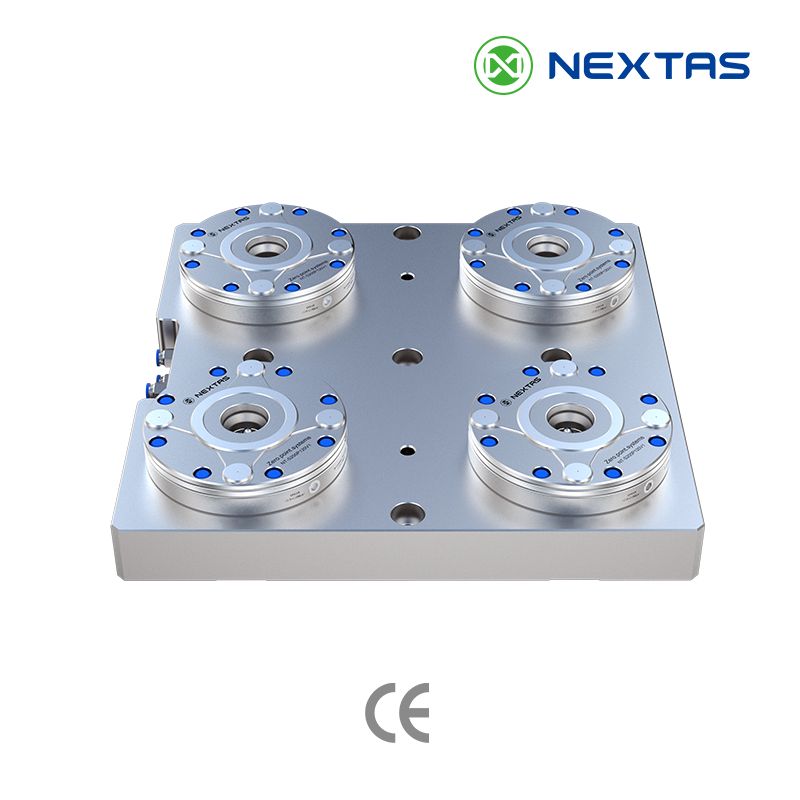
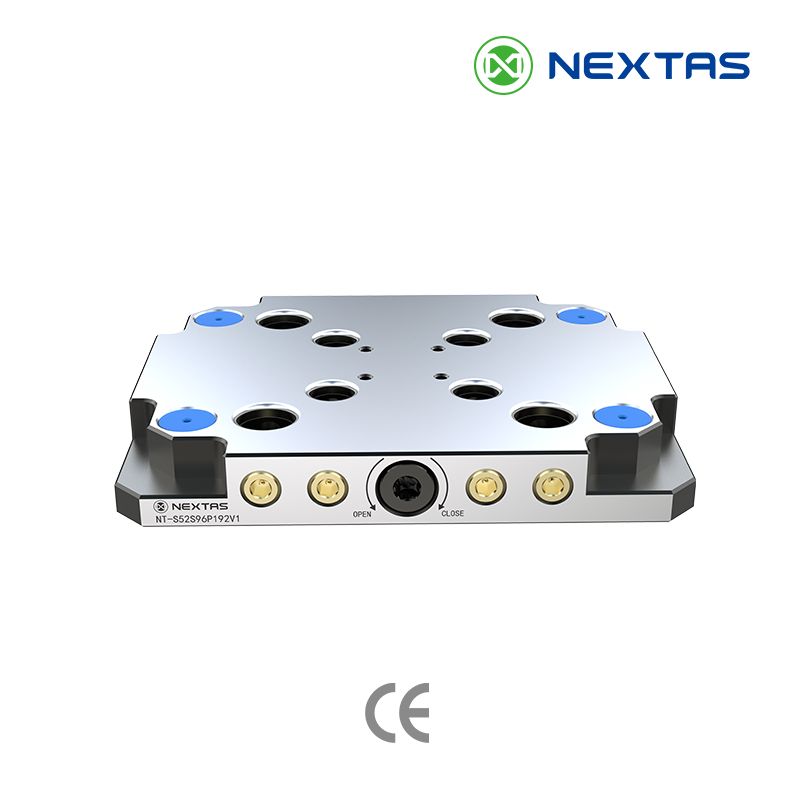
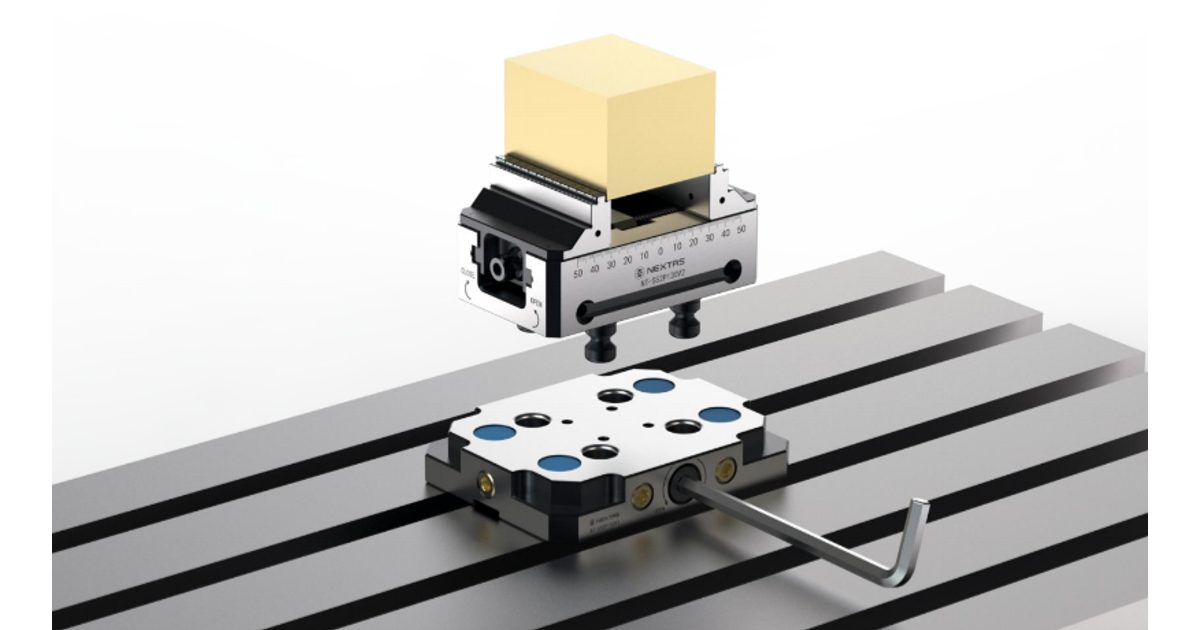
Because the base of the NEXTAS elevated self-centering vise can either bolt directly to a T-slot platter via its four corner slots or mount onto a NEXTAS Zero-Point Clamping System, the shop didn't paint itself into a corner. Today, operators use the 35-0-35 mm jaw scale to load blanks rapidly on the machine; tomorrow, those exact same vises can transition seamlessly onto an offline pallet rack or NEXTAS Automatic Pallet Changer (APC) without rewriting a single NC program.
5-axis table match
Match this vise to your 5-axis table
Send the rotary table, the tilt you run, and the saw-cut billet size.
Request an engineering review