How tall should the fixture be on a 5-axis machine? Tall enough that the spindle housing clears the table at the tilt you need. Short enough that the longest tool can still pull back for a tool change. Those two limits set the stack. A catalog photo does not.
Add every layer from the table face to the top of the stock. Then compare that sum with the tool-change height and with the steepest tilt the part needs. If a number is missing, write unknown and take it from the machine manual before you order a taller block.
Two limits, not one favorite height
A stack that is too tall trips the up-and-down travel, called the Z axis, or stops the automatic tool changer (ATC). The changer needs a set height to grab the holder. If the part is still in that path, the macro stops.
A stack that is too short has the other problem. When the table tilts, the spindle housing moves toward the table. The cutter can look clear while the housing hits a trunnion arm, a vise body, or the platter.
| What you see | Likely limit | Next change |
|---|---|---|
| Tool change stops, or Z alarms on the way up | The layers under the stock, plus the longest tool, plus the stock, are taller than the tool-change height | Lower the stack or shorten the tool |
| Housing meets the table at tilt | The clamp face is too close to the table | Raise the part, or cut the tilt in the program |
| A 200 mm block was assumed | No 200 mm riser is listed in the current English NEXTAS catalog | Use a drawing height, or leave the riser out of the sum |
Machine names such as DMU 50, UMC-750, Variaxis, and G350 only show the kind of layout people ask about. NEXTAS is not affiliated with those makers. This guide does not use their travel numbers. Take Z, the tool-change height, and the tilt limit from that machine's manual.
Add the layers you will actually bolt on
Start at the rotary table face. Add the adapter, the zero-point receiver or plate, any riser you already own, the vise or dovetail, and the stock above the jaws. Add a separate jaw height only when the drawing shows the jaws above the listed vise height. Count fittings that stay on the stack while the table turns.
The current English catalog does not list a standard riser, and it does not list a 200 mm riser. Do not type 200 mm into the sum unless that height is already on a drawing. A shop habit is not a part number.

52 mm and 96 mm are pitch, not height
On the self-centering vise page, 52 mm and 96 mm name the mounting pattern. They are not the listed height. Jaw width is separate too: 77 mm on the S52 family and 125 mm on the S96 family. Two rows you can put in a first sum are below. Other rows on that matrix have their own height. Use the row for the model you will buy.
| Model on the vise page | Listed height | Listed jaw opening | Do not read it as |
|---|---|---|---|
| NT-S52P210V2 | 87 mm | 0 to 200 mm | A 200 mm riser, or the full stack |
| NT-S96P210V2 | 111 mm | 0 to 200 mm | A taller stack just because the pitch is 96 mm |
The 200 mm figure is how far the jaws can open. It is not a riser, and it is not the distance from the table to the part. Repeat positioning on that vise page is under 0.02 mm. That is the vise, not the finished part, and it is not a clearance check.
The zero-point system page lists repeatability at or under 0.003 mm for the receiver. The manual plate page lists under 0.005 mm for the listed 52 mm and 96 mm families. A plate that reseats does not prove the spindle will clear at the tilt the part needs. Module names such as 85 mm or 160 mm are family sizes on the system page, not the height to add, unless the drawing says that number is the height.
The top limit is the tool change
A machine can list a long Z travel and still give you less room where the changer grabs the holder. Use that tool-change height. If you only have the full travel number, mark the tool-change height as unknown.
Planning sum: room under the stock = tool-change height − longest tool − stock above the jaws − a clearance gap.
Here is a made-up machine, not a NEXTAS test and not a travel figure for any named mill. Tool-change height 500 mm. Longest tool 120 mm. Stock above the jaws 80 mm. Gap 30 mm. Room under the stock is 270 mm. That 270 mm has to hold the adapter, the receiver or plate, any riser, and the vise or dovetail. Add jaw height in that 270 mm only when the drawing shows the jaws above the listed vise height. Put your machine's numbers in before you buy.
A gap of 25 mm to 50 mm is a common place to start so a rapid move does not clip a jaw. It is not a NEXTAS limit. The longest holder and the controller set the real gap.
The low limit shows up at tilt
On a table-table machine, both rotary axes sit in the table. At a steep tilt the spindle housing moves toward the platter and the support arms. A short stack makes the tool reach into that pocket.
On a swivel-head machine, the tilting head can strike the table edge or a tall block. On a head-head machine, the head can strike a tombstone or a clamp at the edge of the table. Draw the housing, not only the cutter.

Some shops start a trunnion check near 200 mm from the table face to the clamp face. Treat that as a first guess for one machine, then prove it in the model. It is not a NEXTAS riser, and it does not clear every brand.
If the lowest safe stack is taller than the highest stack that still clears the tool change, one height cannot do both. Shorten the tool, split the job, or cut the tilt. Do not hide the housing in the simulation to force a fit.
A short tool is why you raise the part
Five-axis work lets you tip the part so a short tool can reach a side face. In simple beam math, doubling how far a tool sticks out makes it about eight times less stiff. That is planning math, not a cut test on a NEXTAS vise. Use it when you choose between a longer holder and a tilt the machine can still clear.
A dovetail can sit lower than a vise body
The dovetail fixture page is a 45 degree grip in 52 mm and 96 mm formats. It asks for about 3 to 5 mm of dovetail in the raw stock. That 3 to 5 mm is stock in the tenon, not the height of the fixture body. The body height is on the selected model drawing.
A 60 degree tenon is a different jaw. Do not cut one for the 45 degree fixture on that page. Tenon width, the pocket, and the pin check belong in the dovetail preparation guide. This page only asks whether that lower body still clears the tool change after you add the plate under it.
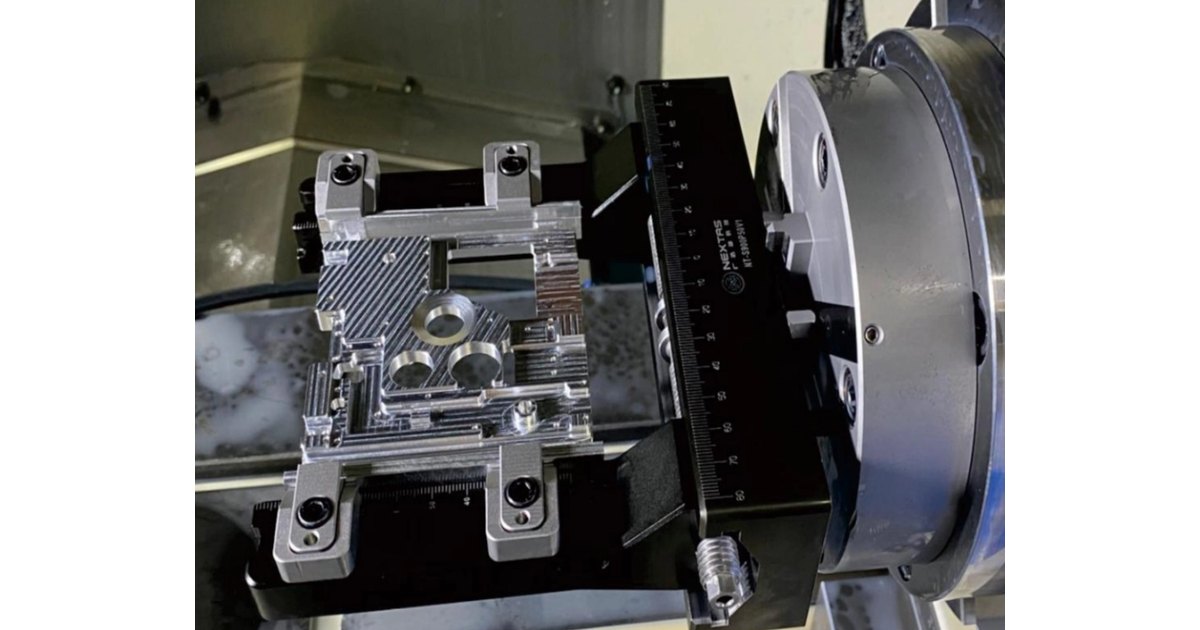
A taller stack stretches a small angle
This is planning arithmetic, not a measured NEXTAS result. A 0.01 degree miss at 200 mm from the pivot is about 0.035 mm at the part, because 200 mm times the sine of 0.01 degree is about 0.035 mm. The same angle at 100 mm is about half of that. If you raise the stack, run the machine maker's rotary-center check again. A receiver repeatability figure does not replace that check.
Send the limits before the stack is ordered
A 4-axis rotary guide covers the table face, the mass, and the release lock. It does not set this height window. Choosing a 52 mm or 96 mm plate is a separate fit check on the plate page.
- Machine layout: table-table, swivel head, or head-head.
- Z at the tool-change position, or unknown.
- Steepest tilt the part needs.
- Longest tool, from the spindle gauge line to the tip.
- Stock size, and how much of it sits above the jaws.
- The vise or dovetail model, or unknown.
- Any riser height that is already on a drawing. If there is no drawing, write none.
Questions buyers ask before they set the stack
Does NEXTAS sell a 200 mm riser?
No. The current English catalog does not list a standard riser, and it does not list a 200 mm riser. The 0 to 200 mm figure on NT-S52P210V2 and NT-S96P210V2 is jaw opening. Use a riser height only when it is on a drawing.
Is 52 mm or 96 mm the stack height?
No. Those numbers are the mounting pitch. Listed height is a different column. NT-S52P210V2 is 87 mm high. NT-S96P210V2 is 111 mm high. Other models have their own listed height. Add jaw height on top only when the selected drawing shows the jaws above that listed height.
Does receiver repeatability prove the tool will clear?
No. At or under 0.003 mm on the zero-point system page, and under 0.005 mm on the listed manual plates, is a reseat figure. Clearance comes from the machine model, the tool, and the tilt.
How much dovetail stock should I add to the height?
The dovetail page asks for about 3 to 5 mm of 45 degree profile in the stock. That is the tenon, not the fixture body. Add the body height from the selected model drawing, then the plate under it.
What if the safe tilt height is already too tall for the tool change?
One stack cannot satisfy both limits. Shorten the tool, split the job, or reduce the tilt. Do not assume a taller block will fit because a photo looks clear.
Before you order the stack
Send the tool-change height and the tilt
Share the machine layout, the Z position at tool change, the steepest tilt, the longest tool, the stock size, and the vise or dovetail model. If a riser height is not on a drawing, write none. NEXTAS can compare those limits with the selected receiver, vise, or dovetail drawing and list what is still unknown.
Send your stack limits