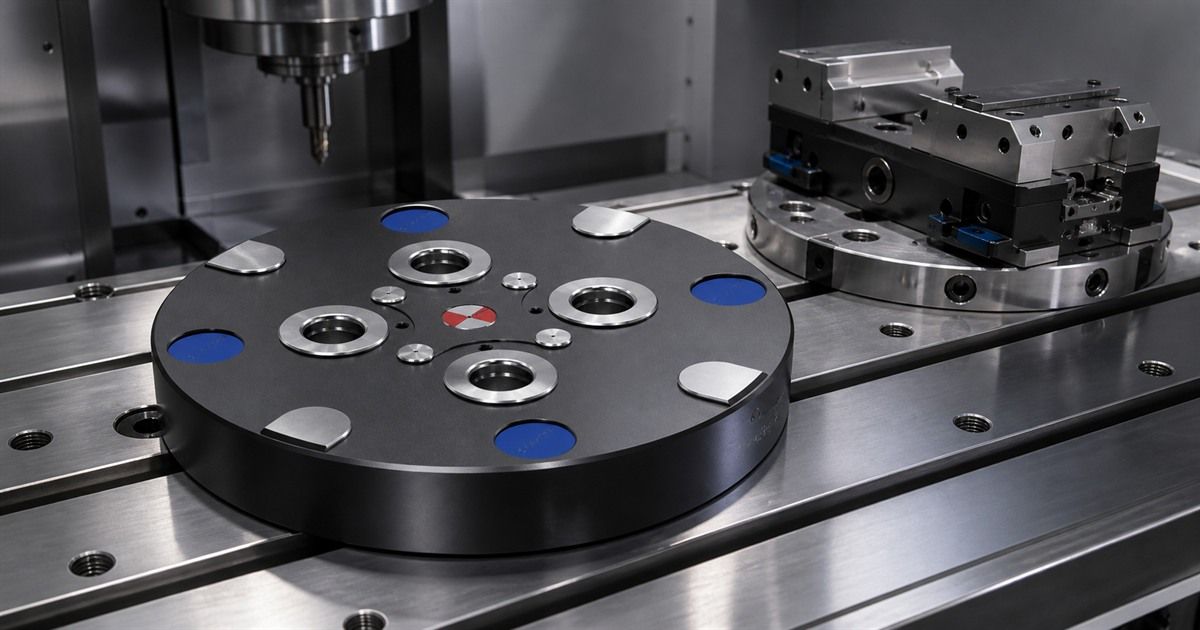
When a Quick-Point alternative makes sense
A zero-point plate becomes attractive when the machine is good but setup time is eating the margin. Typical cases include 5-axis job shops moving between small batches, mold shops moving electrodes or inserts between machining and inspection, and production cells where a vise, pallet, or custom nest must return to the same datum without re-indicating every time.
An alternative plate makes sense when you want more sourcing flexibility, a different plate size, a custom hole pattern, a lower total package cost, local engineering support, or a layout that fits your existing vises better than an off-the-shelf catalog plate. It does not make sense if the only goal is to buy something that looks similar. In workholding, the interface is the product. A few millimeters of height, a different stud shoulder, or a blocked air port can turn a promising replacement into a risky one.
For 5-axis machining, the decision is stricter than for a simple VMC table. You need clearance around the rotary axes, enough stiffness for side cutting, a clean chip path, and a known datum stack from the machine table to the part. The right question is not “Can this replace my current plate?” The better question is “Can this plate support my part family, my fixture library, and my inspection process with less setup time and no new uncertainty?”
Compatibility checklist before you request a quote
Before comparing price, collect the interface facts. This is where most RFQs slow down. A supplier can usually respond faster when the drawing package shows the machine table, the current plate or fixture base, and the target pallet or vise interface. If you only send a screenshot and ask for “something compatible,” the supplier has to guess, and guessing is not acceptable for a 5-axis datum system.
| Check item | Why it matters | What to send |
|---|---|---|
| Grid spacing | Determines whether existing vises, adapter plates, or pallets can be reused. | 52 mm, 96 mm, mixed grid, or your current drawing. |
| Pull-stud interface | The stud and receiver geometry control seating, pull-down, and repeatability. | Stud drawing, underside photo, current plate model, or sample dimensions. |
| Plate height | Affects 5-axis tool reach, collision envelope, and Z travel. | Current stack height from machine table to fixture top. |
| Mounting pattern | Controls whether the plate bolts directly to the table or needs an adapter. | Machine table drawing, T-slot spacing, bolt size, rotary table model. |
| Release method | Manual and pneumatic plates suit different production rhythms. | Changeover frequency, air availability, automation plan. |
| Datum transfer | Inspection and offline setup only work if the same datum is preserved. | CMM, presetting, pallet, and inspection workflow notes. |
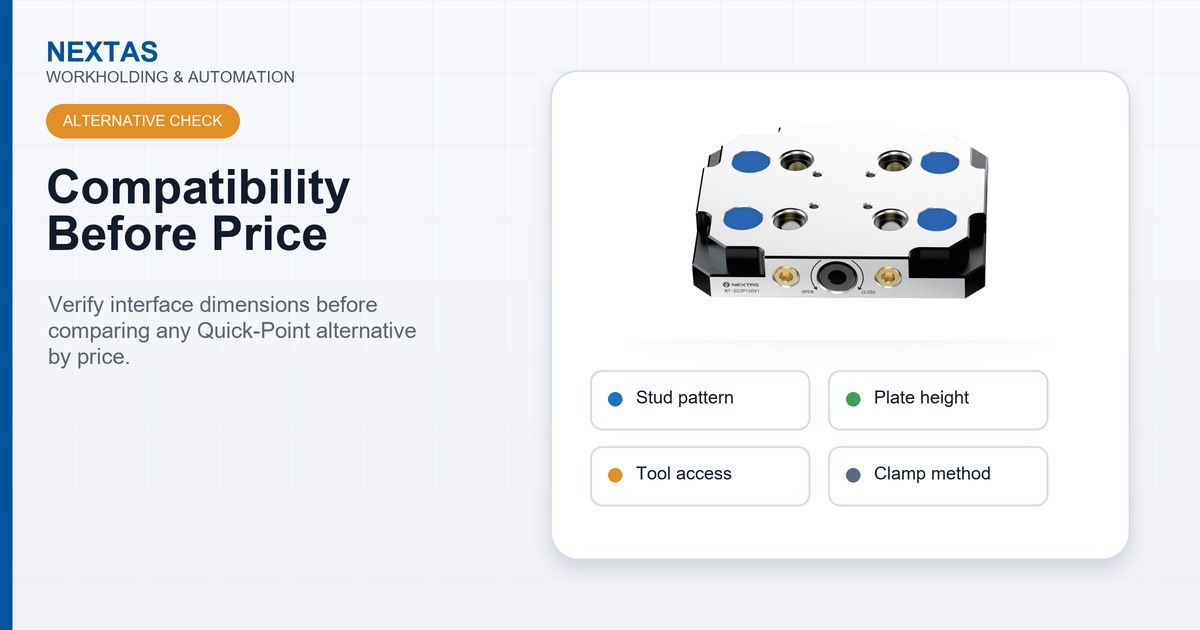
For NEXTAS zero-point hardware, common product routes include zero-point clamping plates for modular quick-change bases and zero-point clamping systems for receiver modules, pallet layouts, and automation-ready configurations. The product pages list practical reference points such as 52 mm and 96 mm modular formats, micron-level repeatability targets, and pneumatic release options.
52 mm, 96 mm, or mixed grid: choose by fixture library
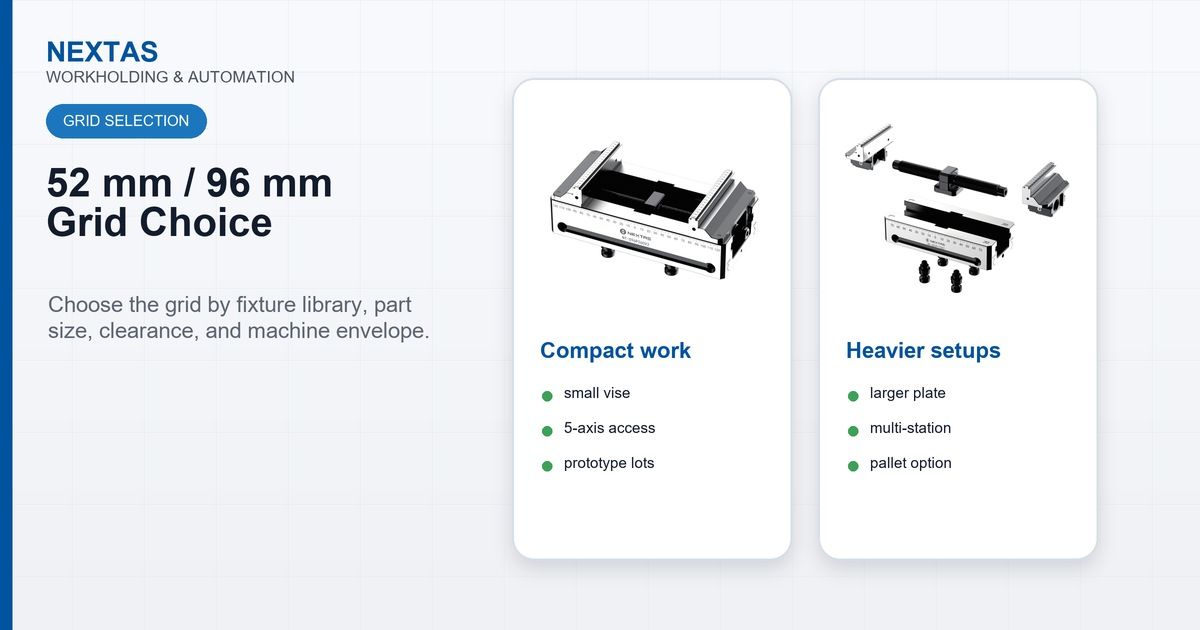
Many 5-axis users start by asking for a plate that fits one vise. That is too narrow. A better approach is to map the fixture library you want to run over the next 12 to 24 months. Small 5-axis vises, compact dovetail fixtures, and light pallets often fit a smaller grid. Larger vises, heavier pallets, and broader adapter plates often need a larger grid. Shops with both can consider a mixed 52 mm + 96 mm layout if the machine envelope allows it.
The advantage of standardizing the grid is not only faster mounting. It also reduces programming and operator variation. Once the team trusts the plate datum, work offsets, probing routines, offline setup carts, and inspection fixtures can follow the same logic. That is where zero-point workholding becomes a production system instead of a single accessory.
For a buyer comparing alternatives, ask the supplier to explain which grid is native, which is adapted, and where compromises appear. An adapted solution can be perfectly reasonable, but you should know whether it adds stack height, reduces usable clamping area, changes bolt access, or places a receiver too close to chip flow.
Manual vs pneumatic zero-point plates
Manual zero-point plates are often enough for prototype and lower-frequency changeovers. They are simple, cost-effective, and easy to understand on the shop floor. If an operator changes fixtures a few times per day and the machine is not part of an automated cell, manual release may be the most practical starting point.
Pneumatic release becomes more attractive when changeovers are frequent, when the operator must load multiple fixtures quickly, or when you are planning robot loading, pallet staging, or unattended machining. Pneumatic systems also make it easier to build a repeatable clamp/unclamp sequence. For automation, ask about air pressure, filtration, sensing options, fail-safe locking logic, and what happens if air pressure drops. NEXTAS zero-point system pages reference spring locking with pneumatic release, commonly around 6 bar, but the final requirement should always be confirmed for the selected model.
Do not choose pneumatic only because it sounds more advanced. Choose it when the workflow benefits from controlled release, faster cycle between jobs, or automation readiness. Otherwise, the extra plumbing and checks may not pay back immediately.
Repeatability is not only a catalog number
Buyers often compare zero-point plates by repeatability alone. That number matters, but it is only one part of the risk picture. Repeatability depends on receiver geometry, stud quality, plate flatness, mounting quality, cleanliness, clamp force, and the rigidity of everything above the plate. A plate with strong repeatability on a bench can still disappoint if chips sit on the locating surface or if the adapter plate flexes during side milling.
For quote review, ask how repeatability is inspected, whether the supplier provides an inspection report, and what maintenance routine is expected. If you machine abrasive materials or castings, ask about chip protection and cleaning access. If you machine medical, aerospace, or mold components with tight datum transfer requirements, ask whether matched plates or a CMM-side plate should be included in the same standard.
NEXTAS product pages describe zero-point receiver repeatability targets such as ≤0.003 mm for certain system modules and ≤0.005 mm for clamping plate configurations. Treat those as configuration-specific claims, not a blanket promise for every custom stack. The safe buying move is to define the full stack and ask for the inspection method in writing.
5-axis clearance checks that prevent expensive surprises
A zero-point plate can save time while quietly stealing clearance. On a trunnion or compact 5-axis machine, extra height may reduce usable swing, force a longer tool, or create a collision risk near the spindle nose. Before ordering, simulate the full stack: machine table, plate, studs, adapter, vise or pallet, jaws, raw stock, finished part, tool holder, and probing hardware.
Check the worst case, not the easiest setup. Tilt the rotary axes to the angles used in real programs. Include the longest drill, the shortest roughing holder, and any side-access operation that approaches the plate edge. Also check how an operator will clean the receivers. If the plate is hard to clean between fixtures, repeatability will drift even if the hardware is good.
What drives price and what to include in the RFQ
Zero-point plate pricing is driven by plate size, material, receiver count, grid complexity, custom hole patterns, pneumatic features, sensing, inspection documentation, and whether adapter plates or pull studs are included. The lowest line-item price is rarely the lowest project cost if it creates rework, custom drilling, or delayed setup validation.
| RFQ input | Good enough | Best for a fast engineering quote |
|---|---|---|
| Machine | Brand and model | Table drawing, T-slot/bolt pattern, photos |
| Current workholding | Brand or plate name | Underside drawing, stud dimensions, stack height |
| Part family | Material and size range | Weight, tolerance, cutting load, batch size |
| Fixture plan | Vise or pallet type | CAD/STEP, required grid, adapter needs |
| Changeover goal | Faster setup | Current setup minutes, target minutes, shifts per day |
| Documentation | Standard quote | Inspection report, material certificate, lead-time requirement |
Common mistakes when comparing alternatives
Assuming visual similarity means compatibility. Two plates can look similar while using different receiver geometry, stud shoulders, unlock direction, bolt access, or plate height. Always verify drawings.
Buying one plate before defining the standard. If you will later add CMM transfer, offline setup, or pneumatic release, choose the platform with that roadmap in mind. A cheap first plate can become an expensive dead end.
Ignoring cleaning access. Chips and coolant residue are the enemy of repeatable seating. A good 5-axis layout leaves room for wiping, air blast, and inspection of the locating faces.
Skipping fixture drawings. Suppliers can quote faster and safer when they see the fixture underside, not only the top-side photo. If you do not have drawings, send measured photos and mark the critical dimensions.
Comparing only the plate price. Include studs, adapter plates, shipping, documentation, spare parts, lead time, and engineering support. Total project cost is what matters.
Where NEXTAS fits in the evaluation
NEXTAS is a practical option when you want a zero-point plate or system engineered around the machine and fixture package, not only a catalog SKU. Buyers commonly ask for 52 mm or 96 mm formats, mixed-vise plate layouts, pneumatic release, custom mounting holes, and support for existing self-centering vises or pallets.
If you are replacing or supplementing a current Quick-Point-style process, send your current interface details and the outcome you want: lower project cost, additional plates, faster lead time, custom size, automation readiness, or a second-source option. The more specific the reason, the easier it is to design a sensible alternative.
For a deeper product starting point, review NEXTAS zero-point clamping plates, compare receiver-module options under zero-point clamping systems, and use the related guide on 5-axis self-centering vise selection when the plate will carry compact 5-axis vises.
If the zero-point plate is already settled and the open decision is the upper workholding route, compare the conversion and pilot requirements in the LANG Makro-Grip alternative guide for self-centering and dovetail options.
Bottom line
A good LANG Quick-Point alternative is not defined by the brand it is compared against. It is defined by whether it preserves your datum, fits your machine envelope, supports your fixture library, and gives operators a repeatable process they can trust. Start with interface data, check 5-axis clearance, decide manual versus pneumatic by workflow, and ask for inspection and documentation before comparing final price.
When you are ready to evaluate a NEXTAS zero-point plate, send the machine model, current plate or fixture drawings, required 52 mm / 96 mm layout, target repeatability, part weight, and changeover goal. That is the fastest route to a quote that answers the real engineering question.
Need a zero-point plate quote for a 5-axis setup?
Send your machine table drawing, current fixture interface, part envelope, and target changeover time. NEXTAS can review plate layout, grid spacing, and quote options for your workflow.
Request Engineering Quote →FAQ
Is NEXTAS affiliated with LANG Quick-Point?
No. NEXTAS is not affiliated with, endorsed by, or sponsored by LANG Technik or the Quick-Point brand. This article uses the search term only to help buyers compare alternative zero-point plate options.
Can I replace a Quick-Point plate without changing my process?
Sometimes, but never assume a drop-in swap. Confirm grid spacing, pull-stud interface, plate height, locating datum, bolt pattern, clamping method, and machine envelope before approving any replacement.
What information should I send for a fast zero-point plate quote?
Send machine table size, T-slot or bolt pattern, current plate model if any, fixture or vise base drawings, required 52 mm or 96 mm spacing, part weight, cutting load, air availability, target repeatability, quantity, and photos of the current setup.
Should I choose manual or pneumatic zero-point plates for 5-axis machining?
Manual plates fit lower-frequency changeovers and simpler cells. Pneumatic plates make more sense when operators change fixtures often, when the machine is part of an automation plan, or when clamp confirmation and repeatable release speed matter.
What repeatability target should I ask for?
Ask for the repeatability at the plate and stud interface, how it is inspected, and what conditions apply. For NEXTAS zero-point systems, product pages list micron-level repeatability such as ≤0.003 mm for receiver modules and ≤0.005 mm for clamping plates, depending on configuration.