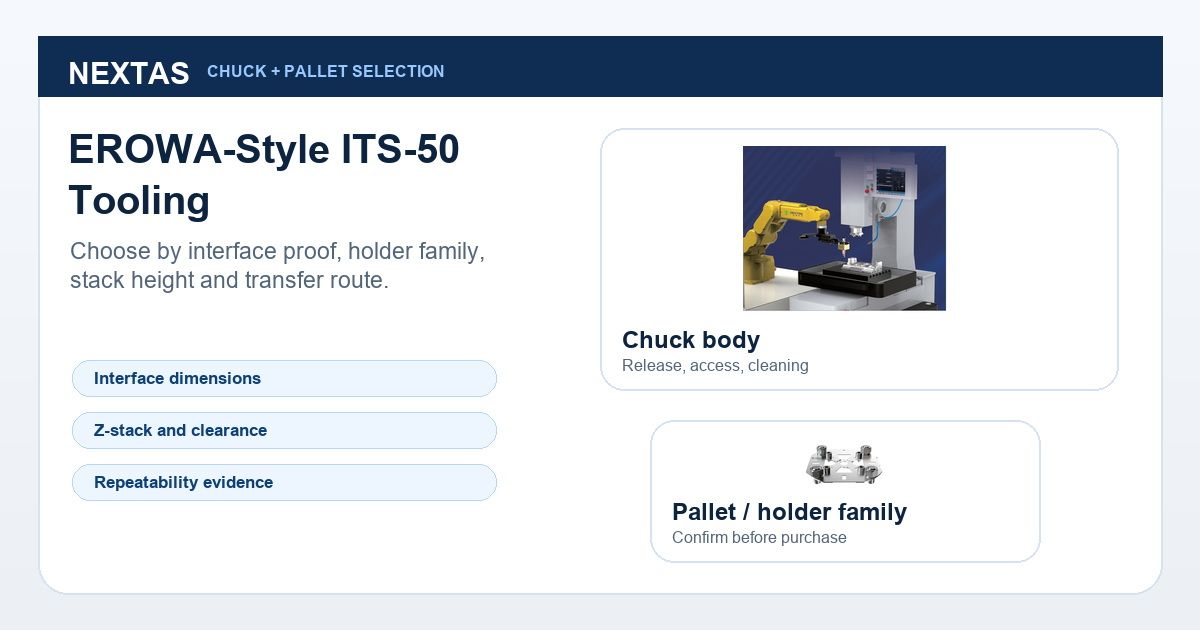
What buyers usually mean by EROWA-style ITS-50 tooling
In a mold shop or precision EDM cell, ITS-50 tooling is not just a fixture accessory. It is the standard that lets an electrode, small workpiece or inspection artifact move between stations without rebuilding the datum every time. The chuck, holder, pallet, pull feature, Z reference and release method all contribute to whether that transfer is reliable.
That is why the first buying question should be, "What problem are we solving?" If the shop already owns a stable holder library, the project may be a chuck replacement. If operators lose time building electrodes one by one, the project may be a holder and pallet expansion. If the company is moving toward robots or off-machine presetting, the project becomes a tooling route, not a single item purchase.
This article stays focused on that buyer decision. It does not repeat a general zero-point system comparison or a broad EDM-versus-milling overview. The practical goal is to help you brief a supplier clearly: which interface must be respected, which station carries the highest risk, which documents you need, and which parts belong in the first quote.
Choose the buying route before choosing the part number
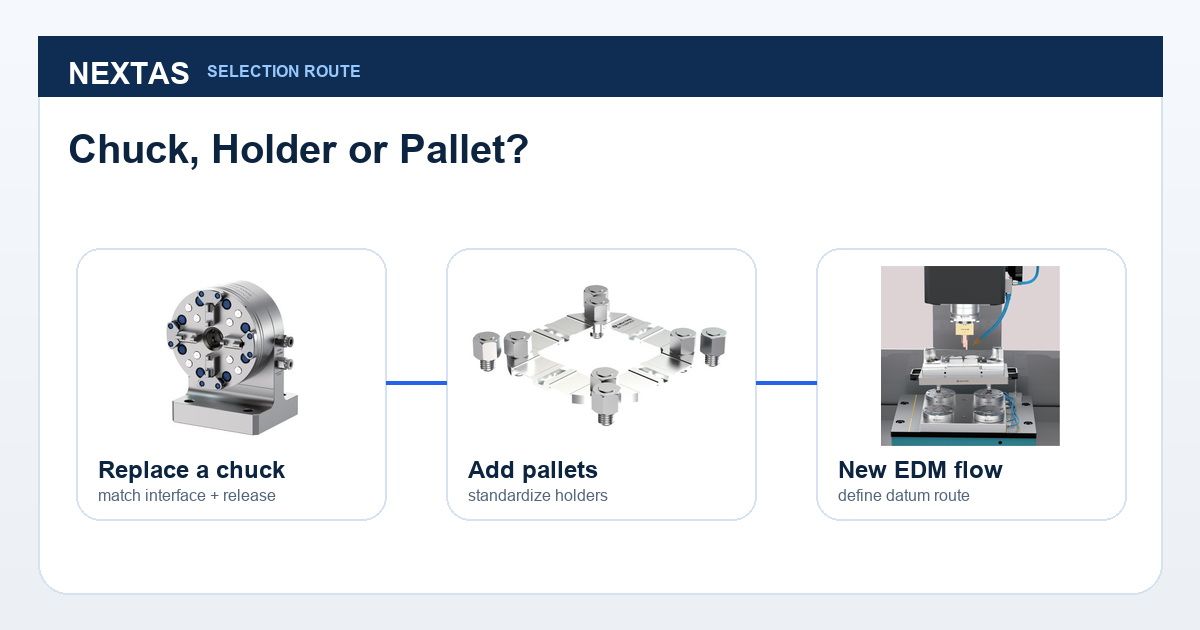
There are three common routes. The first is replacement. A chuck is damaged, missing, slow to release, or no longer holds repeatability. In this route, the existing holder or pallet library drives the decision. Your supplier needs photos, measured interface details, release method and any known model references. The risk is ordering a chuck that looks familiar but changes stack height or locking geometry enough to break the existing process.
The second route is expansion. The current chuck still works, but the shop needs more holders, pallets, electrode carriers, inspection adapters or spare stations. Here, price per accessory matters, but standardization matters more. The quote should show which holders are interchangeable, which pallets are reserved for inspection, which adapters require machining, and how the numbering or labeling system will be controlled.
The third route is a new datum flow. This happens when a buyer wants to connect electrode milling, sinker EDM, WEDM, CMM and storage around one repeatable standard. In this case, do not start with the cheapest chuck. Start with the route map and decide where the datum must survive: presetting to EDM, EDM to inspection, or machining to EDM. A complete tooling package may include chucks, holders, pallets, adapter plates, cleaning rules and inspection proof.
Interface fit is not a brand phrase
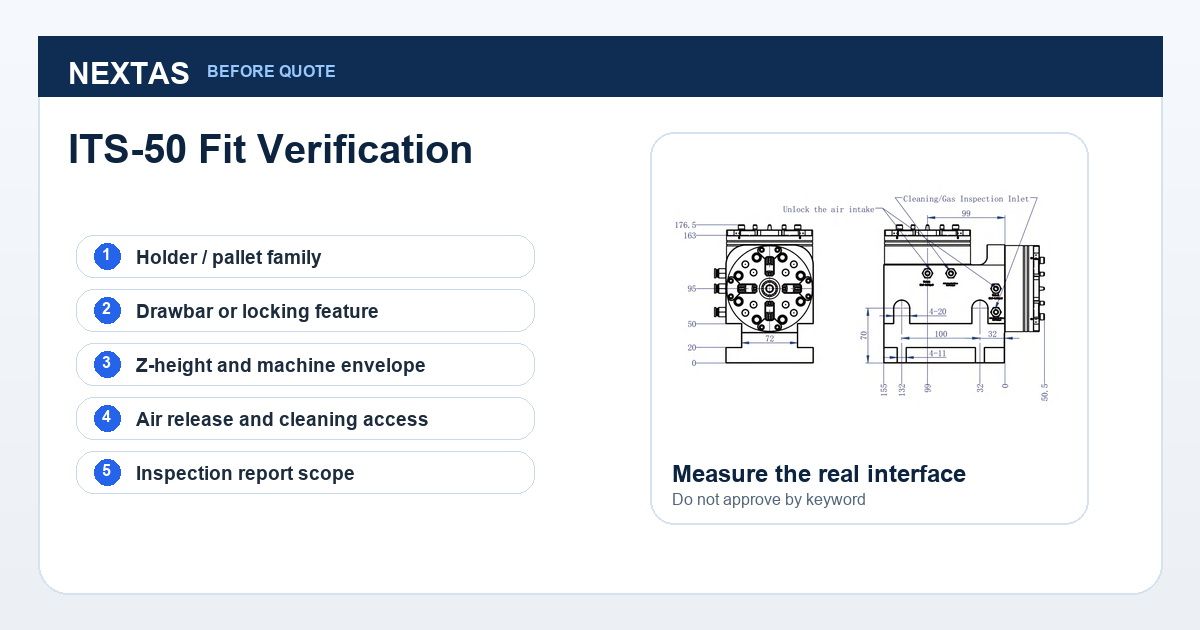
"Compatible" should never be approved from a keyword alone. For ITS-50 style tooling, the details that matter are the holder or pallet family, the centering feature, clamping groove, Z reference face, draw direction, release action and any air or cleaning ports. A small mismatch can still allow the part to sit in the chuck while destroying repeatability, changing offsets, or making the holder difficult to release after contamination.
Ask the supplier what it needs to verify fit. A serious quote will usually ask for underside photos, side photos, key dimensions, current chuck photos, machine model, and a note on how the holder is used. If you do not have drawings, measured photos with calipers are still useful. For high-risk cells, send a sample holder for physical confirmation before approving a larger order.
Stack height is just as important as fit. A chuck that raises the electrode or pallet by a few millimeters can change tank clearance, spindle reach, toolholder collision risk or inspection offsets. In an EDM-only station, extra height may be acceptable. In a 5-axis milling or compact machining center, the same height change can force different tooling or reduce access.
| Fit check | Why it matters | Best RFQ input |
|---|---|---|
| Holder / pallet family | Confirms the precision seating and locking relationship. | Photos, model reference, measured underside and side view. |
| Z height and envelope | Controls electrode reach, tool clearance and inspection offsets. | Current stack height, machine limits and highest-risk station. |
| Release method | Manual and pneumatic release suit different workflows. | Operator access, air pressure, valve plan and change frequency. |
| Cleaning access | Contamination is a common repeatability failure source. | Coolant, graphite dust, EDM sludge and cleaning routine notes. |
| Inspection proof | Turns a catalog claim into an acceptance criterion. | Target repeatability, report format and number of clamp cycles. |
Chuck, holder and pallet decisions are linked
A chuck purchase affects holder and pallet choices. If the chuck uses pneumatic release, ask whether the holder family and pallet dimensions make operator handling easier or harder. If the shop wants to add a robot later, ask whether the pallet shape, grip access and label position can support that future step. If the shop only needs manual electrode loading, a simpler holder package may be more practical than an automation-ready one.
For replacement projects, the safest approach is to approve the chuck against the existing holder library first. For expansion projects, standardize the holder family before buying quantity. For new routes, define the minimum package as a working system: one or more chucks, a reference holder, production holders, inspection or presetting adapters, spare hardware and a written acceptance routine.
The NEXTAS E-Series chuck is the most relevant product page when the project involves EDM, WEDM, grinding or inspection transfer with ITS-50 style datum handling. If the project also includes palletized CNC automation or off-machine loading, review the automatic pallet changer options and the practical setup logic in the manual pallet changer efficiency guide. Those links help separate electrode tooling from broader pallet flow.
Manual versus pneumatic release
Manual release is still a good choice when changeovers are low-frequency, operators can reach the chuck easily, and the tooling library is small. It is simple to diagnose and often works well for prototype electrodes, short-run mold repair and inspection transfer. Manual operation can also be a sensible first step when the shop is testing a new datum standard before investing in air routing or sensor logic.
Pneumatic release becomes more valuable when changeovers are frequent, operators handle many electrodes, or the cell may later connect to a robot, pallet rack or off-machine presetting station. The preferred logic is usually mechanical self-locking with pneumatic release, so loss of air does not mean loss of clamping. Ask about required air pressure, filtration, inlet direction, valve logic and whether clamp or unclamp confirmation is available.
Repeatability proof should be written into the quote
Repeatability claims need context. Ask where the value is measured: at the chuck interface, above the holder, on a pallet, or at a part datum. Ask how many clamp cycles are tested, whether the test is radial, axial or both, and whether the inspection condition matches your usage. A clean bench test does not fully represent a wet EDM tank or a graphite milling environment.
For electrode work, small datum errors can become mold correction time. For inspection transfer, inconsistent seating can create false measurement disagreement. For milling, small location errors can create mismatch between operations. Put the report requirement into the RFQ, not after purchase. If you need a written factory inspection report, say so. If you need a first-article acceptance routine, define the station and reference artifact.
Also ask how the tooling should be maintained. A strong ITS-50 style process usually includes a cleaning routine for contact faces, periodic inspection of pull features, a simple reference holder check, and rules for removing damaged holders from circulation. The tooling system is only as repeatable as the surfaces operators actually keep clean.
Cost depends on scope, not just chuck price
Two quotes for EROWA-style tooling can look very different because they include different scope. One quote may include only a chuck body. Another may include holders, pallets, adapters, spare parts, inspection reports and support for machine-table mounting. Compare the same package before judging price.
Useful cost drivers include chuck body type, material, interface precision, manual or pneumatic release, sealing, corrosion protection, holder quantity, pallet quantity, adapter machining, inspection documentation and shipping. For a replacement, the scope may be narrow. For a new EDM route, the cheapest single chuck can become expensive if it requires custom adapters later.
| Quote scope | When it fits | Hidden risk if omitted |
|---|---|---|
| Chuck only | Existing holder library is verified and stable. | Stack height or release mismatch appears after arrival. |
| Chuck plus holders | Shop needs more electrode capacity. | Holder naming, storage and inspection rules remain unclear. |
| Chuck plus pallets/adapters | Datum must move through inspection or machining. | Adapters become one-off and hard to reorder. |
| Complete route package | New EDM or automation workflow. | Supplier quotes parts but not the process standard. |
RFQ checklist for a firm ITS-50 tooling quote
Send the current chuck and holder photos, underside and side views, key interface measurements, machine model, process route, maximum electrode or workpiece weight, required release method, available air pressure, target repeatability, documentation needs and expected quantity. If the project connects multiple stations, include a simple route map. For example: electrode milling, presetting, sinker EDM, WEDM, CMM and storage.
If the project is a replacement, say what failed or what is slow today. If it is an expansion, say how many holders or pallets are needed and how operators will store them. If it is a new datum route, say which station is the bottleneck and whether automation is planned. This helps engineering quote the right package instead of guessing from a product keyword.
Common mistakes to avoid
Approving by visual similarity. Similar shape does not prove interface fit. Ask for measured confirmation.
Ignoring Z height. A replacement that fits mechanically can still disrupt offsets or clearance.
Buying one chuck without planning holders. A datum standard only works when the holder library is controlled.
Skipping contamination control. EDM sludge, graphite dust and coolant residue can all hurt seating repeatability.
Leaving documents out of the order. If quality needs an inspection report, make it part of the quote scope.
Where NEXTAS fits
NEXTAS is a practical option when the buyer needs a reviewed ITS-50 style tooling scope for EDM, WEDM, grinding, inspection transfer or light machining support. The E-Series route is strongest when the core need is repeatable holder datum handling with pneumatic release and a clean engineering review. If the project grows into broader palletized CNC fixtures or automation, NEXTAS can also review related pallet changer and zero-point routes.
The best outcome is not just a compatible-looking chuck. It is a written tooling standard: approved holder family, chuck body, release method, cleaning routine, inspection proof, spare parts and reorder information. That standard protects the shop from future purchasing confusion and keeps operators from improvising around the datum.
Bottom line
Choose EROWA-style ITS-50 tooling by the job it must do. Replacement projects start with exact interface proof. Expansion projects start with holder and pallet standardization. New EDM or automation routes start with the datum flow. Once that route is clear, compare chuck body, release method, stack height, cleaning access, repeatability proof and quote scope.
When you are ready to quote, send your current holder details, machine route, repeatability target and release preference through the NEXTAS engineering quote form. That gives engineering enough context to recommend the right E-Series chuck, holder package or related tooling route without guessing.
Need an ITS-50 tooling review?
Send holder photos, interface dimensions, machine route, repeatability target and release preference. NEXTAS can review the right E-Series chuck and tooling package for your EDM workflow.
Request E-Series Tooling QuoteFAQ
Is NEXTAS affiliated with EROWA?
No. NEXTAS is not affiliated with, endorsed by, or sponsored by EROWA. EROWA-style and ITS-50 language is used only as buyer search terminology for compatible-style tooling discussions.
Can an ITS-50 chuck be a drop-in replacement?
Only after interface review. Confirm holder family, locking geometry, Z height, release method, machine envelope and repeatability proof before approving a replacement.
Should I buy the chuck or holders first?
If the holder library already exists, verify the chuck against it first. If you are building a new route, specify the chuck, holders, pallets and inspection routine together.
What should I send for a fast quote?
Send current holder and pallet photos, key dimensions, machine model, process route, target repeatability, required release method, air supply and documentation needs.
Where does the NEXTAS E-Series chuck fit?
The E-Series chuck fits EDM, WEDM, grinding and inspection transfer projects that need repeatable ITS-50 style datum handling and a reviewed tooling scope.