The Bottleneck: The Hidden Cost of "Machine-Specific" Setups
For many growing precision contract manufacturers, buying one zero-point clamping plate solves a local bottleneck on a single machine. Going from bolted T-slots to quick-change pull studs on a flagship 4-axis VMC is an easy win. However, a much larger scheduling headache emerges when a shop tries to move a hot job from Machine A to Machine B during a production crunch.
Even when two vertical machining centers share the same make and model, traditional bolted setups—or poorly toleranced aftermarket subplates—force operators to treat every machine as an island. Moving a pair of self-centering vises or a dedicated manifold fixture to an open spindle typically requires unbolting the base, sweeping the X-axis with a dial test indicator, and re-probing X, Y, and Z work offsets. Worse yet, when mounting dual-station plates onto 4th-axis rotary indexers or compact high-speed tapping centers (like Brother Speedio or Fanuc Robodrill platforms), excess fixture mass eats up table load capacity and slows down rapid indexing.
To achieve true plug-and-play routing across its milling department, the customer’s manufacturing engineering team needed more than just clamping force. They needed interchangeable geometric accuracy across ten identical dual-station zero-point bases.
The Engineering Solution: Precision-Pocketed Dual-Station Subplates
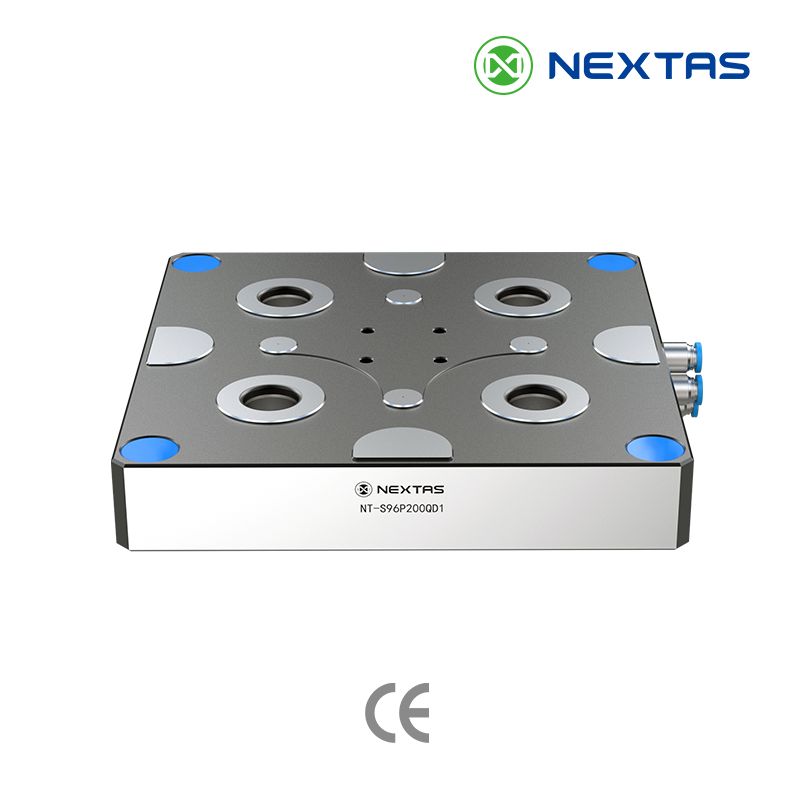
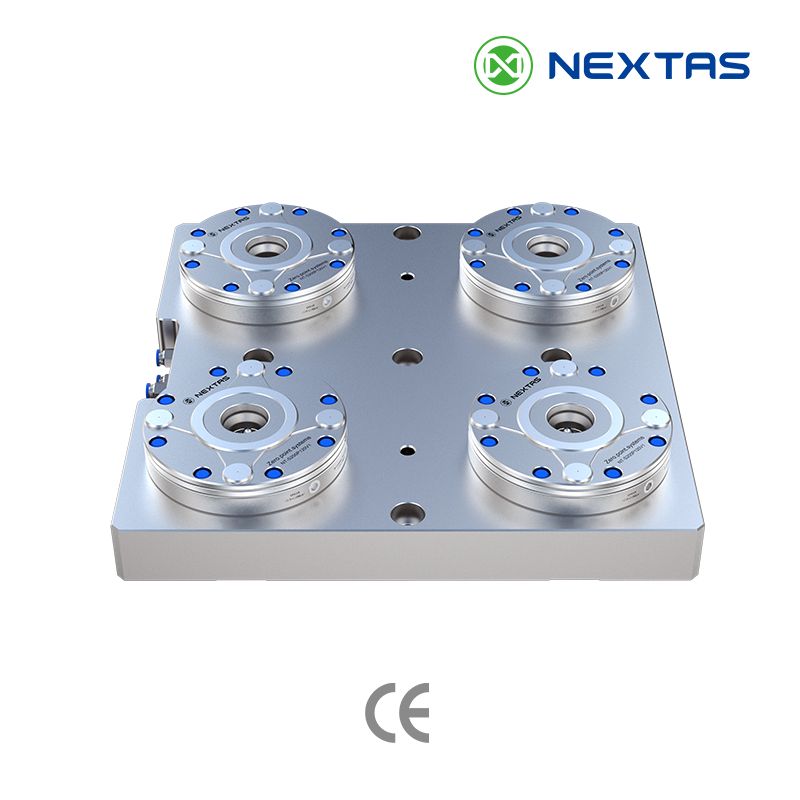
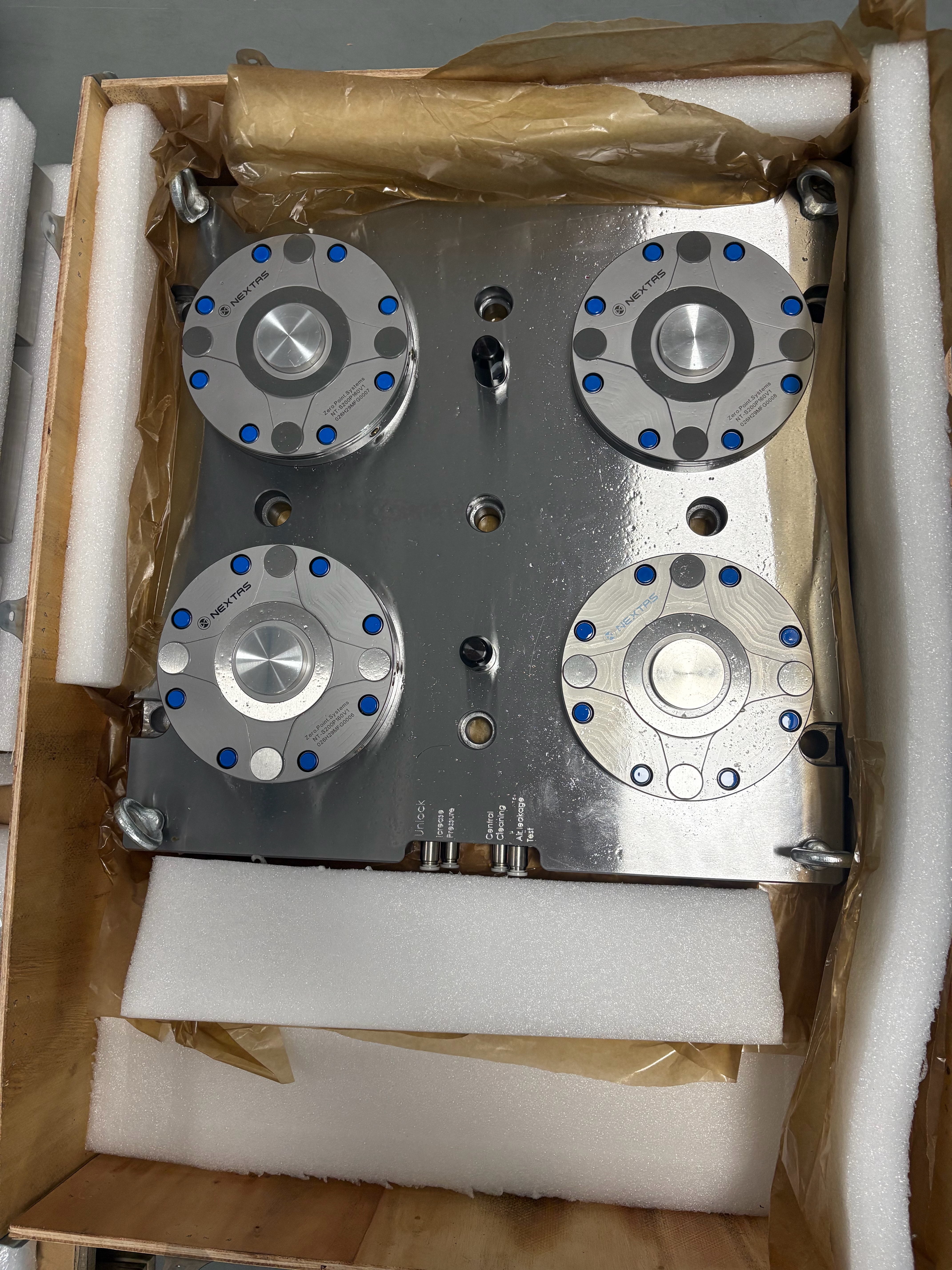
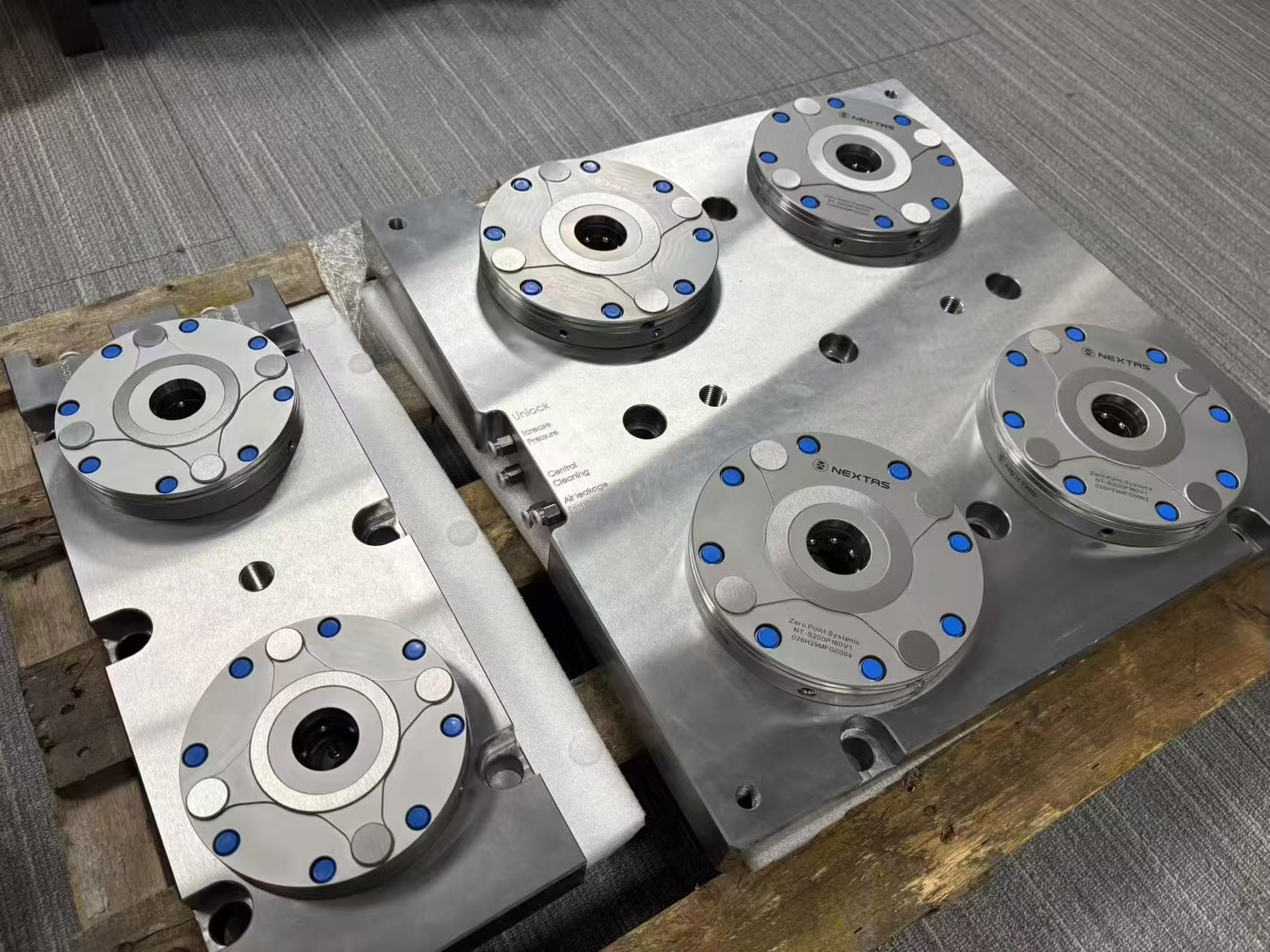
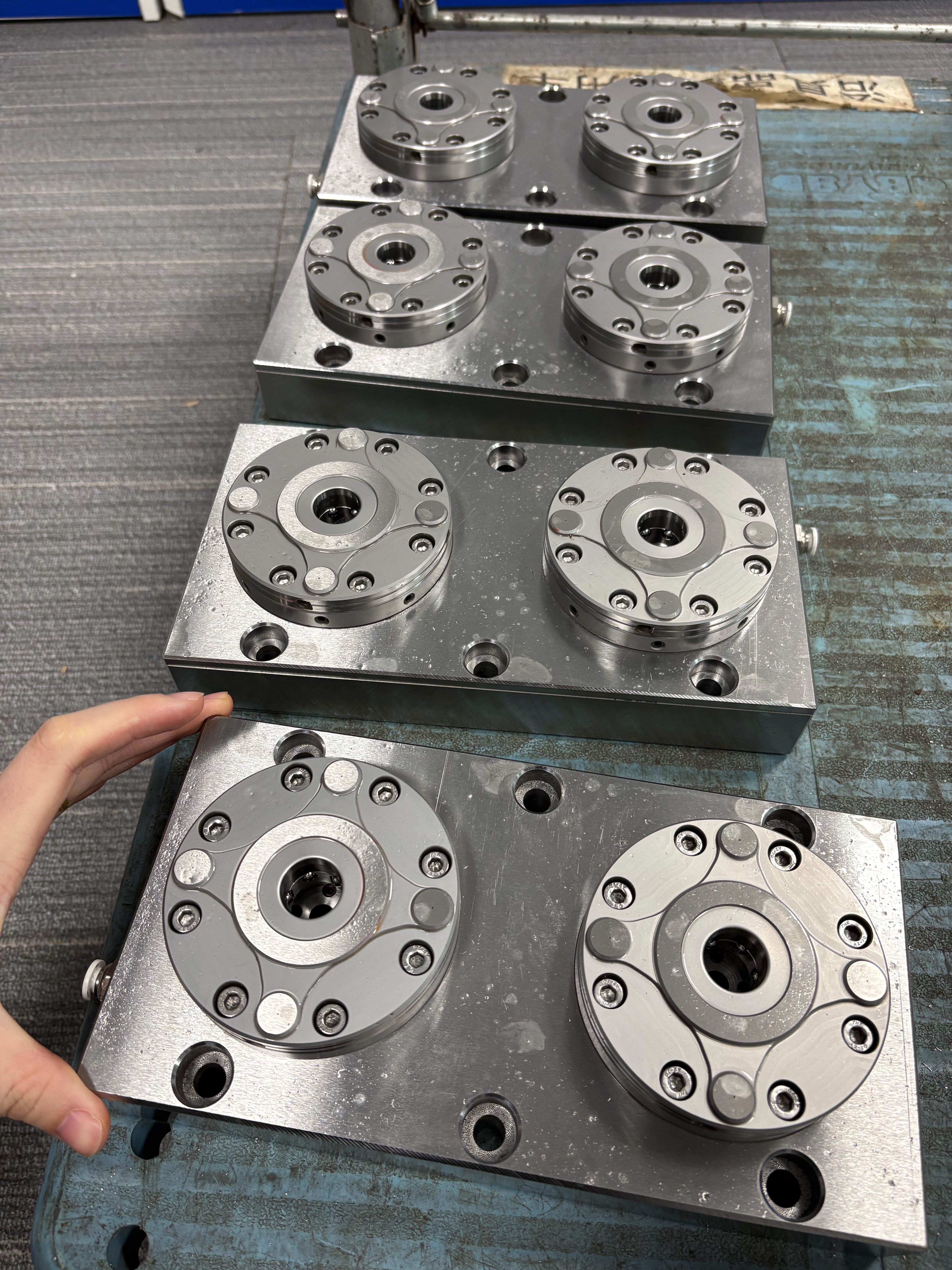
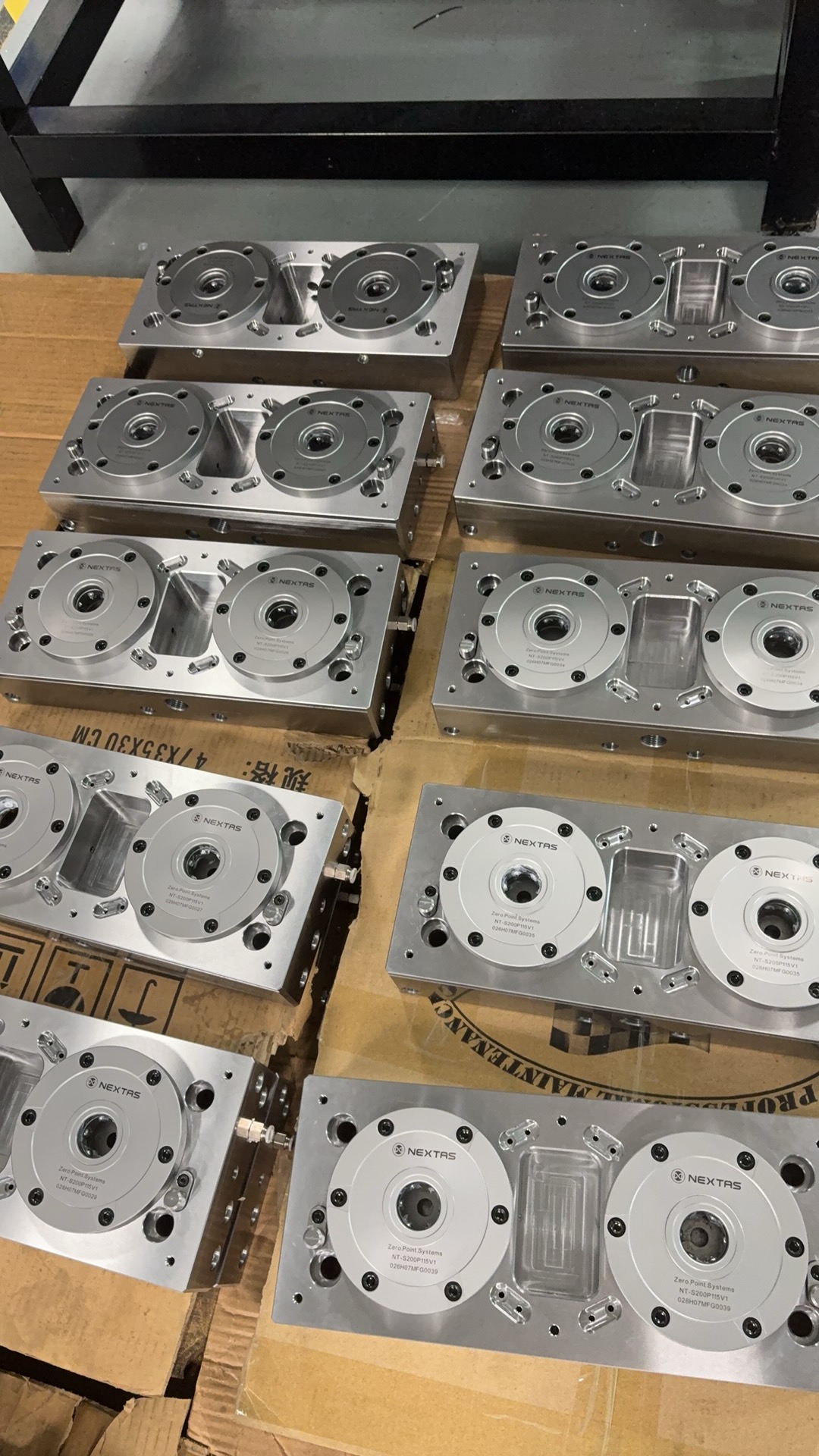
Working directly with the shop’s process engineers, NEXTAS developed and built a batch of ten standardized dual-station pneumatic zero-point base plates outfitted with NEXTAS NT-S200P160V1 zero-point receiver modules.
Rather than bolting off-the-shelf receivers onto heavy, solid steel slabs, the NEXTAS team engineered the subplates from the ground up to balance rigidity, weight, and chip evacuation:
- Mass-Optimized Bridge Architecture: Between the two hardened stainless steel zero-point receivers, each base plate features a CNC-machined central weight-reduction pocket and angled perimeter relief slots. This pocketing strips away parasitic dead weight—crucial for protecting 4th-axis rotary drives and high-speed X/Y linear guides—without sacrificing torsional stiffness under heavy roughing cuts.
- Single-Line Pneumatic Actuation: Each dual-station base is internally manifolded to a single side-mounted push-to-connect air port. Operators connect a shop air gun (or machine M-code air line) to release both receivers simultaneously, triggering the auto-lift and integrated air-blast cleaning functions to clear fine chips from the tapered seating surfaces. Once the air is disconnected, the mechanical spring-driven self-locking mechanism maintains full holding force with zero trailing hoses.
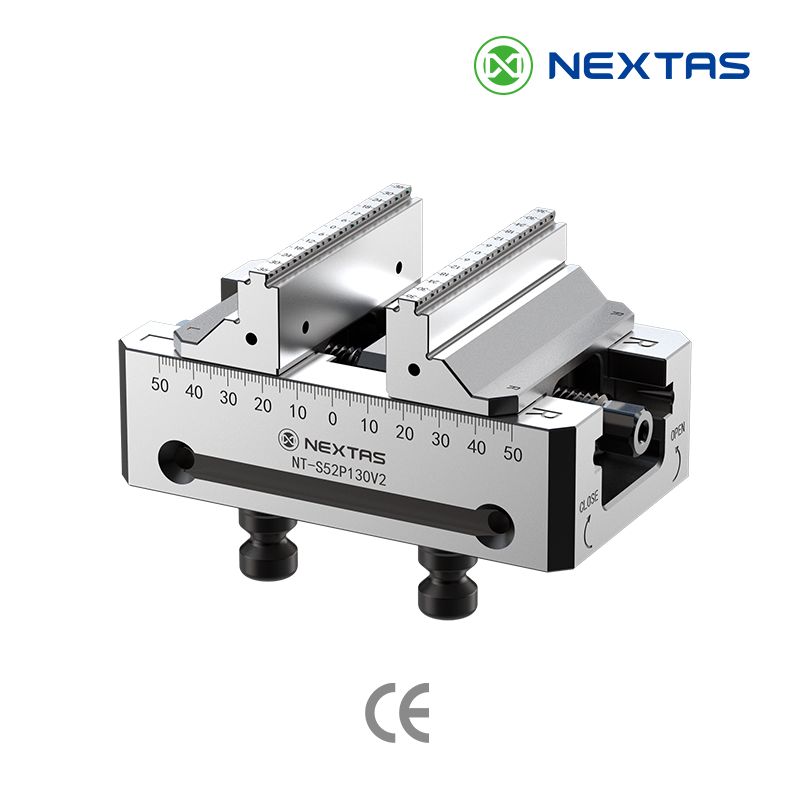
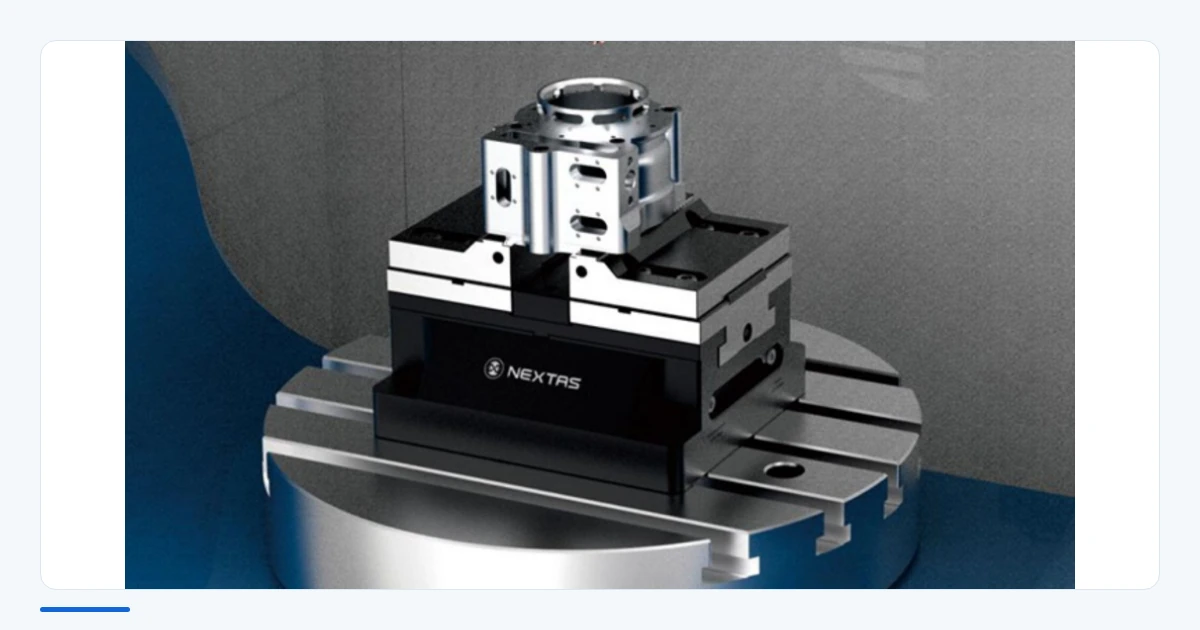
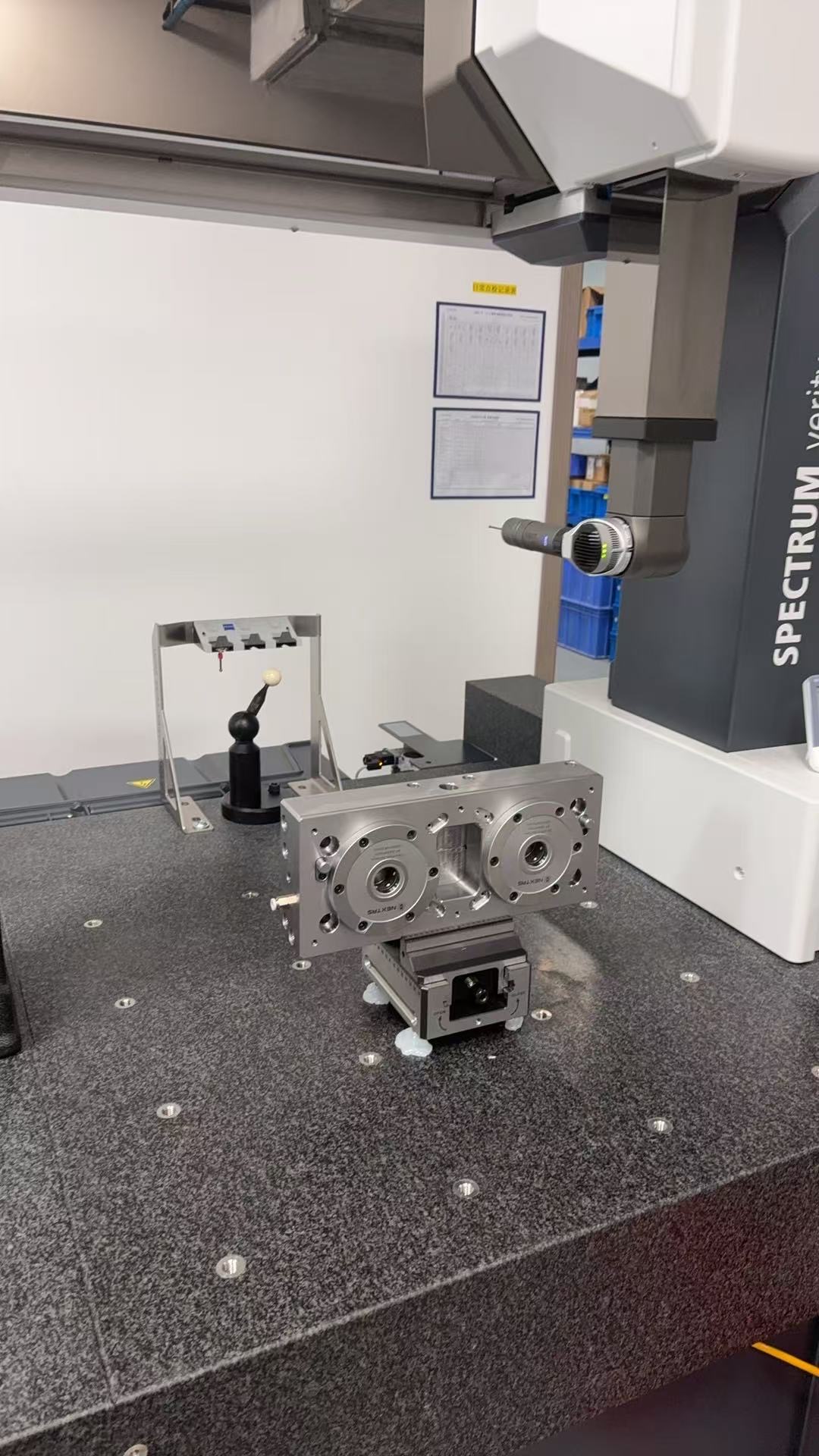
- CMM-Verified True Position (The Interchangeability Secret): Repeatability on a single receiver is one thing; matching center-to-center spacing across ten separate plates is another. Before leaving the NEXTAS facility, every assembled dual-station base was mounted onto a SPECTRUM coordinate measuring machine (CMM) (interestingly held in place during inspection by a NEXTAS self-centering vise). The CMM verified that the bore-to-bore pitch, Z-height coplanarity, and receiver taper concentricity matched master print tolerances down to the micron level.
Shop Floor Impact: True "One Datum Strategy" at Scale
With all ten NEXTAS dual-station plates installed across the shop’s VMC fleet, the barrier between machines disappeared:
- Under 90-Second Cross-Machine Transfers: Any palletized fixture, custom hydraulic jig, or pair of NEXTAS self-centering vises can now be lifted off Machine 1 and dropped directly onto Machine 8 with < 0.003 mm repeat positioning accuracy. Operators load the program and press Cycle Start—no indicator sweeping required.
- Flexible Dual-Station Workflow: The dual-receiver footprint supports two distinct production modes. For small prismatic parts, each station holds an individual 5-axis self-centering vise for simultaneous OP10/OP20 machining. For larger aerospace or fluid-power housings, a single large fixture plate bridges across both NT-S200P160V1 receivers, using one locating pin and one diamond pin to lock the X-axis rotation while doubling the pull-down clamping force.
- Zero Unplanned Spindle Idle Time: Offline setup carts now feed the entire ten-machine cell. While the spindles are cutting chips, setup technicians pre-assemble and dial in upcoming jobs offline, pushing overall spindle utilization past 85%.