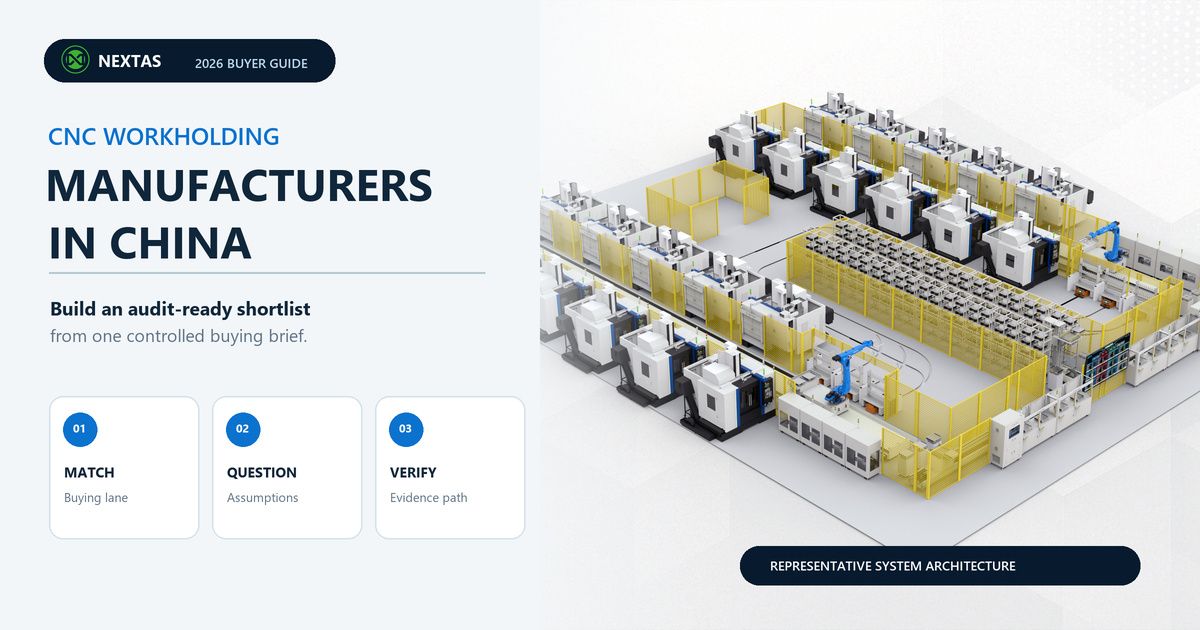
A buyer looking for CNC workholding manufacturers in China can collect dozens of catalogs in an afternoon. That does not create a defensible shortlist. A five-axis job shop standardizing pallet changes, a turning plant sourcing a special chuck, and an integrator building a robot-loaded cell need different engineering responsibilities, interfaces and evidence.
The comparison becomes especially weak when suppliers receive different requests. One may quote a bare vise, another a zero-point package, and a third a custom fixture with controls and runoff. The lowest number may simply represent the smallest scope. The objective here is narrower and more useful: identify candidates whose public product focus fits the buying task, test how they respond to one controlled brief, and move only the strongest two to four into formal qualification.
Define the buying lane before naming suppliers
Start with the production decision, not the brand list. A standard modular vise purchase prioritizes model coverage, jaws, replacement parts and batch consistency. A custom fixture needs a clear owner for datum strategy, clamping risk, controls, tryout and changes. Powered workholding adds service media, clamp confirmation, pressure-loss behavior and recovery logic. A second-source project begins with a controlled interface drawing; a familiar spacing number or the word “compatible” is not enough.
If the workholding architecture is still open, first compare dovetail fixtures, self-centering vises and zero-point systems. Supplier comparison is meaningful only after every candidate is solving the same functional problem.
| Buying lane | Primary selection question | Evidence needed at shortlist stage |
|---|---|---|
| Standard modular workholding | Does the family cover the part range and machine interface? | Model drawing, jaw or pallet options, batch scope and spares path |
| Custom fixture | Who owns the application design and the acceptance result? | Inputs required, design boundary, deliverables and change process |
| Powered or automated cell | Can the supplier define actuation, sensing and safe recovery? | Media conditions, I/O concept, state confirmation and integration boundary |
| Existing-interface second source | Can fit be proven without assuming interchangeability? | Both controlled drawings, stack height, locating features and release method |
Public-information shortlist by application fit
The following companies are starting points for an RFQ, not winners. Inclusion means an official page identifies a relevant China location, publishes applicable workholding categories and provides a commercial contact route. Public pages do not prove delivered accuracy, capacity or service performance.
| Candidate | Publicly documented scope | RFQ lane to consider | Verify before qualification |
|---|---|---|---|
| NEXTAS Zhuhai, Guangdong | Official pages describe Zhuhai manufacturing and QC activity, with zero-point systems, self-centering and pneumatic vises, fixtures, chucks, pallet changing and automation. | Connected milling packages or projects expected to expand toward powered workholding or automation. | Selected-model drawing, test method, delivered scope, documents and acceptance plan. |
| Suzhou SET Suzhou, Jiangsu | The official site describes design, production, sales and service, and lists zero-point, gripping, pallet change, pneumatic/manual vise, ball-lock and non-standard tooling categories. | Quick-change or gripping projects requiring several published interface routes. | Operations performed at the listed site, model data, sensor scope, service media and test evidence. |
| Clamp (Chongqing) / ADJIG Chongqing | Official pages describe non-standard fixture design, production and assembly across zero-point, automated, hydraulic, expansion, ID/OD and self-centering products. | Custom or mixed-component fixtures combining application-specific clamping methods. | Design responsibility, calculations, circuit documents, component scope, validation and spares. |
| Dongguan LiHeng / AST Dongguan, Guangdong | The official site states Dongguan manufacturing and publishes zero-point, dovetail, five-axis, self-centering and pneumatic vise products plus OEM work. | Modular milling, dovetail or vise sourcing with a well-defined interface. | The site presents both LiHeng and AST names and conflicting establishment dates; verify legal manufacturer, contracting party, beneficiary and brand relationship. |
| Pingyuan Zhenghao / ZHORTMA Pingyuan, Shandong | Official pages show modular, dual-station and toolmaker vises alongside tool holders, collets and arbors, and describe a multi-stage manufacturing flow. | Standard or configurable vise procurement, including accessory or distribution programs. | Production scope, jaw interchangeability, inspection method, batch consistency and replacement parts; do not rely on website superlatives. |
| KORRETTO Tianjin company/office | Official pages publish manual, hydraulic, pneumatic, diaphragm and indexing chucks, expanding mandrels, collets and custom workholding. | Optional turning-focused candidate where spindle interface, drawtube and workpiece deformation dominate. | The site does not clearly establish a factory at the Tianjin office; verify manufacturing site, balancing method, speed basis and acceptance documents. |
Do not invite every company into every competition. A standard modular vise and a fully engineered hydraulic fixture are not comparable offers. Select candidates whose public scope fits the same package, then let their engineering response—not the size of the website—determine who advances.
Run the same 20-minute pre-screen
Before requesting a detailed quotation, send one machine-and-part brief and ask each candidate to respond under five headings: proposed route, missing inputs, working assumptions, items it cannot yet confirm, and the next engineering step. A supplier that asks precise questions may be more useful than one that immediately promises a model and price.
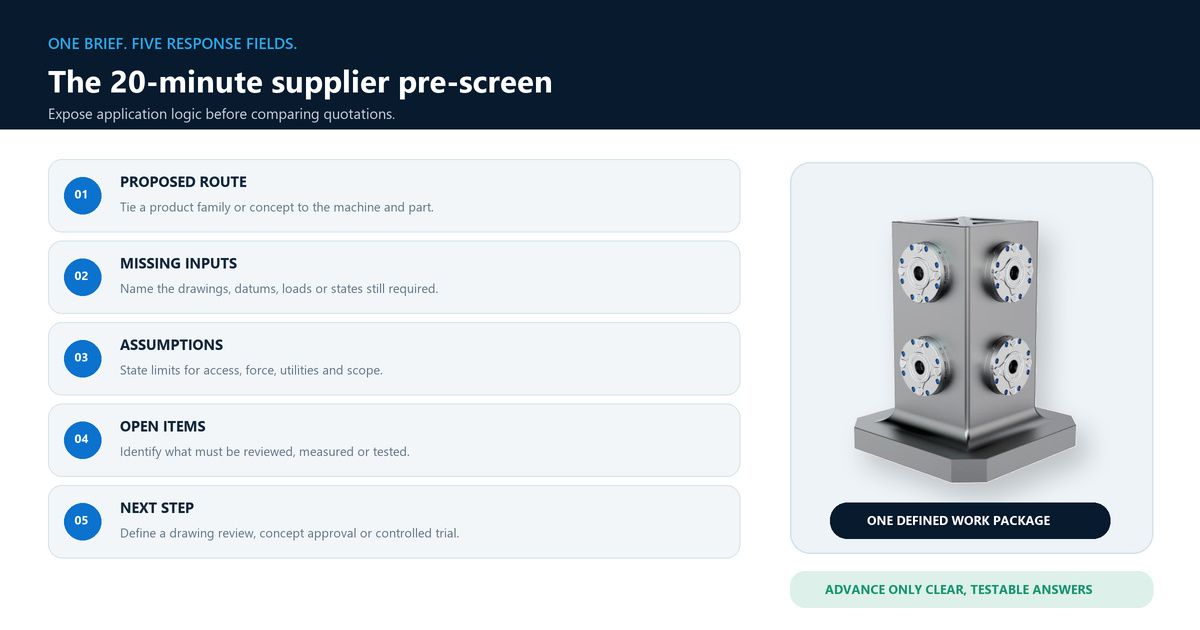
| Response field | A useful answer contains | Reason to pause |
|---|---|---|
| Proposed route | A named product family or custom concept tied to the part and machine | “Best fixture” language without application logic |
| Missing inputs | Specific drawings, loads, datums, interfaces or automation states | A final claim based only on a photo |
| Assumptions | Written limits for stock, access, force, utilities and delivered scope | Important assumptions hidden until after order |
| Open items | A candid list of dimensions or results needing review or testing | Unqualified compatibility or performance promises |
| Next step | A drawing review, application call, concept approval or controlled trial | Pressure to pay before technical scope is defined |
Example: shortlist responses for one 5-axis cell
Consider a buyer with a 5-axis trunnion, an aluminum part family, manual loading today and a possible robot phase later. The brief includes the table drawing, part STEP files, blank range, tool-envelope model, batch mix and a target changeover definition. Three anonymized response styles show why catalog coverage alone is not enough.
Response A recommends a vise immediately but does not request the rotary load limit or model the worst tilt angle. Keep it on hold until clearance responsibility is explicit. Response B proposes a vise-plus-pallet route, identifies the missing table interface, separates the manual and future pneumatic phases, and schedules a concept drawing. Advance it. Response C proposes a capable custom fixture but assumes a stable part family and volume the buyer does not have. The response is technically credible, yet mismatched to the buying case; do not advance it for this package.
This is not a test of which architecture is universally best. It tests whether a supplier reads the same brief, exposes uncertainty and proposes a proportionate path.
Give advancing candidates one controlled RFQ
Use a revision-controlled application sheet. Include the machine model and interface; workpiece drawing and STEP file; raw-stock condition; annual and batch quantity; critical datums and no-mark zones; setup operations and tool approach; manual, pneumatic or hydraulic services; robot and I/O needs; and the acceptance method. For turning, also include spindle nose, drawtube dimensions and travel, speed range, gripping diameter and workpiece inertia.
Require separate prices for base hardware, jaws or pallets, adapter plates, actuation, sensors, engineering, installation, runoff, initial spares and freight. The complete CNC workholding RFQ input guide helps procurement and engineering assemble the package without relying on a long email thread.
Apply elimination gates before commercial scoring
Some failures should stop the comparison rather than receive a low weighted score. Pause a candidate if it cannot identify the legal contracting entity and manufacturing party, if the proposed bank beneficiary does not match agreed documents, or if it will not provide a controlled interface drawing before manufacture.
Reject undefined performance wording. Repeatability, centering accuracy and accuracy to a machine datum are different measurements. Any important value must identify what moves, what is measured, the instrument, cycle count, loading and cleaning condition. For automated workholding, require the intended safe state, clamp confirmation, pressure limits, interlocks and manual recovery. A catalog page cannot be the final acceptance standard for a production-critical system.
Normalize the delivered scope and ownership cost
Create a compliance matrix with one row for every RFQ requirement. Mark each response compliant, deviating, optional or unanswered. Then calculate cost from what the cell needs to become production-ready, not from the first line on the quotation.
| Ownership-cost block | Include |
|---|---|
| Landed acquisition | Hardware, jaws, pallets, studs, sensors, packaging, freight, duty and tax |
| Integration | Adapters, plumbing, valves, PLC work, grippers, guarding and installation downtime |
| Validation | Drawing review, first articles, measurement time, runoff, training and documents |
| Operation and service | Changeover labor, cleaning, inspection, spares, repair freight and expected downtime |
| Expansion and exit | Future stations or machines, proprietary interfaces and later migration effort |
Ownership cost = landed purchase + integration + validation + operation + spares and maintenance + expected downtime
Use your loaded labor and machine-hour rates. Do not copy a universal setup-saving claim into the business case. Measure the current process, define the proposed sequence and test more than one utilization scenario.
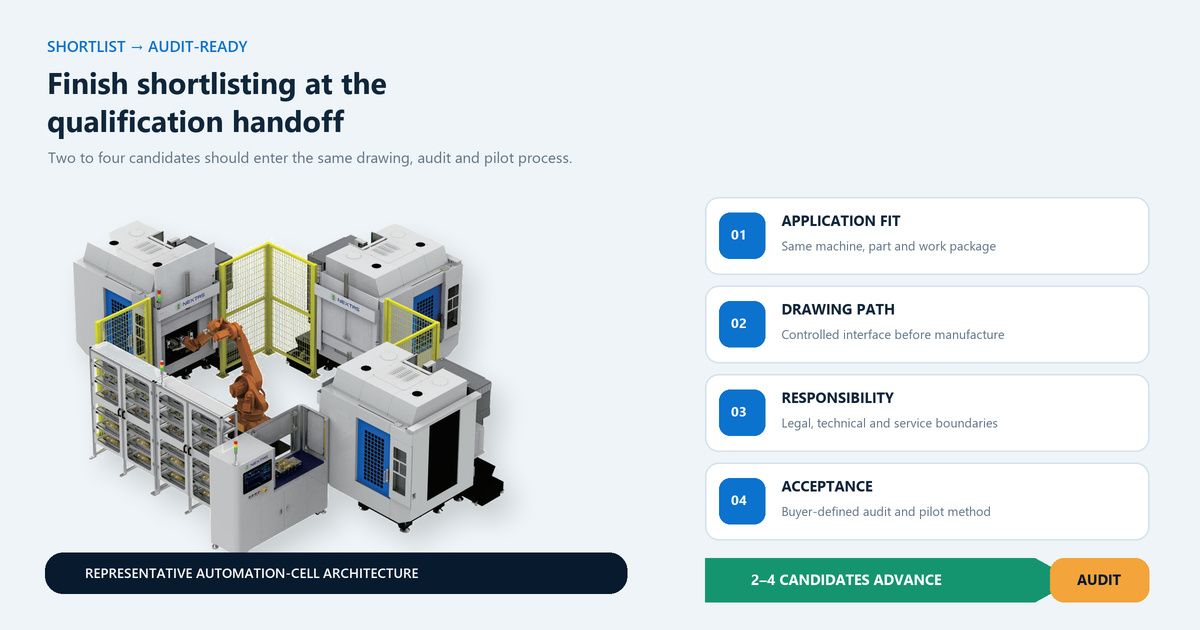
Hand off two to four candidates to qualification
A shortlist candidate is not yet an approved supplier. The next stage should verify the selected legal entity, manufacturing responsibility, quality controls, measurement capability, capacity and order traceability. Use the separate guide to audit the selected CNC workholding factory without turning this first screen into a full factory investigation.
For the pilot, approve the proposed interface drawing, bill of materials, service schematic and test plan. Reinstall the relevant pallet, vise, jaw or workpiece through the stated cycles; record the selected datum without silently resetting it; run representative cutting; repeat with realistic chips and coolant; and test fault recovery where automation is involved. The pass limit must come from the application and purchase order, not whichever catalog value is easiest to quote.
Common shortlist mistakes
- Sending only a part photo. Suppliers cannot solve machine fit, datum transfer or access from appearance alone.
- Comparing prices before normalizing scope. Missing pallets, controls, adapters or commissioning can reverse the apparent order.
- Rewarding the broadest catalog. Product count is less important than a documented fit and a disciplined response.
- Treating published values as acceptance. Convert important claims into a measurement method and pass limit.
- Ignoring the legal and payment trail. Confirm the manufacturer, seller, beneficiary and brand relationship before purchase.
- Assuming interchangeability. Compare controlled interfaces, tolerances and service conditions; do not define fit with another company's trademark.
Make the next supplier conversation specific
Three comparable, fully answered RFQs usually teach a buyer more than ten generic quotations. If your package involves zero-point workholding, five-axis vises, powered clamping or a custom fixture, send NEXTAS the machine and interface, part and blank files, production volume, current setup problem and intended acceptance method. NEXTAS can state whether a catalog route is a reasonable starting point, what remains unconfirmed and what engineering step should come before a production quotation. For company background, see NEXTAS workholding solutions and engineering scope.
Application-Based Shortlist
Request a scoped workholding review
Send the machine interface, part and blank files, production volume and current setup constraint. NEXTAS will identify a starting route, missing inputs and the evidence needed before quotation.
FAQ
How many CNC workholding manufacturers should be included in an RFQ?
Include only suppliers able to quote the same defined work package. Two to four complete, comparable responses are normally more useful than a long list of partial quotes. Add a specialist only when the application needs a different technology, such as a custom turning chuck or internal-expansion fixture.
Should I select a manufacturer before selecting the workholding type?
Usually not. First determine whether the application needs a vise, dovetail fixture, zero-point interface, dedicated powered fixture or chuck. Supplier comparison becomes meaningful after the required function, interface and acceptance method are clear.
What evidence should support a workholding repeatability requirement?
Define the moving interface, measurement point, instrument, loading condition, cleaning procedure, cycle count and pass limit. Distinguish vise return-to-position from centering accuracy, and zero-point interface repeatability from finished-part accuracy.
How can I compare a custom fixture with a standard product?
Compare both against common functional requirements for access, force, datum control, machine fit, safety and acceptance. Then separate engineering, integration, validation, expansion and service costs instead of comparing bare hardware prices.
Does the lowest workholding quotation usually have the lowest total cost?
Not necessarily. A low initial price may omit adapters, controls, validation, spares or commissioning, while a larger proposal may include features you do not need. Normalize scope first, then calculate total cost with your labor, machine and downtime rates.