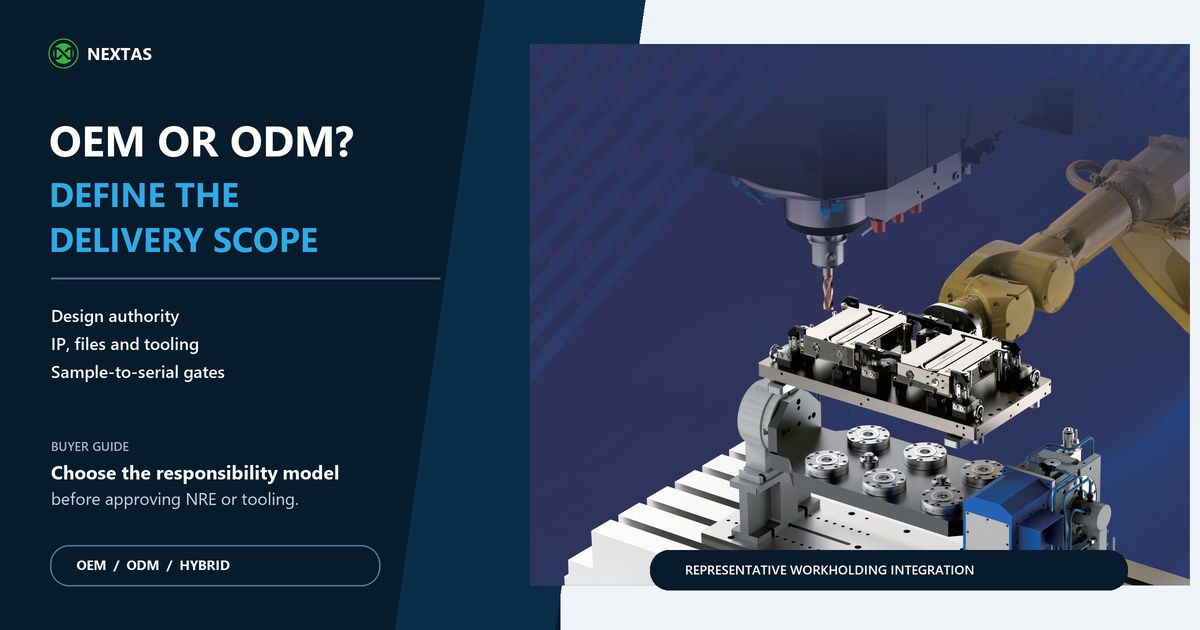
A buyer searching for an OEM or ODM workholding manufacturer does not really need a vocabulary lesson. The practical question is who will make the design decisions, who carries the validation workload, and what the buyer receives after paying for engineering, samples and tooling.
That distinction matters in CNC workholding because an incomplete responsibility split can become a machine-fit problem, a delayed pilot or a design that cannot be transferred later. “OEM” and “ODM” are not consistent scopes across suppliers. Treat them as conversation starters, then replace them with a controlled responsibility map.
OEM vs ODM in workholding starts with design authority
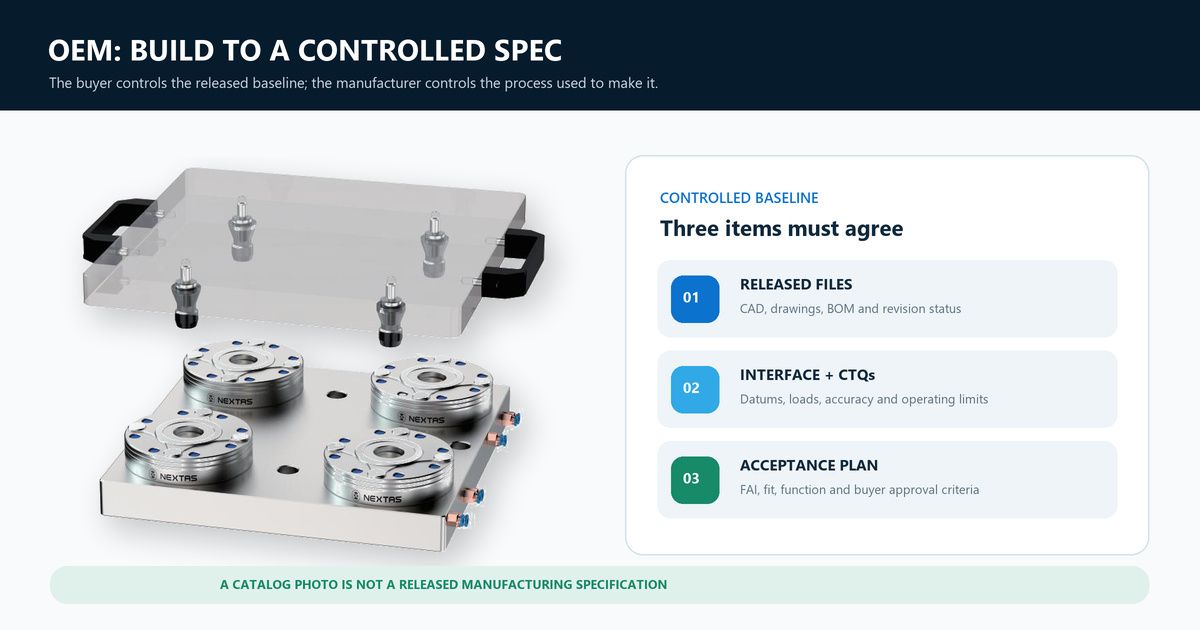
OEM usually means build-to-print: the buyer owns and releases the technical baseline. The manufacturer may review manufacturability, propose process changes and flag risk, but it should not silently change a datum, interface or acceptance requirement. This route fits buyers with mature CAD, drawings, a BOM and a defined validation plan.
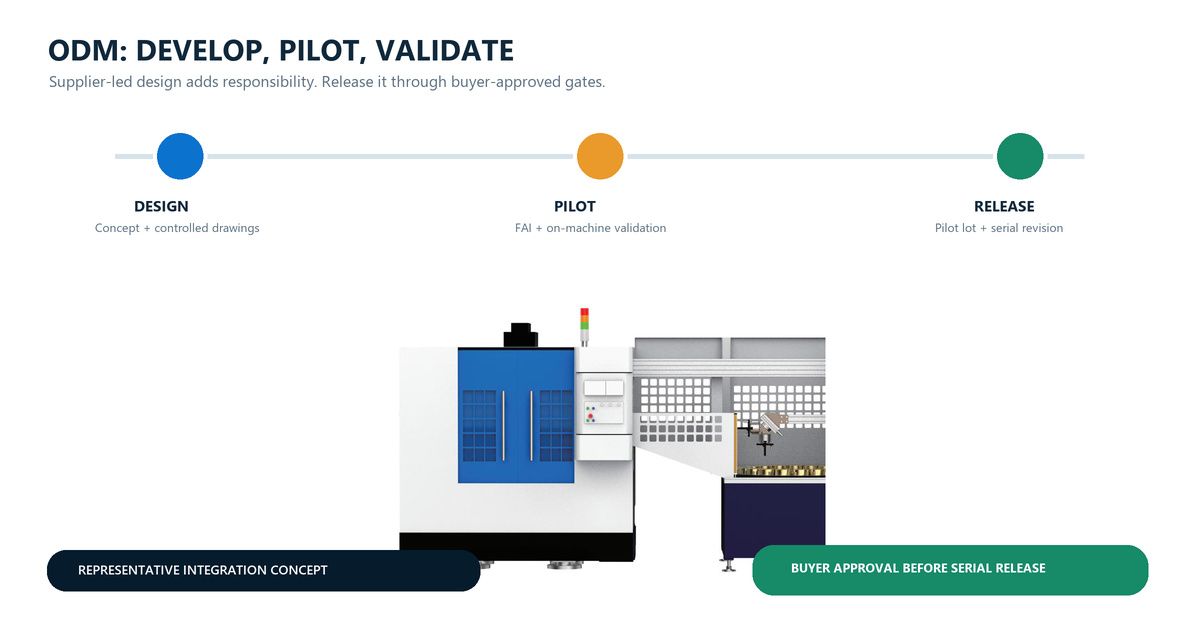
ODM means the manufacturer develops the workholding design from a functional brief. The buyer supplies the machine, part, production and performance requirements; the manufacturer turns them into a concept, controlled design and manufacturing package. The buyer still approves the design and application result.
A hybrid route is common: use a standard zero-point, vise or pallet platform, then customize the mounting interface, jaws, actuation, sensors, marking or packaging. It can reduce engineering without forcing an unsuitable catalog product into the application.
| Decision factor | OEM | ODM | Hybrid / private label |
|---|---|---|---|
| Starting input | Released design package | Functional and performance brief | Proven platform plus controlled changes |
| Design authority | Buyer | Manufacturer proposes; buyer approves | Split by module and interface |
| Buyer workload | High before RFQ | High during review and validation | Focused on deviations and integration |
| Main risk | Incomplete or conflicting files | Undefined ownership and approval | Assuming the standard base fits |
| Best fit | Mature product or controlled second source | New fixture or application architecture | Variants, private label or custom interface |
Name the work package before choosing the label
A distributor changing color, laser marking and packaging on a standard vise is not buying the same service as a machine builder releasing a proprietary pallet drawing. A plant asking for a powered fixture around a new part family is different again. Define the package first: product family, variants, forecast, machine interface, required engineering, documents, market and launch gate.
If the architecture itself is unresolved, use the separate custom fixture design and supplier questions to settle datum, clamping, access and machine-fit issues. This guide stays focused on responsibility, ownership and production release.
Three application cases show where the boundary moves
Private-label catalog vise: choose a hybrid route when the base mechanism is proven but the jaw range, finish, marking, packaging or accessory set changes. Freeze the standard-product revision and treat every branded or interface change as a controlled deviation.
Released pallet or fixture drawing: choose OEM when the buyer can supply complete geometry, tolerances, material, treatment, inspection and acceptance requirements. The supplier's DFM proposal should remain a proposal until the buyer revises the controlled package.
Robot-loaded fixture for a new part family: choose ODM when datum strategy, clamp sequence, chip evacuation, sensing or machine communication still needs development. The buyer must provide representative part and process data, then reserve engineering time for design reviews and on-machine validation. If a standard zero-point base is retained while the upper fixture is newly designed, document the program as hybrid by module instead of forcing the entire project into one label.
Freeze the responsibility split before the RFQ
Create one matrix with three columns: who prepares, who reviews and who approves. Apply it to the machine and pallet interface, part and stock models, datum strategy, clamping loads, utilities, sensors, control states, risk review, drawings, BOM, inspection plan, first article, on-machine trial, pilot lot, packaging and serial release.
For OEM, the manufacturer should return a marked-up DFM response against the buyer's revision. For ODM, require a concept record that identifies assumptions and open inputs before detailed design. For hybrid work, put a boundary around the standard module and list every custom interface. That boundary prevents a standard component revision from quietly changing a buyer-controlled dimension.
Use one formal engineering-change route after design freeze. A chat message may start a discussion, but it should not release a new jaw profile, sensor state or mounting pattern. Record the affected revision, reason, technical impact, cost, timing and approvals.
Put IP, files, tooling and exclusivity in writing
Separate background IP—technology, modules and know-how that existed before the project—from project-specific IP created for the program. Ownership and a right to use are not the same. State whether the buyer receives native CAD, neutral STEP, manufacturing drawings, BOM, inspection records, software or parameter files, and whether those files may be used for service or second sourcing.
Physical tooling also needs a register. Dedicated jaws, casting patterns, gauges and test fixtures should have an owner, asset mark, storage location, maintenance rule, expected life, inventory check and disposal approval. Paying an NRE invoice does not automatically answer those questions.
Private-label programs need additional boundaries for logo use, packaging, target markets, customer or product-line exclusivity, subcontractor access, confidentiality, file retention and what happens if the program ends. These points require a written commercial agreement and appropriate legal review; a quotation note is not a substitute.
Gate sampling from concept to serial release
A good sample is evidence, not a production specification. Use staged approval. First approve the concept and responsibility split. Next freeze controlled drawings and the planned test method. Inspect the engineering sample against those files, then run it on the intended machine with representative parts, tools, chips, coolant, loads and operator or robot sequence.
Only after that should the supplier build a pilot lot using the intended production route. The buyer reviews repeatability of the process, records, packaging, marking, spares and corrective actions, then releases one serial revision. Each gate needs a named approver, pass limit and rule for who pays and how the schedule moves if it fails.
Make the quality agreement survive repeat orders
Serial control should name the released drawing and BOM revision, CTQs and test methods, approved sample status, sampling frequency, lot traceability, nonconformance response, change-notification period, marking, packaging, records retention and spare-part route. A certificate does not define these program controls. Use the factory-qualification guide to verify the manufacturing site, QC and capacity, then bind the approved process to the order.
Compare cost and lead time by program phase
Ask for separate lines for design or NRE, dedicated tooling and gauges, engineering samples, first-article records, on-machine support, pilot quantity, branding and packaging, unit-price tiers, initial spares and freight. A low unit price can hide a heavy approval burden; a larger NRE line may include work the buyer would otherwise perform internally.
A mature OEM package can reduce concept work but still stall on drawing conflicts. ODM reduces the buyer's design workload yet adds review and approval loops. Hybrid is fast only when the existing platform fits the real interface and loads. Manage the schedule by deliverable and approval milestone, not by a single ship date; the custom fixture lead-time guide shows how to separate design freeze, production and validation.
Send an OEM/ODM RFQ that can be quoted
Alongside the baseline CNC workholding RFQ inputs, add the fields that define the commercial program:
- intended route: OEM, ODM or hybrid, with the reason;
- released CAD and drawings, or a functional brief with open decisions;
- variants, annual forecast, order batches, MOQ and target launch date;
- branding, marking, packaging, destination markets and language needs;
- design authority, approval responsibility and required file deliverables;
- IP, dedicated tooling, exclusivity and transfer expectations;
- sample, first-article, on-machine, pilot and serial-release gates;
- NRE, tooling, sample, unit-price tier, spares and freight breakdown.
Ask the manufacturer to list assumptions, exclusions and missing inputs before issuing a production quotation. Those three lists are often more useful than an immediate promise.
Implementation checklist: shortlist to serial release
- Choose OEM, ODM or hybrid from design maturity—not from price-table wording.
- Verify the legal seller, manufacturing party and payment beneficiary.
- Issue one revision-controlled brief and responsibility matrix.
- Approve IP, file, tooling and exclusivity terms before NRE.
- Freeze concept, drawings, acceptance plan and change route.
- Complete first-article and on-machine functional validation.
- Run a representative pilot with production documents and packaging.
- Release the first serial revision and supplier change-notification rules.
Common OEM/ODM workholding mistakes
- Using the acronym as the scope. Write the deliverables and approvals instead.
- Assuming NRE transfers ownership. Define rights to designs, files and physical tooling.
- Quoting from a photo or competitor number. Release a controlled functional interface.
- Treating one sample as the specification. Approve against a test plan and pilot lot.
- Accepting changes through chat. Use an ECO or ECN tied to the serial revision.
- Comparing unit price alone. Include NRE, tooling, MOQ, qualification, spares and freight.
Make the first manufacturer discussion specific
Send NEXTAS either your controlled drawing package or a functional brief, together with the machine interface, target volume, branding needs, acceptance plan and launch date. Ask for the OEM, ODM or hybrid responsibility split, sample gates, tooling and NRE lines, and open assumptions before the production quote. For company context, review NEXTAS workholding and engineering scope.
Responsibility Before Price
Define the responsibility map before you order
Share a controlled design package or functional brief. NEXTAS will identify the proposed route, open inputs, sample gates and quote structure.
FAQ
What is the difference between OEM and ODM for CNC workholding?
In an OEM program, the buyer normally controls the released design or technical baseline and the manufacturer builds to it. In an ODM program, the manufacturer develops the workholding design from a functional brief. A hybrid program uses a proven platform with custom interfaces, branding or application engineering. The contract and responsibility matrix should define the actual split instead of relying on the acronym.
Should I choose OEM if I already have STEP files and released drawings?
Usually, if those files form a complete controlled package with interfaces, critical requirements, revision status and an acceptance method. A STEP file alone is not enough. If important datum, clamping, actuation or validation decisions remain open, the project may still need supplier design work and should be scoped as a hybrid or ODM engagement.
Who owns the design, CAD files and tooling in an ODM project?
There is no automatic answer. The agreement should separate the supplier's background IP from project-specific IP, list which native CAD, drawings and BOMs are delivered, and state who owns or may use dedicated jaws, gauges, patterns and test fixtures. Paying NRE does not by itself define ownership, transfer rights or exclusivity.
How should a workholding sample be approved before serial production?
Use staged approval: controlled concept and drawings, an engineering sample with first-article records, an on-machine functional trial, then a representative pilot lot. Each gate needs a named approver, test method, pass limit and rule for corrections. Freeze the serial revision only after the pilot and documentation pass.
What should I send a Chinese workholding manufacturer for an OEM/ODM quote?
Send the intended OEM, ODM or hybrid route; controlled drawings or a functional brief; machine and interface data; part and blank files; loads, accuracy and operating conditions; variants, forecast and MOQ; branding and packaging needs; acceptance gates; IP and tooling expectations; launch date; and the required breakdown for NRE, tooling, samples, unit price and spares.